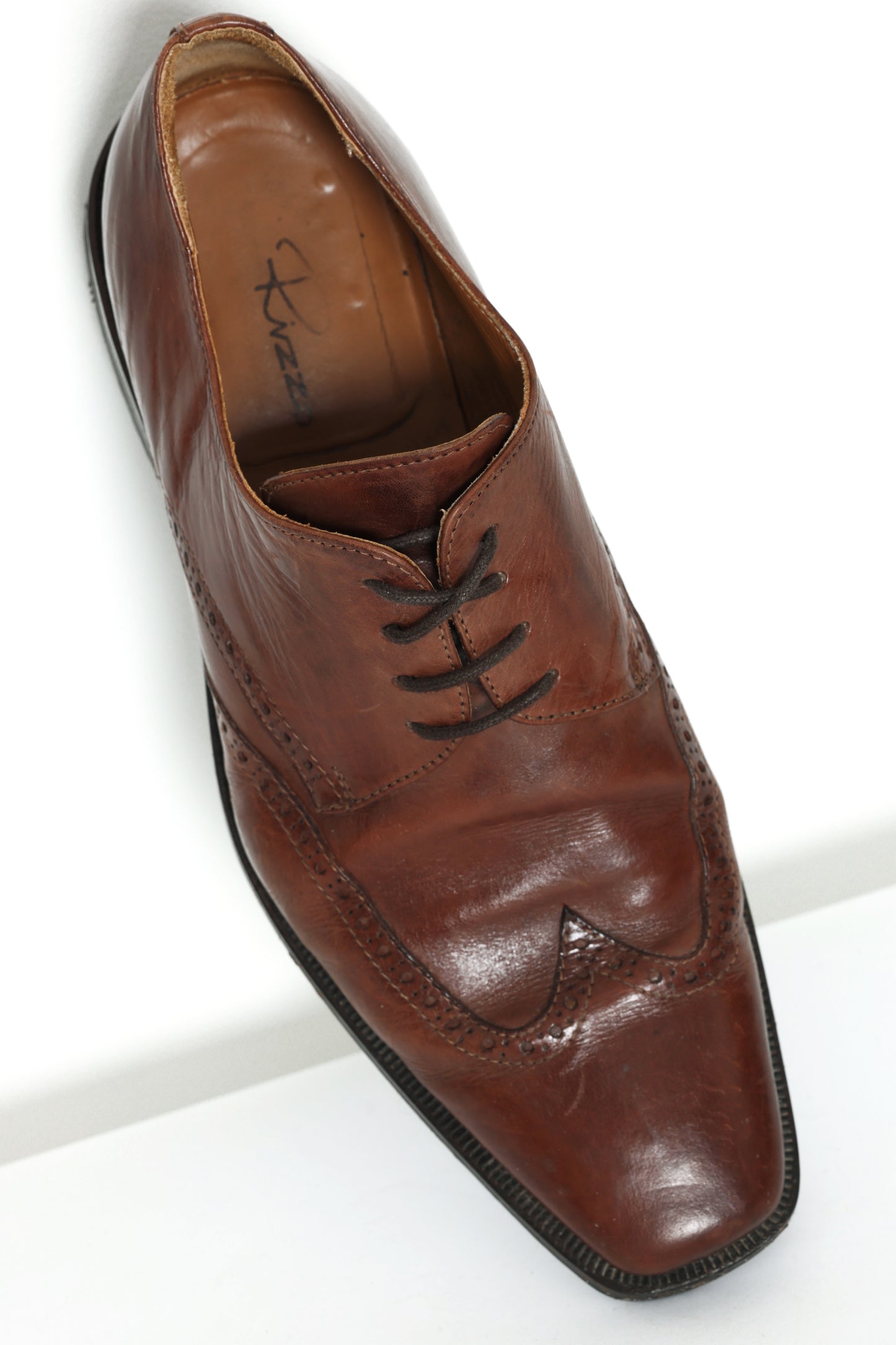
Rizzo (Sweden)
Post-1990s, Swedish Calfskin Wingtip Oxford-Brogue with Goodyear Welt
Post-1990s, Swedish Calfskin Wingtip Oxford-Brogue with Goodyear Welt
Couldn't load pickup availability
~ EU 42, US 8.5–9
Measurements (cm):
insole: 29.5 (elongated)
SKU: 900951
Rizzo occupies an established position within the Swedish menswear footwear landscape as an accessible-luxury house whose design language consistently draws from European classicism—most notably Italian and Spanish last traditions—translated through industrialized factory production systems. Its output reflects a conservative British-formal morphology, here expressed through an Oxford wingtip derivative, yet softened by commercially oriented last shaping and mid-tier finishing methodologies that deliberately avoid bespoke-level interventions such as hand-welting or hand-burnished patina construction. Within the broader Latin American “neo-classic” footwear sector, the brand operates not as a driver of global shoemaking innovation but as a democratizing force, making canonical European silhouettes—Oxford, Derby, and brogue forms—available for mass luxury consumption through repeatable industrial execution. This specific shoe embodies that philosophy, presenting traditional design language stabilized for production-line consistency rather than artisanal variability.
In classification terms, the model is best understood as a wingtip Oxford / semi-brogue Balmoral hybrid, situated within a formal-business to smart ceremonial crossover intent. Its closed throat confirms Oxford constructional logic, while the wingtip configuration and extended brogue patterning introduce decorative elasticity that broadens its suitability toward business-casual adaptability. The design language remains anchored in Anglo-American formalism, with broguing employed not as flamboyant continental ornamentation but as restrained structural embellishment that preserves overall formal integrity.
The upper leather composition is most consistent with chrome-tanned corrected-grain calfskin, finished with a semi-aniline pigment system and mechanically assisted polishing. The grain structure presents moderate natural creasing behavior, though the uniformity of surface appearance strongly indicates light correction or finishing lacquer applied to stabilize visual consistency. This places the leather outside museum-grade or crust leather categories, aligning instead with industrial calf designed for durability, predictable coloration, and controlled aging behavior. Over time, such material is more likely to exhibit surface crease whitening and patina flattening rather than deep aniline evolution or organic tonal stratification.
The last shape reflects a pragmatic ergonomic philosophy rather than anatomical optimization. It presents an elongated almond-to-soft-square hybrid toe, with moderate forefoot volume that avoids aggressive tapering associated with bespoke lasts. The instep height is calibrated toward average Argentine and European foot morphology, while the heel seat offers moderate cupping without deep orthopedic sculpting. Mild lateral flattening in the forefoot suggests intentional mass-market ergonomic compromise, prioritizing wearability and production scalability over individualized anatomical fidelity.
Construction methodology aligns with likely Goodyear welted assembly, evidenced by a visible welt ridge and structured outsole attachment consistent with a welt channel system. Machine-stitched inseam and outsole stitching are strongly implied, supported by the presence of a cork filler layer between insole and outsole functioning as a standard comfort and insulation medium in welted footwear. While resolable, the welt edge finishing indicates factory automation rather than hand-welting refinement, reinforcing its position within industrial rather than artisanal cordwaining systems.
Outsole architecture is built around a black rubber full sole or rubber-dense composite topy integration, paired with a layered synthetic or leather composite heel stack and a molded rubber top lift engineered for traction durability. Heel pitch is moderate, approximately 12–18 mm elevation differential, prioritizing urban stability and slip resistance over the aesthetic refinement of traditional oak-bark leather sole constructions. This reinforces the shoe’s orientation toward daily wear practicality in formal environments.
Internally, the insole structure is likely composed of a vegetable-tanned fiberboard or split leather baseboard topped with a leather covering layer, while lining materials consist of smooth corrected calf or pigmented bovine leather. The heel counter is reinforced with a thermoplastic stiffener system, likely celastic-type construction. Breathability remains moderate, with moisture management relying primarily on lining absorption rather than open-pore tanning systems.
Stitching precision is consistent with industrial standards, with stitch density estimated at approximately 8–10 SPI. Brogue perforations are machine-punched and uniformly distributed, while edge finishing employs machine-burnished feather edging sealed with wax treatments. Symmetry is generally sound but lacks the micro-alignment precision characteristic of hand-finished artisanal work, reinforcing its factory-consistent production identity.
The quarter and vamp configuration consists of a single-piece rear quarter reinforced internally, paired with a multi-panel vamp incorporating a saddle-like integration beneath the wingtip overlay. Stress distribution follows standard three-zone tension mapping across toe break, vamp flex, and quarter hold. While structurally correct, panel alignment does not prioritize grain continuity or pattern-matching refinement.
Toe structure is supported by a thermoplastic toe puff system (celastic or equivalent synthetic stiffener), providing moderate shape retention while remaining susceptible to creasing under prolonged wear. The break line is engineered for natural flex at the metatarsal junction rather than a sculpted rolling toe mechanism, again emphasizing affordability and manufacturability over biomechanical optimization.
Closure is executed through a closed-lacing Oxford configuration, with punched and internally reinforced eyelets, likely metal-lined for durability. Waxed cotton laces of medium thickness complete the system. Alignment is mechanically precise but lacks the hand-finished countersinking often associated with higher-tier shoemaking traditions.
Finishing and polishing techniques consist of a factory-applied antiqued brown gradient, with subtle tonal darkening at the toe and vamp achieved through heat polishing or wax layering. There is no evidence of artisanal patina construction such as museum calf hand-layering techniques. The finish is therefore repeatable, controlled, and production-line standardized rather than individually developed.
Decorative elements are limited to wingtip broguing across vamp and quarters, with moderate perforation density and no additional embellishments such as saddle straps or kilties. The overall aesthetic balance adheres to restrained British brogue tradition rather than ornate continental styling.
Heel cup and collar shaping exhibit medium stiffness reinforced by synthetic components, with a topline formed through slightly asymmetric machine lasting. Heel grip is adequate but does not achieve bespoke-level locked heel geometry, instead prioritizing comfort-oriented retention rather than orthopedic precision.
Midfoot architecture includes partial shank reinforcement, likely steel or composite, with a semi-narrowed waist that avoids aggressive beveling. Arch support is moderate and primarily longitudinal, consistent with standard factory Goodyear welt construction rather than orthopedic calibration.
Historically and stylistically, the shoe situates itself within post-1990s European formalwear reinterpretation, drawing indirectly from the 1930s–1950s British Oxford brogue canon and the 1980s industrial revival of Goodyear welt manufacturing. It does not possess a direct historical lineage but instead represents a modern industrial synthesis of established menswear codes.
The underlying design philosophy is best described as accessible classicism, in which British formal archetypes are simplified for scalable industrial production. The emphasis lies on recognizability and market stability rather than artisanal deviation, employing minimal-risk design strategies rooted in proven silhouette archetypes.
Within fashion and industry positioning, the model occupies an entry-to-mid luxury formalwear segment. It competes broadly with higher-end lines from Clarks, entry-level models from Loake, and Spanish factory welted footwear manufacturers. It holds strong relevance in Latin American professional formalwear markets but remains less competitive within high-fashion European cordwaining circles or artisanal shoemaking ecosystems.
The final evaluation characterizes the shoe as structurally competent and commercially sound Goodyear-welted Oxford-brogue hybrid footwear designed for consistent daily formal use rather than artisanal distinction. Its strengths lie in resolable welt construction, durable rubber outsole engineering, balanced and wearable last geometry, and broadly compatible classic styling suitable for diverse professional wardrobes. Its limitations are rooted in industrial leather finishing that restricts patina depth, synthetic reinforcement that limits long-term foot molding adaptation, decorative execution that lacks hand-finished refinement, and overall misalignment with high-luxury cordwaining standards such as Norvegese construction, hand-welt systems, or museum calf-tier craftsmanship. In market terms, it occupies a strong mid-tier formal position suited to professional environments, yet remains outside the category of collector-grade or bespoke-level shoemaking artifacts.
Share