Pepe (England)
London's Portobello Road, Anti-Glamour of the Early 1990s
London's Portobello Road, Anti-Glamour of the Early 1990s
Couldn't load pickup availability
Rooted in 1990s anti-fashion and reissued for today’s youth market, the jeans merge accessibility and authenticity.
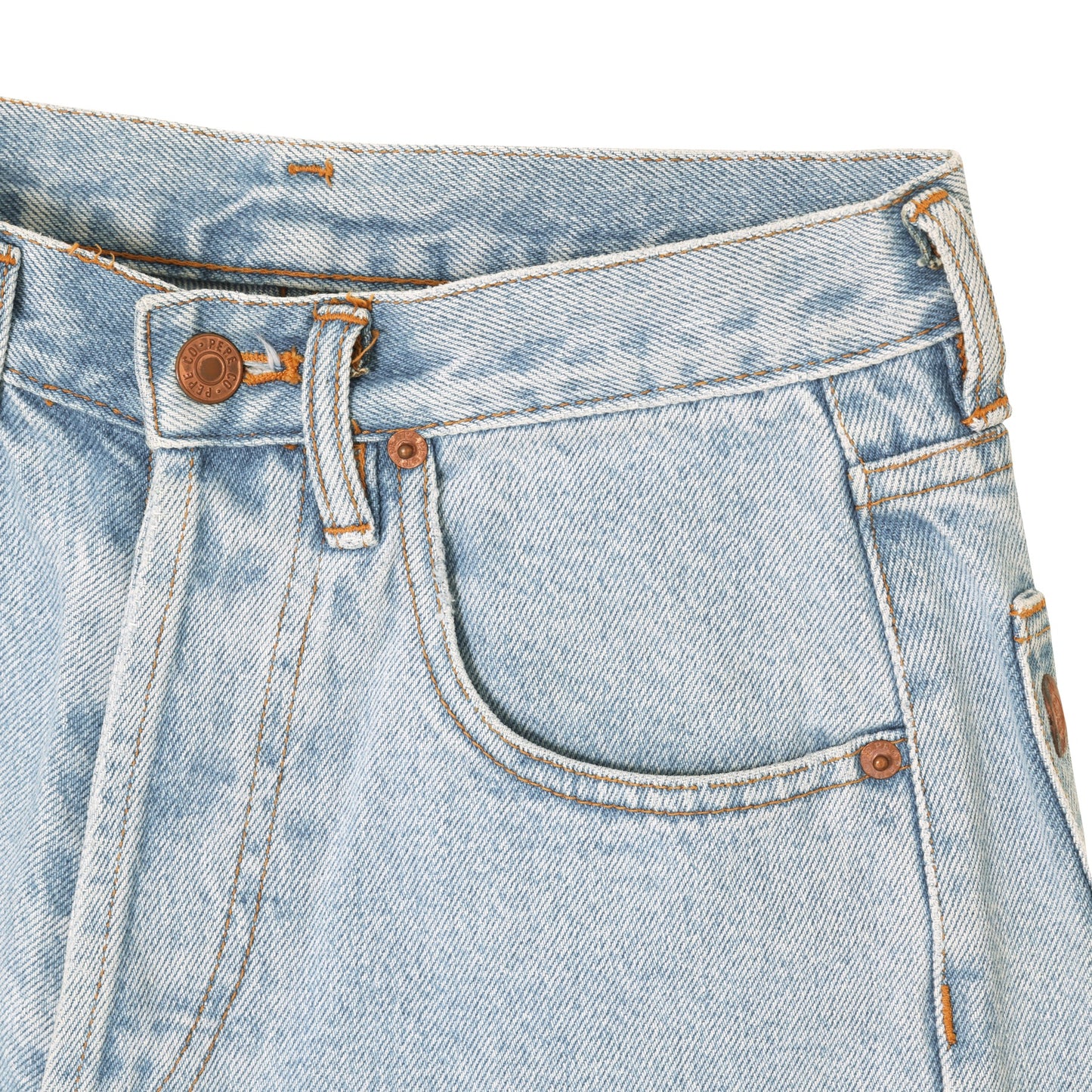
Pepe Jeans’ light-wash, high-rise tapered denim represents a precise fusion of retro-inspired tailoring and European trend sensitivity, positioning the garment within the crosshairs of contemporary youth denim culture and 1990s nostalgia. Founded in 1973 on London’s Portobello Road, Pepe Jeans evolved from a market-stall operation into one of Europe’s most recognizable denim brands, known for its distinctive synthesis of British streetwear motifs and Continental fit innovation. This particular pair distills that ethos—channeling the structural language of early-90s high-rise jeans while streamlining the silhouette through modern tapering techniques and clean finishing. The garment’s silhouette is rooted in archival proportions but reconstructed for a contemporary masculine frame. The high rise, paired with a narrow hem circumference, reflects a lineage that includes early dad jeans and late-80s tapered silhouettes, now reimagined through the lens of directional urban fashion. This retro-referential cut has found renewed cultural traction in the post-2014 womenswear landscape, when the pendulum began to swing back toward looser tops, higher waists, and narrower ankles—eschewing the hyper-compression of 2000s-era skinny fits. Pepe’s execution of this form leverages anatomical panel shaping and yoke angling to achieve visual taper without resorting to elastomeric distortion. The jeans project intentionality: a tailored looseness in the thigh gives way to a controlled narrowing below the knee, achieving a balance between drape and structure that can accommodate a wide range of styling—from oversized outerwear to minimal sneakers. Construction techniques emphasize authenticity without sacrificing efficiency. The fly features a metal button closure with embossed branding, deliberately referencing Levi’s-style heritage design. Seamwork across the garment relies heavily on double-needle lockstitching, with a chainstitched waistband offering structural integrity and roping potential after laundering—an uncommon but deliberate addition at this mid-market tier. Inseams are flat-felled, maximizing tensile strength and providing internal neatness consistent with heritage manufacturing standards. Bartacks are applied at fly base and crotch stress zones, ensuring durability in high-movement regions. Pocket reinforcements include copper rivets across all major entry points, with a triple-riveted coin pocket—a rare detail that communicates both utility and brand-specific visual identity. Panel configuration reinforces the garment’s commitment to a classic yet stylized form. The front panels are cut with an extended rise and a longer crotch seam, providing room through the seat and upper thigh. The rear construction employs a pronounced yoke with steep angularity, effectively sculpting the seat area and driving the visual taper downward. Rear pockets are topstitched with an arcuate design distinct from, but clearly referencing, the Levi’s batwing—providing a familiar iconography while avoiding outright imitation. Branding is subtly assertive: a faux leather waistband patch carries the embossed Pepe logo, signaling both market positioning and lifestyle affiliation in a crowded denim sector. Textile analysis suggests a 100% cotton composition, woven in a 3x1 right-hand twill and weighing approximately 12–13 oz/sq yd—a range that supports year-round wear while preserving the rigid, non-stretch integrity essential to vintage-inspired silhouettes. The fabric surface displays evidence of mechanical abrasion, likely achieved through enzyme washing or controlled bleach stonewashing, producing an even tonality and soft hand without compromising the fiber structure. Twill direction and puckering confirm authentic loom production; ring-spun warp yarns paired with open-end weft create a slub-textured surface that ages attractively over time. The absence of elastane or other stretch fibers positions this denim within the current return to rawer, unblended compositions—a direction driven as much by sustainability concerns as by aesthetics. Detailing across the garment reveals an alignment with European mid-tier manufacturing quality. Pocket bags are constructed from plain-weave cotton, overlocked at all edges and dimensioned for practical depth. Hem finishing consists of a double-folded edge secured by a lockstitched twin needle—a method that balances manufacturing speed with durability and allows for controlled roping if the jeans are hemmed post-purchase. Fly edge finishing demonstrates precision, with minimal seam stack and clean lockstitch execution that mitigates bulk while preserving reinforcement. Conceptually, these jeans function as both artifact and intervention. They resurrect anti-glamour silhouettes of the early 1990s—garments born from subcultural disinterest in fashion’s excess—then strategically reframe them within a contemporary framework. The high-rise and tapered profile offer wearers a point of stylistic contrast: anti-skinny, anti-overdesigned, yet fully calibrated to current fashion discourse. Their psychological resonance lies in their familiarity—jeans that feel “worn in” from the outset—not in terms of physical distressing, but in their conceptual approachability. This design direction taps into collective memory, surfacing aesthetic cues from dad jeans, skatewear, and late grunge without veering into parody. Artistically, the garment draws from a tripartite framework: retro urban realism, minimalist European denim codes, and American heritage motifs. The light wash and orange-gold stitching evoke a clean, archival sensibility—brutalist in their reductionism, yet elevated by proportional discipline and stitch execution. Pepe’s branding, while present, does not dominate; rather, it punctuates—a visual underscore that locates the garment within a particular lifestyle narrative: accessible, directional, and distinctly youth-coded. Historically, the jeans likely date from the mid-to-late 2010s, a period defined by denim’s reinvention in both silhouette and material integrity. Pepe’s choice to revisit the high-rise taper—popularized decades earlier, then rediscovered via contemporary reinterpretations by labels like Acne Studios and Weekday—reflects its agile responsiveness to fashion’s cyclicality. This garment is less a reproduction than a translation: an updated expression of a classic form, engineered for current fit expectations and aesthetic preferences. Within the denim market, Pepe Jeans occupies a niche that balances aspirational branding with broad retail accessibility. Competing against labels such as Diesel, Replay, and Scotch & Soda, it appeals to fashion-literate consumers aged 18–35 who are drawn to narrative denim—garments that speak to cultural memory while enabling contemporary styling. These jeans, with their measured taper and mid-weight rigidity, fit seamlessly into current menswear trajectories that emphasize intentionality, heritage referencing, and minimalist utility. Their relevance is sustained by a consumer base attuned to both authenticity and versatility, as well as by the garment’s compatibility with capsule wardrobes, retro-themed collections, and casual-social dressing. Technically, the jeans are well-executed. Stitch work is consistent, edge finishing secure, and the silhouette effectively balanced between volume and line. While they do not introduce material innovation or radical constructional deviation, they excel in their chosen purpose: to reframe a nostalgic fit through a modern lens. Manufacturing efficiency is high, with standardized panel geometries and production techniques that lend themselves to cost-effective replication without compromising fit fidelity. In sum, this Pepe Jeans high-rise tapered model represents a conscious articulation of fashion history through the medium of denim. It captures a moment in womenswear when form memory—of 1990s anti-fashion and urban youthwear—is once again driving silhouette evolution. By merging authenticity cues with contemporary engineering, the garment occupies a distinct space in today’s denim hierarchy: rooted, relevant, and attuned to the shifting intersection of heritage and style.
Measurements (cm):
Waist: 35
Inseam: 81
Outseam: 105
Opening: 18
Size Conversion (approximate):
US Women’s Size: 2–4
EU Women’s Size: 34–36
SKU: 015193
Share