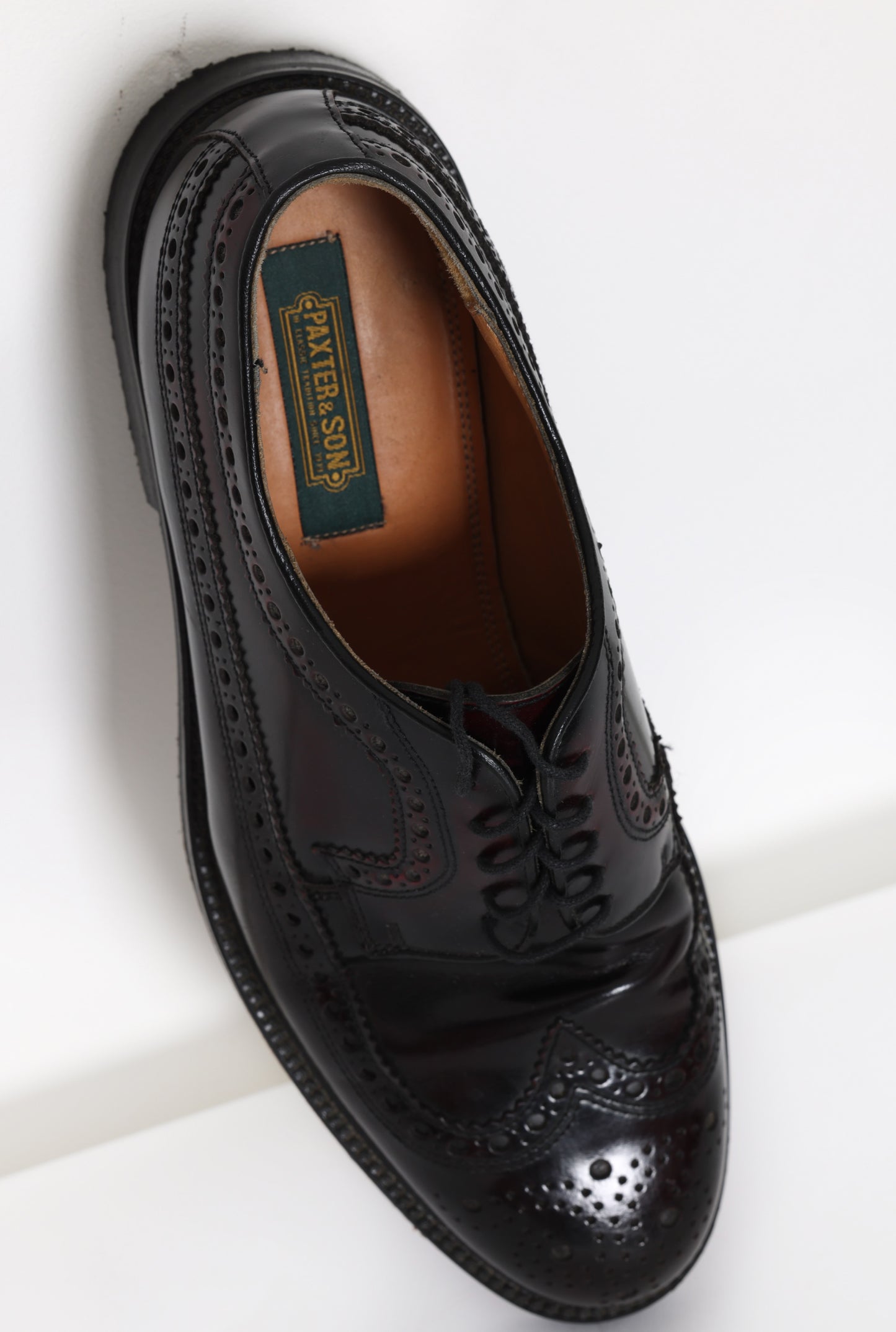
Paxter & Son (England)
Oxblood Burnished Calfskin Longwing Brogue Derby with Goodyear Welt
Oxblood Burnished Calfskin Longwing Brogue Derby with Goodyear Welt
Couldn't load pickup availability
~ EU 45, US 11.5–12
Measurements (cm):
insole: 29.5
SKU: 900941
The Paxter & Son Longwing Derby Brogue in burgundy and black antiqued calfskin, marked “Classic Tradition Since 1919,” “Vero Cuoio,” size 45, and internal code 13008 45 L, represents a traditional Anglo-European interpretation of the full brogue derby executed within the framework of classic industrial welted shoemaking. Although it does not occupy the ultra-luxury echelon inhabited by makers such as Edward Green, Gaziano & Girling, Saint Crispin’s, John Lobb, or bespoke houses, the shoe demonstrates a clear commitment to established heritage manufacturing principles and appears designed to deliver durability, conservative elegance, long service life, and broad stylistic versatility. Every visible aspect of its construction reflects an adherence to enduring footwear archetypes rather than contemporary fashion experimentation, positioning it firmly within the tradition of heritage shoemaking.
The brand presentation itself reinforces this orientation. The phrase “Classic Tradition Since 1919” places Paxter & Son squarely within the familiar language of European heritage footwear marketing, emphasizing longevity, continuity, and conservatism rather than innovation or avant-garde design. The visual language suggests strong influences from English country footwear, Northampton shoemaking traditions, and mid-century continental manufacturing practices. Consequently, the design priorities appear centered on timeless silhouettes, broad commercial appeal, durable construction methods, and traditional leather finishing techniques. Unlike fashion-led houses that continually reinterpret classic forms through changing aesthetic lenses, the apparent objective here is the preservation and continuation of established footwear conventions.
Although independent verification of the company’s historical pedigree remains outside the scope of visible evidence, the shoe itself clearly participates in a lineage that traces directly to Northampton longwing brogues, Scottish country footwear, and the American longwing traditions that flourished between the 1940s and 1960s. Its construction language is rooted in industrial heritage shoemaking rather than luxury experimentation, serving as a continuation of classical brogue design rather than a platform for advancing new construction technologies. In this respect, the model contributes to the preservation of traditional footwear vocabulary rather than its reinvention.
From a classification standpoint, the shoe is unequivocally a full brogue longwing derby. The defining indicators include an open-lacing derby configuration, a wingtip toe, a complete brogue perforation package, and, most importantly, wing lines that continue uninterrupted through the quarters toward the heel. This distinction is critical, as the shoe is not merely a wingtip derby but specifically a longwing brogue, identifiable by the uninterrupted extension of the wing pattern along the entire length of the shoe. In terms of formality, it occupies a moderately formal position within the menswear hierarchy. It is particularly well suited to business wear, country tailoring, tweed ensembles, flannel trousers, seasonal sport coats, and a broad range of smart-casual tailoring applications, while remaining less appropriate for black-tie contexts or highly formal city dress.
One of the shoe’s strongest visual attributes is its upper leather. The material appears most consistent with full-grain corrected box calf or a high-grade polished calfskin. Observable characteristics include a tight grain structure, minimal pore visibility, smooth surface compression, and a controlled break pattern indicative of quality calf leather. The finish itself is especially noteworthy, displaying a richly executed antiqued treatment that combines burgundy-black coloration with visible undertones of oxblood, dark cherry, and black over-dye. This chromatic complexity appears to result from layered pigmentation, burnished finishing techniques, and controlled surface staining rather than natural hide coloration. The tanning process is most likely chrome tanning, as evidenced by the leather’s uniform consistency, strong polish retention, and tight flex characteristics. Over time, the material can be expected to develop increased tonal depth, a richer patina, and moderate vamp creasing while maintaining its structural integrity.
The last exhibits classic English proportions and reflects a philosophy of balanced ergonomics rather than aggressive styling. The toe shape is best described as a rounded almond profile, combining generous forefoot volume with moderate taper and a conservative overall silhouette. The instep appears moderately elevated, while the heel seat demonstrates balanced proportions and proper alignment relative to the ball position. Orthopedically, this configuration offers several advantages, including reduced metatarsal compression, improved allowance for natural toe splay, and conservative pressure distribution throughout the forefoot. Compared with many Italian lasts, it is notably less aggressive, while remaining considerably more accommodating than much of contemporary fashion footwear. The overall geometry prioritizes comfort, stability, and wearability without sacrificing traditional elegance.
Visible evidence strongly suggests Goodyear welt construction. Supporting indicators include a distinct welt line, a clearly defined welt strip, a pronounced sole edge, and a traditional sole profile consistent with established welted manufacturing methods. The likely construction sequence begins with a leather insole, followed by gemming or rib attachment, welt stitching, cork filling, outsole attachment, and subsequent heel building. Such a construction system offers significant advantages in terms of rebuildability, shape retention, moisture management, and long-term durability. With proper maintenance, a lifespan of fifteen to thirty years is entirely plausible, reinforcing the shoe’s position within the heritage welted footwear category.
The outsole is marked “Vero Cuoio,” denoting genuine leather. This designation most likely indicates vegetable-tanned outsole leather produced from machine-finished sole bends, although it does not necessarily imply the use of premium oak-bark tanning methods. The edge profile remains traditional and restrained, while the heel stack appears to be constructed from multiple leather lifts capped with a rubber top lift for traction and durability. The heel geometry exhibits a moderate military pitch that supports neutral posture and promotes an efficient gait cycle without inducing excessive forward weight transfer.
Interior construction reflects substantial use of leather components. The visible lining appears to be full leather, likely calf or kip leather, offering notable benefits in moisture absorption, thermal regulation, and shape retention. The insole is most likely produced from vegetable-tanned bend leather with an estimated thickness of approximately 4.5–5.5 mm. From an orthopedic standpoint, such leather-lined interiors provide superior moisture management, reduced friction, and the ability to gradually conform to the wearer’s foot over time, enhancing long-term comfort and fit.
The stitching quality appears comfortably above average for industrial heritage footwear. Upper stitching density is estimated at approximately 8–10 stitches per inch, with visible evidence of uniform spacing, controlled thread tension, and consistent seam tracking. Edge treatment is similarly competent, featuring black edge dressing, clean perimeter finishing, and consistent welt coloration. While the execution does not rise to the level of elite handwork, the overall manufacturing standards appear disciplined and technically sound.
Pattern engineering reflects classical longwing design principles. The upper consists of a wingtip toe section, a single vamp, derby facings, extended quarter panels, and a rear seam closure. Structurally, the longwing configuration provides several advantages, including improved distribution of flex stresses, enhanced lateral stability, and a visually elongating effect that contributes to the shoe’s elegant proportions. Pattern alignment appears accurate throughout, indicating careful cutting and assembly procedures.
The toe structure exhibits remarkable stability despite visible wear, suggesting the presence of a structured toe puff, most likely executed in Celastic or thermoplastic reinforcement. This internal structure allows the toe to maintain symmetry, volume, and a sharply defined wing contour while resisting collapse over time. The absence of visible deformation further supports the conclusion that the reinforcement system remains effective.
The closure system employs a traditional five-eyelet derby arrangement featuring open lacing, balanced throat geometry, and appropriate eyelet spacing. Compared with closed Oxford construction, this configuration accommodates a broader range of instep heights and offers greater fit adaptability, contributing to both comfort and versatility.
Finishing represents one of the shoe’s most successful technical and aesthetic achievements. The antiqued treatment demonstrates a sophisticated interplay between black perimeter shading, burgundy underlayers, and controlled tonal variation. Additional burnishing is visible around the quarter edges, wingtip boundaries, and heel area, introducing dimensionality and visual depth without descending into excessive theatricality. The overall polish level achieves a semi-gloss, military-style brilliance that remains refined and avoids the artificial appearance often associated with heavily pigmented commercial finishes.
Decorative detailing is extensive but remains disciplined within traditional brogue conventions. The shoe incorporates a medallion toe, serrated pinking, longwing perforations, and multiple rows of quarter perforations. Punching alignment appears generally consistent, and while not executed to bespoke standards, the overall precision remains entirely acceptable. The design achieves a commendable balance, embracing the decorative richness inherent to full brogue construction while avoiding excessive ornamentation.
The heel architecture adheres closely to classical English standards. The heel counter appears firm and properly structured, while the collar line maintains a low-cut, elegant profile. In practical terms, this configuration should provide secure heel lock, reduced slippage, and effective rearfoot stabilization without introducing unnecessary rigidity or discomfort.
Visible waist shaping suggests moderate arch support and competent midfoot engineering. Internally, the shoe likely incorporates a steel shank working in conjunction with the leather insole and cork filler. This arrangement should deliver good long-term standing comfort, efficient walking mechanics, and reliable midfoot stability. Although less sculpted than the highly refined waists found in bespoke footwear, the configuration remains functionally sound and entirely appropriate for its market segment.
Stylistically, the shoe draws heavily from the English country brogues of the 1930s through the 1950s, particularly the longwing sporting footwear associated with rural gentleman’s dress. Despite these historical references, the actual production is most likely situated between the late 1990s and the 2010s. Indicators supporting this conclusion include contemporary finishing chemistry, modern welt proportions, and commercial manufacturing tolerances. The result is a historical revival rather than a period-original artifact, faithfully translating traditional forms into a contemporary production environment.
At a conceptual level, the design embodies English country formalism. Its core principles are durability, practical elegance, and decorative restraint. Whereas many Italian footwear traditions prioritize sensuality, sharpness, and visual lightness, this design emphasizes presence, stability, and heritage authenticity. The silhouette aligns naturally with classic tailoring traditions and remains largely insulated from short-term fashion cycles.
In the contemporary market, the shoe would sit comfortably alongside offerings such as Loake 1880 longwings, Barker country brogues, Cheaney country collections, Berwick’s heritage line, and Sanders brogue derby models. It occupies a tier above mass-market corrected-leather dress shoes while remaining below the refinement, finishing sophistication, and material standards associated with Edward Green, John Lobb, Saint Crispin’s, and Gaziano & Girling. Its relevance remains exceptionally strong in modern wardrobes, particularly when paired with tweed, corduroy, flannel, raw denim, and a wide range of smart-casual tailoring.
From a technical standpoint, the shoe performs admirably across most evaluation categories. Leather quality merits an assessment of 8.0/10, pattern engineering 8.5/10, last design 8.0/10, construction quality 8.0/10, finishing 8.5/10, brogue execution 8.0/10, comfort potential 8.0/10, heritage authenticity 8.5/10, and luxury positioning 7.0/10. Its principal strengths include the attractive antiqued finish, classical longwing proportions, presumed Goodyear welt construction, durable leather sole platform, strong versatility, accurate pattern engineering, and excellent heritage styling. The primary limitations are comparatively minor and include a waist lacking the refinement of higher-end makers, brogue punching that falls short of bespoke precision, somewhat utilitarian heel finishing, and a last that lacks the sculptural sophistication found in elite English houses.
Taken as a whole, the Paxter & Son Longwing Derby Brogue successfully channels the traditions of English country shoemaking through a coherent combination of balanced last design, rich oxblood-black antiqued finishing, substantial leather construction, and authentic longwing patterning. Although it does not exhibit the extreme refinement, anatomical sculpting, hand-finishing depth, or material exclusivity associated with premier Northampton manufacturers or bespoke production, it occupies a highly respectable position within the heritage welted footwear market. From a manufacturing perspective, it stands as a competent and well-executed example of classic industrial Goodyear-welted shoemaking, delivering durability, stylistic longevity, and long-term value to consumers seeking traditional craftsmanship without entering the ultra-luxury segment.
Share