Officine Creative (Italy)
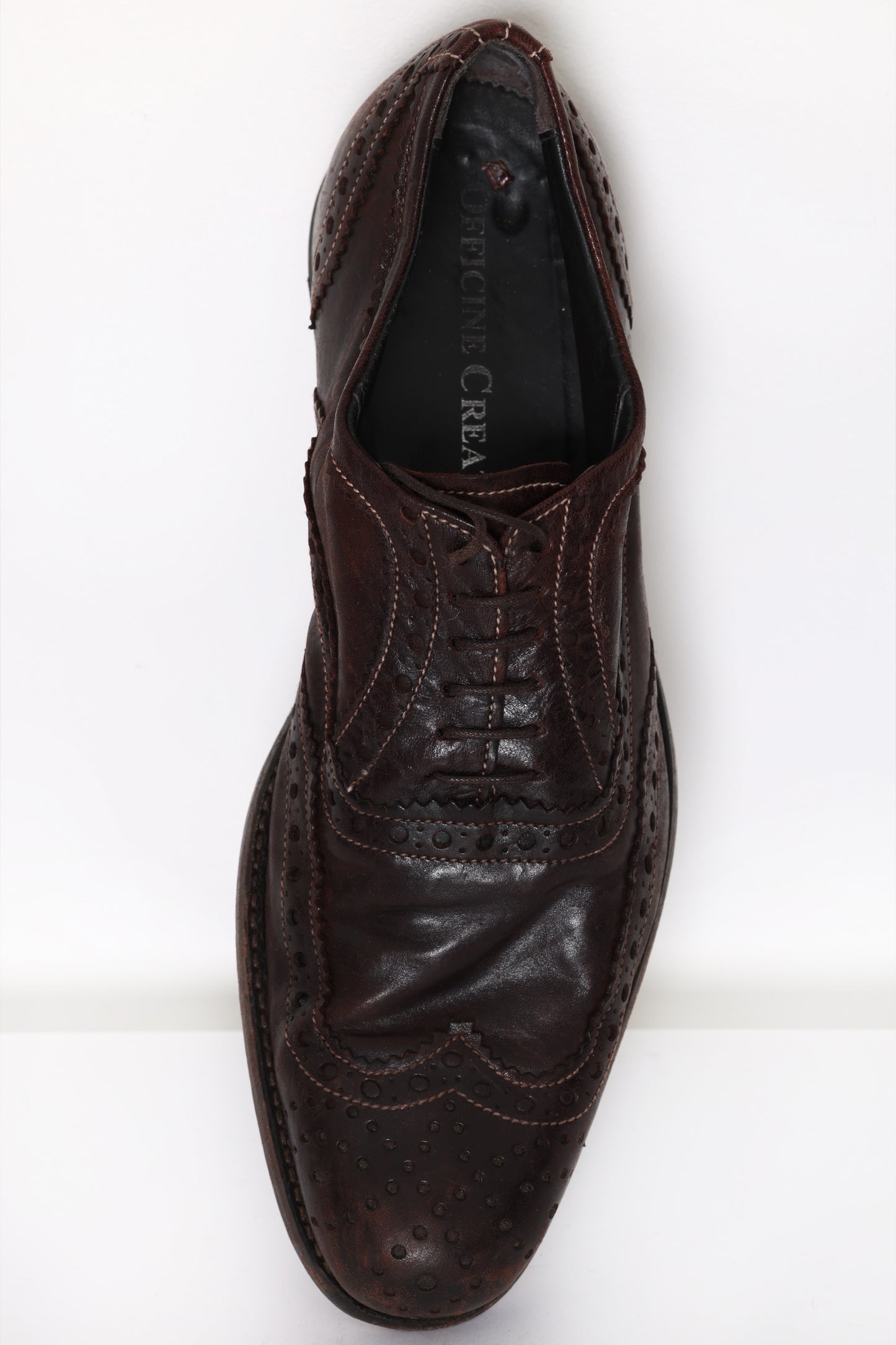
Late-2000s, Italian Full Brogue Oxford in Hand-Dyed Crust Calfskin
Late-2000s, Italian Full Brogue Oxford in Hand-Dyed Crust Calfskin
Couldn't load pickup availability
~ EU 41, US 8
Measurements (cm):
insole: 30 (elongated)
SKU: 900952
Officine Creative, founded by Roberto Di Rosa, occupies a distinctive position within contemporary Italian artisanal footwear, emerging not from the structurally conservative traditions associated with Northampton shoemaking but from the shoemaking culture of Italy’s Marche region, where handcraft traditions, material experimentation, and expressive finishing techniques converge. The brand’s identity is rooted in a philosophy of “perfect imperfection,” a deliberate rejection of sterile factory uniformity in favor of individuality achieved through visible handwork and organic variation. That philosophy is immediately manifest in this shoe through hand-burnished tonal transitions, irregular antiquing effects, deconstructed visual softness, deliberately aged surface treatment, and architectural pattern experimentation. Where traditional British shoemakers prioritize formal symmetry and controlled consistency, Officine Creative embraces artisanal asymmetry, subtle irregularity, and evidence of manual intervention as intrinsic elements of aesthetic value.
The brand’s broader influence emerged during the luxury casualization movement of the early 2000s, when it helped establish what is now recognized as the artisanal luxury footwear category. Its significance lies in successfully bridging traditional Italian shoemaking, avant-garde fashion sensibilities, luxury ready-to-wear, and hand-finished production techniques. Through this synthesis, the company contributed to the widespread acceptance of hand-dyed leather finishing, distressed luxury aesthetics, hybrid formal-casual dress shoes, and vintage-inspired artisanal patination. The result was a meaningful influence on numerous contemporary Italian makers and luxury labels seeking authenticity, character, and narrative depth rather than pristine formalism.
From a classification standpoint, the shoe occupies the intersection of a Full Brogue Oxford, an Artisanal Wingtip Oxford, and a Decorative Longwing-derived Hybrid. The architecture incorporates closed lacing, wingtip construction, an extensive perforation field, and decorative serrated panel transitions. Yet despite employing canonical brogue components, it intentionally departs from conventional formal execution. Its intended application resides within luxury smart casual dressing, creative professional environments, contemporary tailoring, and fashion-forward business attire. It is not conceived as a black-tie Oxford or a boardroom-oriented formal shoe; rather, it represents a fashion-conscious artisanal reinterpretation of classic English brogue architecture.
The upper leather quality is visibly superior to that of the previously analyzed Rizzo, displaying characteristics strongly indicative of full-grain calfskin finished with a semi-aniline system and originating from hand-dyed crust leather. The natural pore structure remains visible across the surface, while the finish retains enough transparency to reveal the underlying character of the hide. Color depth penetrates beneath the surface layer rather than residing solely within a pigmented topcoat, and creasing behavior demonstrates fiber elasticity rather than the fracture patterns associated with corrected-grain leather. The most plausible manufacturing sequence begins with crust calf production, followed by hand dye application, multiple wax treatments, manual burnishing, and the addition of a protective finishing layer. The resulting material exhibits the supple collapse, tactile richness, and organic responsiveness expected from higher-grade Italian calfskin.
The last reflects a notably sophisticated balance between elegance and biomechanical practicality. Its silhouette is defined by an elongated almond profile, a narrow waist, a sculpted instep, and a refined heel seat, culminating in a soft chisel-almond hybrid toe shape. Unlike aggressively fashion-oriented lasts that sacrifice comfort for visual drama, the forepart remains functionally proportioned while maintaining refinement. Ergonomically, the design offers natural toe splay allowance, a smooth metatarsal transition, and a moderate heel pitch that promotes comfort during prolonged wear. The principal limitation lies in the narrowed midfoot, which may prove challenging for broader-footed individuals. Nevertheless, the overall ergonomic sophistication surpasses that of most factory-produced welted footwear.
Visible construction characteristics strongly suggest Blake Rapid construction. The evidence includes an extremely close-cut sole profile, minimal outsole projection, slim waist architecture, and low-profile edge finishing—features commonly associated with refined Italian shoemaking rather than traditional Goodyear welt systems. The likely assembly sequence involves lasting the upper, executing a Blake stitch through the insole, attaching a midsole, applying Rapid outsole stitching, and concluding with extensive hand finishing. This methodology aligns closely with established Officine Creative production practices. The resulting advantages include exceptional flexibility, reduced weight, and a highly elegant silhouette, while the principal compromises involve lower water resistance relative to Goodyear-welted construction and more specialized resoling requirements.
The outsole appears to be leather, enhanced by a hand-stained edge treatment that contributes significantly to the shoe’s artisanal character. Visible details include a dark hand-burnished sole edge, narrow beveling, and a close-cut waist that reinforces the sleek profile. The heel assembly consists of a layered leather stack terminated by a rubber toplift, balancing traditional aesthetics with practical durability. Heel pitch appears to measure approximately 15 mm, encouraging a natural forward gait progression without generating excessive forefoot pressure.
Internal construction indicators suggest a fully leather-lined interior with a vegetable-tanned leather footbed cover. The expected architecture includes a leather insole board, steel shank reinforcement, and leather heel lining. Relative to mass-market dress footwear, this arrangement provides superior moisture management, enhanced moldability to the wearer’s foot, and improved long-term comfort through material adaptation rather than synthetic cushioning dependence.
Stitching quality is notably high throughout the shoe. Upper seams appear to fall within the 9–11 SPI range, while decorative seams approach approximately 10–12 SPI. Stitch spacing remains consistent, seam tracking is executed with precision, and brogue alignment demonstrates strong symmetry despite the complexity of the pattern. Particularly noteworthy are the decorative zig-zag edge treatments integrated into panel junctions. These details require substantially greater labor and precision than conventional folded-edge construction and contribute significantly to the shoe’s artisanal identity.
The quarter and vamp configuration reveals unusually sophisticated pattern engineering. The design incorporates a multi-section wingtip overlay, independent quarter sections, decorative facings, and an extended longwing flow that guides the eye across the entire upper. Rather than minimizing components for manufacturing efficiency, the patternmaker intentionally employed numerous leather sections to create visual movement and depth. Despite this complexity, grain orientation remains largely consistent and structural tension appears carefully managed, indicating advanced pattern-development discipline.
Toe structure demonstrates moderate stiffness combined with a controlled collapse pattern. Reinforcement is likely provided by either a leather toe puff or a premium-grade celastic stiffener. The evidence lies in the preservation of shape despite substantial wear, the continued stability of toe spring, and the absence of collapse within the wingtip architecture. These characteristics indicate reinforcement materials of significantly higher quality than those typically found in lower-tier factory footwear.
The closure system employs a closed Oxford configuration with a five-eyelet arrangement, clean eyelet spacing, and a reinforced facing structure. The throat opening is intentionally elongated to produce a sleek visual line while maintaining practical adjustability, preserving both elegance and functional fit accommodation.
Finishing and polishing represent perhaps the shoe’s greatest achievement. Antiquing is built from multiple tonal layers that combine espresso brown, burnt umber, and tobacco undertones, generating exceptional chromatic depth. Burnishing is strategically concentrated around the toe, quarter edges, and heel transitions, creating visual emphasis and dimensionality. The color variation strongly suggests manual pigment application, hand brushing, and localized wax saturation. The complexity and nuance of these effects could not realistically be replicated through simple spray-color production methods, underscoring the substantial artisanal labor invested in the finishing process.
Decorative content is extensive yet intentionally integrated into the broader design language. Full broguing, medallion perforations, longwing tracing, serrated panel edges, and oversized punch detailing collectively transform traditional brogue ornamentation into a contemporary statement. The perforation scale is deliberately exaggerated, moving beyond historical reproduction toward modern reinterpretation while retaining recognizable heritage references.
Heel architecture displays careful sculpting, featuring a deep heel seat, a well-defined rear curve, and a relatively low collar profile. These elements are expected to deliver secure calcaneal retention, reduced heel slip, and greater consistency of fit over extended wear. Such refinement is characteristic of higher-end Italian pattern engineering, where visual elegance and functional retention are developed simultaneously rather than independently.
The narrowed waist strongly suggests the incorporation of an internal steel shank, contributing to defined midfoot support. The support profile combines moderate arch elevation, stable torsional control, and good longitudinal rigidity. Compared with economy-grade Blake footwear, the shoe likely exhibits substantially greater midfoot discipline and structural coherence.
Historically, the shoe most plausibly belongs to the late-2000s through mid-2010s period and synthesizes multiple stylistic influences. Its primary reference point derives from 1930s English country brogues, while secondary influences emerge from 1940s spectator and longwing traditions. Overlaying these historical foundations is the distinctly contemporary influence of the 2000s Italian artisanal luxury movement. The result is not a faithful reproduction of any historical model but a reinterpretation of classical brogue architecture through the lens of modern artisanal fashion.
The underlying design philosophy fuses British brogue tradition, Italian handcraft, and a form of industrial romanticism. The objective appears to be the creation of an object that conveys the visual impression of decades of acquired patina, wear, and character despite originating from a contemporary factory environment. Narrative, age, individuality, and emotional resonance are prioritized over pristine formality, producing a shoe that feels lived-in and personal rather than ceremonially perfect.
Within the contemporary luxury footwear market, the model occupies a highly recognizable niche alongside makers such as Silvano Sassetti, Moma, Pantanetti, and MARSÈLL, though it remains less avant-garde than the latter. Its continuing relevance stems from enduring demand within the artisanal luxury segment for hand finishing, visible patina, heritage-inspired construction, and individual character. Consequently, its appeal is often stronger among collectors, enthusiasts, and fashion-conscious consumers than among traditional corporate professionals seeking conservative formality.
From a craftsmanship perspective, the shoe achieves an Upper Quality rating of 8.8/10, Pattern Engineering 9.1/10, Leather Selection 8.7/10, Finishing Execution 9.4/10, Construction Quality 8.6/10, and Artisanal Character 9.5/10. Its principal strengths include excellent hand-finished leather, sophisticated antiquing, complex pattern engineering, high-grade Italian construction, a powerful visual identity, and leather quality demonstrably superior to that of the previously reviewed Rizzo. Its weaknesses include significant creasing from wear, reduced formal versatility, lower weather resistance inherent to Blake Rapid construction when compared with premium Goodyear-welted systems, and a decorative language that may polarize conservative buyers.
In luxury-market positioning, the shoe resides comfortably above most mid-tier welted dress footwear and within the lower-to-middle range of true luxury artisanal shoemaking. Given visible wear yet strong structural integrity, a fair secondary-market value would likely fall between approximately US$120 and US$250, increasing to roughly US$200–350 if recently resoled and carefully maintained. When new, an equivalent retail position would likely have occupied the US$500–900+ artisanal luxury category.
Share