Meiker (Finland)
Late-1990s, Finnish Elk Nappa Leather Blouson
Late-1990s, Finnish Elk Nappa Leather Blouson
Couldn't load pickup availability
~ EU 40–42, US L
Measurements (cm):
shoulder to shoulder: 42
sleeve (shoulder to cuff): 63
chest (pit to pit): 60
length (collar to hem): 68
SKU: 900949
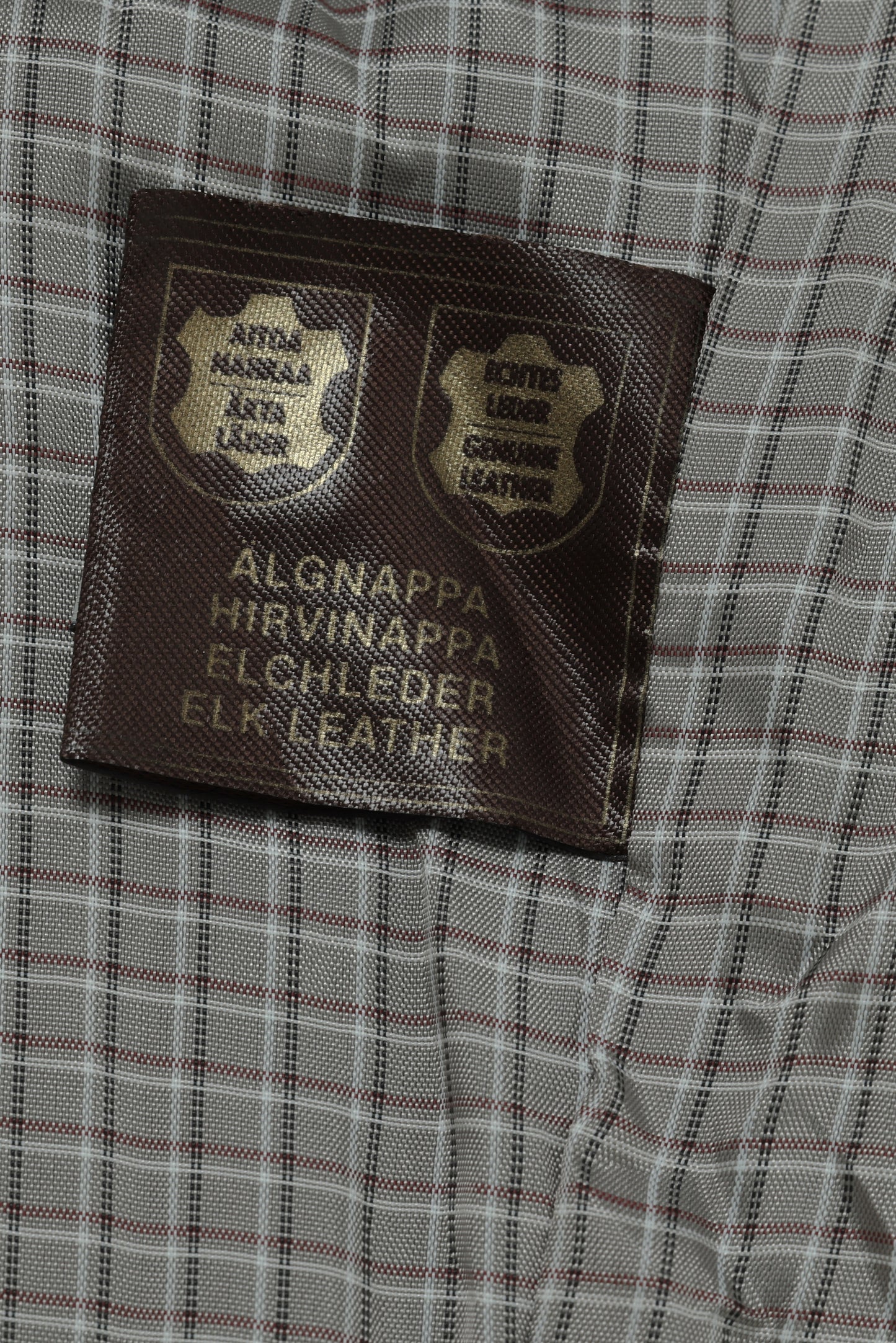
This is a Finnish-manufactured leather leisure jacket produced under the Meiker label, most plausibly during the late 1990s to early 2000s. Constructed from elk leather identified by both branded and material-content labels, it represents a category of Northern European casual outerwear that occupied the territory between tailored city jacket, driving jacket, and relaxed weekend leather coat. The design combines a concealed zip-front closure, shirt-style collar, angled welt pockets, and a comparatively clean exterior free from overt biker, aviation, or military references. Construction evidence indicates industrial production executed to a relatively high commercial standard, with careful leather selection, stable lining integration, and thoughtful seam placement intended to manage bulk across thick hide sections. As an artifact, it illustrates a period when Scandinavian leather manufacturers increasingly pursued understated metropolitan styling while retaining the material authority associated with traditional hide garments.
I. Designer Origin & Brand Profile
Meiker appears to belong to the Finnish leather manufacturing tradition that flourished during the final decades of the twentieth century, particularly among regional producers supplying domestic Nordic markets with durable outerwear. Unlike internationally visible luxury houses whose business depended upon seasonal novelty, companies of this type typically specialized in material competence, sourcing quality hides and producing garments intended to survive years of wear. The surviving labels emphasize material content before design authorship, an indication that leather quality constituted the principal selling proposition.
From a design perspective, the garment reflects a philosophy centered on longevity and broad usability. There is little evidence of trend-driven detailing. The exterior avoids excessive pocketing, decorative hardware, epaulettes, belts, or contrast stitching. The jacket instead relies upon proportion, material quality, and surface character generated through wear. Such decisions indicate a manufacturer addressing consumers who expected a leather jacket to remain serviceable beyond a single fashion cycle, a concept less glamorous than the runway mythologies of the era but considerably more profitable.
II. Brand Heritage & Industry Influence
The garment belongs to a Nordic leatherwear tradition shaped by climate, durability requirements, and a consumer preference for understated products. Finnish leather manufacturing historically occupied an intermediate position between luxury fashion production and utilitarian outerwear manufacture. Firms frequently adopted efficient industrial methods while maintaining material standards above those commonly found in lower-priced global imports.
The use of elk leather is particularly significant. Elk occupies a distinct place within Scandinavian leather culture due to its naturally pronounced grain, resilience, and substantial hand. During the 1980s and 1990s, marketing emphasis frequently highlighted species-specific hides as indicators of authenticity and quality. The multiple material labels found within the garment suggest that hide origin formed a central commercial narrative.
While Meiker may not have influenced global fashion discourse, garments such as this contributed materially to the evolution of European leather outerwear by demonstrating how robust natural hides could be adapted to increasingly urban and less overtly masculine styling categories.
III. Garment Classification & Design Intent
This garment is best classified as a leather leisure jacket or metropolitan casual blouson. It shares characteristics with driving jackets, executive leisure jackets, and civilian utility outerwear without belonging fully to any of those categories.
Its intended purpose was daily urban wear. The concealed zipper construction, moderate length, and absence of waist belts or action-back systems indicate that it was designed primarily for walking, commuting, automobile use, and general city activity. The jacket is not engineered as motorcycle apparel, despite superficial similarities to some riding garments.
The design intent appears directed toward visual simplification. The front closure is hidden beneath a leather-covered placket. Pocket openings are integrated into the body with minimal interruption. Horizontal chest seams divide large leather panels into manageable cutting sections while creating visual order. The result is a garment whose visual identity depends almost entirely on hide quality and silhouette.
IV. Construction Methodology & Engineering
Assembly reflects industrial leatherwear production executed by operators familiar with heavy material handling. The shell utilizes machine-stitched lockstitch construction throughout visible structural seams. Stitch density appears moderate, avoiding excessively short stitches that could perforate and weaken the hide.
The front zipper is concealed beneath a full-length leather-covered placket. This arrangement improves weather protection while reducing visual emphasis on hardware. The zipper itself appears to be a molded-tooth system suitable for repeated heavy use.
Shoulder seams, armhole seams, and sleeve panel junctions appear reinforced through multiple rows of topstitching. Such construction distributes tension across larger surface areas and reduces seam creep over prolonged wear.
The checked lining is assembled separately before insertion into the shell. The lining appears fully bagged rather than partially suspended, a method improving production efficiency and interior cleanliness.
V. Technical Design Elements & Precision Detailing
The most notable design feature is the multi-panel sleeve architecture. Instead of relying upon a conventional two-piece sleeve alone, the designer introduced additional curved seam lines across the upper arm and shoulder region. These seams serve both technical and aesthetic functions.
From a cutting perspective, they improve hide utilization by permitting smaller pattern components. From a visual perspective, they break the potentially monotonous expanse of dark leather. From a production standpoint, they reduce waste, a concern of particular importance when working with expensive natural skins.
The angled welt pockets are carefully integrated into the front body. Their inclination follows a natural hand trajectory, improving accessibility while maintaining visual continuity.
The concealed front placket demonstrates similar thinking. It suppresses visual noise while introducing a modest weather barrier.
VI. Style Nomenclature & Historical Evolution
The garment belongs to the broad family of leather leisure jackets that emerged from postwar sportswear and driving jacket traditions. By the 1990s, these garments had largely abandoned military and aviation associations in favor of metropolitan versatility.
Its shirt-style collar traces lineage to civilian work jackets and casual sports coats of the mid-twentieth century. The concealed closure reflects developments common in European outerwear during the 1980s and 1990s, when cleaner facades became commercially desirable.
Unlike biker jackets derived from Perfecto traditions or bomber jackets derived from flight clothing, this example occupies a less dramatic category. It is the sort of garment purchased by someone who wished to own leather without appearing committed to a motorcycle, a rebellion, or a squadron.
VII. Fabric Composition & Textile Engineering
The shell is identified as elk leather through multiple internal labels. Visually, the material exhibits a moderately pronounced pebble grain with irregular natural texture. Surface reflectivity remains subdued. The hide demonstrates sufficient flexibility to drape around the torso while retaining structural mass.
The leather appears medium-heavy by garment standards, likely within a range suitable for outerwear use without excessive rigidity. Wear patterns visible along the surface suggest strong abrasion resistance and favorable aging characteristics.
The lining displays a stable woven check structure. Its smooth hand suggests a filament-based construction engineered to facilitate movement over underlying garments. The textile exhibits low bulk, moderate sheen, and limited frictional resistance.
Together, shell and lining form a balanced system. The shell provides structure and environmental protection while the lining improves comfort and dressing efficiency.
VIII. Construction & Pattern Analysis
Pattern architecture reveals a block developed for comfort and layering. The chest measurement relative to shoulder width indicates substantial ease through the torso. This relationship was common in Northern European outerwear of the period.
The front body consists of large panels interrupted by a horizontal chest seam. These divisions reduce hide consumption inefficiencies while helping control drape.
The sleeve pattern incorporates additional articulated sections above the bicep. Such segmentation permits more accurate grain placement and improved hide utilization. It also softens the transition between shoulder and sleeve, creating a more relaxed silhouette.
The collar is a conventional shirt-collar derivative composed of upper and under collar components. It lacks the rigid architecture associated with tailoring. Instead, it relies on leather thickness and seam structure for shape retention.
Assembly sequencing likely followed a standard industrial workflow: shell panel preparation, pocket insertion, sleeve assembly, collar construction, zipper installation, placket integration, shell joining, lining preparation, and final bagging operations.
IX. Structural Integrity & Panel Configuration
Structurally, the garment appears sound. Stress-bearing regions receive reinforcement through seam placement and multiple stitch rows.
The shoulder configuration distributes load effectively despite the relatively soft silhouette. The chest seam functions not merely as decoration but as a structural interruption that limits distortion across large leather surfaces.
The neckline junction appears stable. Collar attachment seams are adequately supported by the natural thickness of the hide. Unlike tailored garments requiring canvas and pad stitching, this jacket derives much of its structural integrity directly from material properties.
Pocket entries are reinforced through folded leather welts and multiple rows of stitching. Hem and cuff regions likewise benefit from doubled material layers that resist edge deformation.
X. Edge Finishing, Seam Termination & Closures
Edge management demonstrates disciplined industrial execution. Collar edges are turned and topstitched with consistent spacing. Cuff edges utilize folded leather construction to conceal raw cut surfaces.
The concealed front placket deserves particular attention. It houses the zipper while protecting it from abrasion and environmental exposure. This arrangement also prevents visual interruption of the front panel.
The collar exhibits a gentle fall with minimal stand height. Roll behavior remains controlled by leather thickness rather than inserted shaping materials. No evidence suggests extensive internal reinforcement.
Seam terminations appear clean and efficient. Bulk reduction has been managed adequately at intersections, particularly around collar corners and shoulder transitions.
XI. Manufacturing Context, Production Scale & Industrial Feasibility
This garment was almost certainly produced within a medium-scale industrial environment rather than a couture workroom or bespoke establishment.
Numerous characteristics support this conclusion. Pattern segmentation improves hide yield. Machine topstitching remains standardized. Interior finishing follows efficient commercial practices. Material quality is high, yet labor expenditure remains controlled.
The design occupies an intelligent manufacturing position. It delivers perceived value through material selection while avoiding expensive hand operations. A production manager examining the jacket would likely approve its balance between cost containment and market appeal.
The collar design alone illustrates this balance. It delivers visual familiarity and wear comfort without requiring the labor-intensive internal architecture associated with tailored outerwear.
XII. Conceptual Influence & Psychological Design Intent
Conceptually, the garment reflects a late twentieth-century movement toward understated material luxury. Its authority derives not from decoration but from substance.
The jacket communicates permanence, reliability, and maturity. The wearer is not invited to perform an identity through aggressive styling cues. Instead, the garment offers material confidence. That distinction may sound subtle, yet it marks an important shift within menswear during the 1990s.
The concealment of the zipper is particularly revealing. The designer deliberately suppresses mechanical display. Hardware exists to serve function. The leather itself becomes the primary visual subject.
XIII. Artistic & Aesthetic Direction
Aesthetically, the garment aligns with Northern European design traditions emphasizing material presence and controlled proportion.
The silhouette forms a broad rectangular field with limited waist suppression. Visual interest derives from grain variation, seam placement, and surface aging. The horizontal chest seam acts as a compositional anchor.
The collar contributes significantly to facial framing. Its moderate spread and soft roll direct attention upward while maintaining a low visual profile. Because no lapels are present, the neckline becomes the primary organizational element of the upper torso.
The overall visual system values continuity. Large uninterrupted surfaces dominate. Decorative intervention remains minimal.
XIV. Historical Placement & Contextual Analysis
Several indicators place production most plausibly between the mid-1990s and early 2000s.
The silhouette reflects post-1980s relaxation while avoiding the exaggerated proportions of earlier decades. The concealed molded-tooth zipper, woven content labels, panel engineering, and overall styling correspond closely to Northern European leatherwear from this period.
The checked lining pattern was especially common among commercial leather outerwear manufacturers during the late twentieth century. It provided visual distinction inside the garment while remaining inexpensive to produce.
This example therefore occupies an interesting historical position. It sits after the highly structured leather jackets of earlier decades and before the slimmer, fashion-oriented leather garments that became widespread during the 2000s.
XV. Use Case
The garment is designed for movement through ordinary urban environments: walking from a parked car to an office, crossing a city center in cool weather, standing at a railway platform, or spending an afternoon moving between indoor and outdoor spaces.
The generous chest ease suggests accommodation of a lightweight knit, shirt, or fine-gauge sweater beneath.
Share