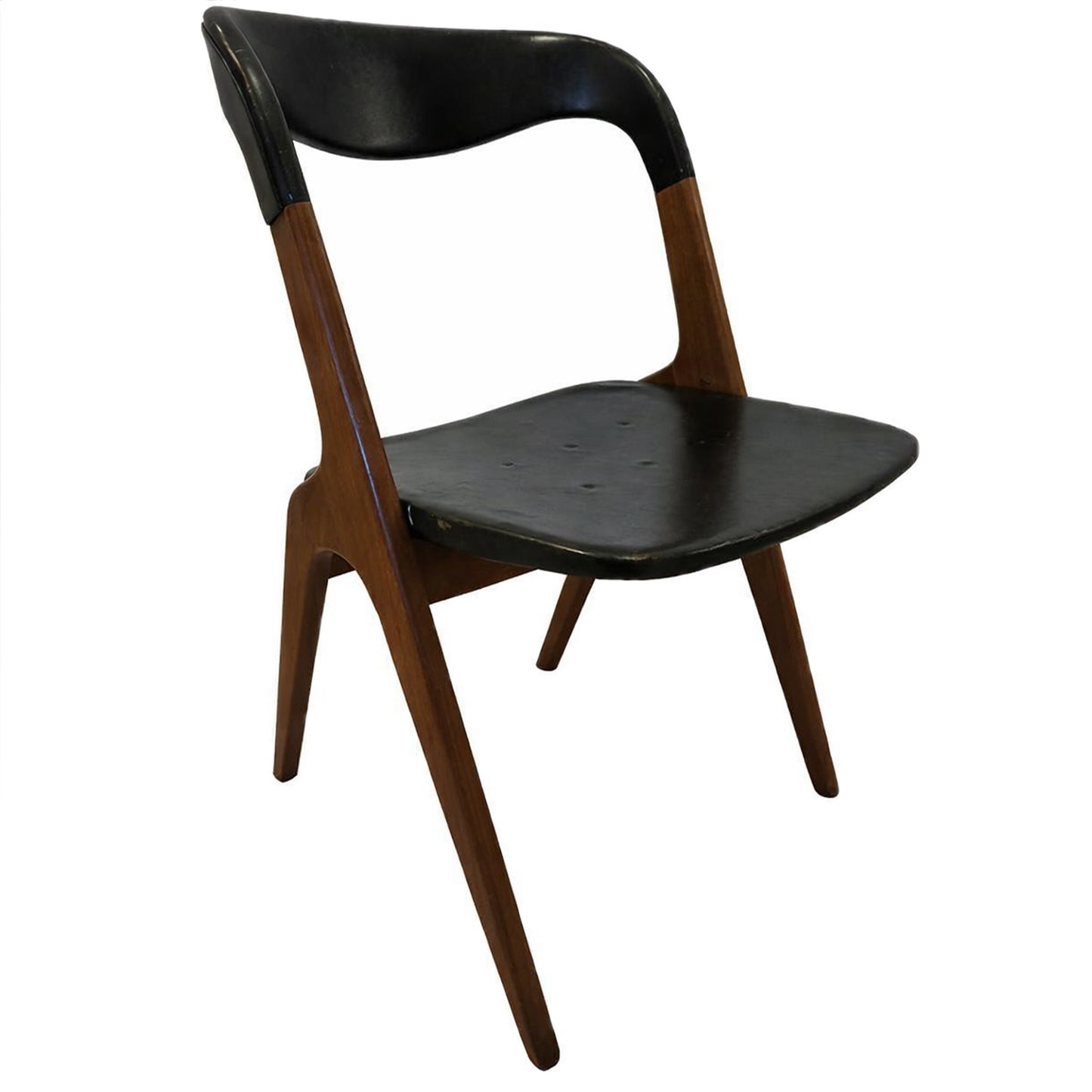
Johannes Andersen for Vamo Møbelfabrik (Denmark)
Sonja Dining Chair, Solid Teak Frame with Upholstered Leather Seat and Back
Sonja Dining Chair, Solid Teak Frame with Upholstered Leather Seat and Back
Couldn't load pickup availability
This is a dining chair designed by Johannes Andersen and manufactured by Vamo Møbelfabrik in Sønderborg, Denmark, estimated production period mid-1960s to early 1970s. The chair employs a solid teak structural frame supporting an upholstered seat and backrest finished in black leather. The construction combines sculpted hardwood joinery with minimal upholstery components typical of Danish modern dining furniture. Fabrication appears to be workshop-scale industrial production rather than hand-built studio craft, with consistent shaping and repeatable joinery geometry. The design reflects the Danish modern emphasis on ergonomic restraint, structural clarity, and the integration of sculpted timber with minimal soft surfaces.
I. Primary Materials & Structural Integrity
The primary load-bearing structure is solid teak, a hardwood selected for dimensional stability and moderate oil content, which resists minor humidity fluctuations common in domestic interiors. The legs and rear uprights form a continuous structural system, transferring weight from seat to floor without intermediate framing. The seat and backrest panels are likely plywood substrates upholstered in leather. These components are secondary to the hardwood frame and are mechanically fastened rather than integrated structurally. The teak members appear relatively slender but are reinforced through triangulation created by the rear legs, seat rails, and central stretcher. No structural deformation, cracking at joints, or warping of the timber elements is apparent. Minor surface wear on the leather indicates use but does not suggest compromise of the internal substrate.
II. Fabrication Method & Production Logic
The chair frame components are machine-shaped from solid teak blanks using template routing and spindle shaping typical of Danish furniture workshops during the 1960s. Surfaces appear hand-finished after machining to soften transitions and remove tool marks. Production was organized as small-scale factory output rather than automated mass production. Each component would have been milled, sanded, and assembled using repeatable joinery jigs. The consistent curvature of the backrest element and uniform taper of the legs indicate standardized manufacturing processes. Upholstery components were likely fabricated separately and installed after frame assembly.
III. Joinery, Fastening & Engineering Resolution
The primary joints between legs and seat rails are likely mortise-and-tenon, concealed within the frame intersections. Danish manufacturers of this period commonly reinforced these joints with adhesive and internal dowels. The backrest panel is mounted between the rear uprights, either doweled or tenoned into shallow sockets. The seat panel rests within or atop the seat rails and is secured from beneath with screws or concealed brackets. A single stretcher between the rear legs adds lateral rigidity and prevents splaying under load. No evidence suggests later reinforcement or replacement joinery.
IV. Surface Finish & Material Treatment
The teak frame is finished with a clear oil or light lacquer typical of Danish mid-century production, allowing the natural grain pattern to remain visible. Surface sheen is low to moderate, consistent with either original oil maintenance or light refinishing over time. The leather seat and backrest appear to be black pigmented leather, possibly original but showing wear patterns consistent with prolonged seating use. Creasing and light abrasion occur in expected contact areas. No evidence of aggressive refinishing, heavy sanding, or modern polyurethane coatings is apparent on the wood.
V. Formal Language & Design Lineage
The chair’s geometry reflects classic Danish modern dining furniture principles: slender legs, subtly sculpted backrest, and minimal upholstery. The rear uprights transition smoothly into the curved back support, creating a continuous visual line. Johannes Andersen’s work often emphasized flowing wood forms without excessive ornament. In this design, the backrest acts as both ergonomic support and visual signature, bridging the rear legs while remaining visually light. The balance between wood structure and upholstered surfaces situates the chair firmly within the Scandinavian modern dining tradition of the 1960s.
VI. Production Context & Market Position
Manufactured by Vamo Møbelfabrik, a Danish producer active during the peak period of Scandinavian furniture exports, the chair was part of a broader range of modern dining furniture designed for domestic interiors. Production scale would have been moderate, serving both Scandinavian and export markets, particularly Europe and North America. These chairs were positioned as quality mid-range furniture—crafted from solid hardwood but produced in sufficient volume for broad distribution. Designer attribution to Johannes Andersen elevates the chair’s standing within the mid-century Danish design market.
VII. Preservation State & Intervention Evidence
The teak frame appears structurally stable, with no visible separation at joints or structural repairs. Minor surface marks are consistent with age and normal use. Leather upholstery shows signs of wear but remains intact. Without underside inspection, it is not possible to confirm whether the leather is original or a later replacement, though the wear pattern suggests long-term use rather than recent reupholstery. The stretcher and leg alignment remain straight, indicating preserved structural integrity.
VIII. Market Standing & Value Estimation
Estimated current secondary market range: 650–900 EUR per chair depending on condition, presence of original upholstery, and confirmation of Vamo manufacturer marks. Sets of four or six typically command stronger prices per unit due to dining set demand. Liquidity is moderate within the mid-century Scandinavian furniture market. Chairs with original leather and unaltered frames achieve higher collector interest, while reupholstered examples are valued primarily for functional use. Value is derived from designer attribution, solid teak construction, and Danish manufacturing pedigree rather than rarity.
Share