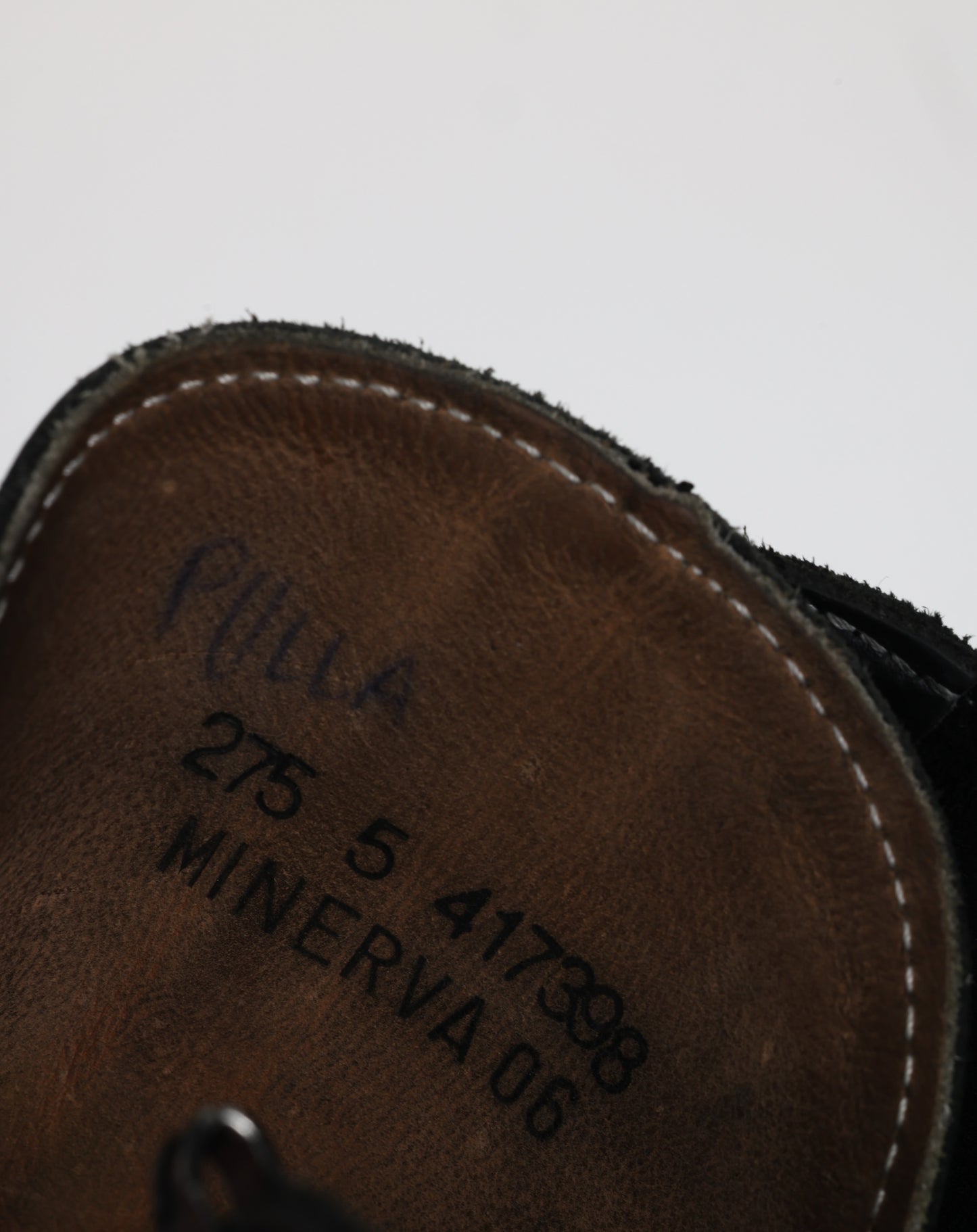
MINERVA 06
High-Quarter Patrol Boot with Speed-Lace Hardware
High-Quarter Patrol Boot with Speed-Lace Hardware
Couldn't load pickup availability
~ EU 42.5, US 9.5
Measurements (cm):
insole: 27.5
SKU: 900940
The tongue stamp reading “MINERVA 06,” accompanied by the numerical coding “275 5 417398,” strongly suggests a military or government-contract production designation rather than a luxury footwear model name. The coding structure closely resembles sizing and procurement identification systems commonly encountered within European military supply chains, immediately positioning the boot within a framework of institutional acquisition rather than commercial fashion manufacture. From its visible construction language, the boot appears firmly rooted in Central European military footwear traditions, drawing heavily from Scandinavian and Germanic service-boot engineering and reflecting procurement specifications characteristic of late twentieth-century military contracts. Unlike luxury manufacturers, who typically develop footwear from silhouette and aesthetic considerations outward, military boot designers begin with performance requirements and engineer solutions inward. Consequently, the governing priorities evident throughout this design are operational durability, rapid field maintenance, waterproofing potential, ankle stabilization, and manufacturing efficiency. The resulting aesthetic is unapologetically utilitarian, with every visible feature subordinated to function.
Although the absence of visible branding prevents precise attribution, the boot clearly follows a lineage established by German Bundeswehr combat footwear, Austrian military mountain boots, Scandinavian defense-force service boots, and Eastern European military contract manufacturers. The underlying influence derives from post-Second World War military footwear engineering, a period during which military designers progressively abandoned hobnailed leather-soled boots in favor of molded rubber unit soles, speed-lacing systems, improved ankle support structures, and reduced maintenance requirements. As such, the design reflects practical military evolution rather than fashion-led development, embodying decades of iterative refinement driven by operational necessity.
From a classification standpoint, the boot is best categorized as a high-quarter combat boot, more specifically occupying the overlapping categories of service boot, field boot, garrison boot, and light combat boot. It bears no meaningful relationship to dress boots, Balmoral boots, Jodhpur boots, or officer’s dress boots. Its design intent is unmistakably purpose-built for military service, security work, patrol operations, and field deployment. The plain-toe construction and uniform black finish further indicate compatibility with military uniform regulations, reinforcing its institutional rather than civilian origins.
The upper leather exhibits characteristics most consistent with corrected-grain chrome-tanned bovine leather. Several indicators support this conclusion, including highly uniform pigmentation, consistent black coloration, moderate pebbling, controlled surface texture, and limited natural grain variation. The leather appears to fall within an estimated thickness range of approximately 2.0–2.4 mm and displays a medium temper coupled with a semi-aniline or pigmented finish. The observed creasing pattern suggests a functional military-grade hide possessing good tensile strength and moderate fiber density. It does not exhibit the qualities associated with premium box calf, shell cordovan, or vegetable-tanned heritage leathers. Instead, the material selection clearly prioritizes durability, moisture resistance, and predictable field performance over luxury characteristics or artisanal appeal.
The last employed is highly utilitarian and ergonomically driven. The toe geometry consists of a rounded service toe characterized by substantial vertical volume, generous forefoot allowance, and pronounced toe spring, with no attempt made to achieve elegant tapering or aesthetic sleekness. The instep appears moderately high, providing accommodation for thick military socks and the foot swelling commonly experienced during prolonged activity. The heel seat is notably wide and stable. From an orthopedic perspective, this configuration offers several advantages, including reduced digital compression, lower risk of neuroma development, and improved circulation during extended wear. The principal compromise is somewhat less precise forefoot control than would be expected from a mountain-specific technical last. Overall, the ergonomic profile prioritizes endurance, comfort under load, and long-duration wearability rather than precision foot placement.
Indicators of cemented unit-sole construction include the absence of a welt, the absence of visible sole stitching, the presence of a thick molded sole perimeter, and economic characteristics consistent with military procurement requirements. The likely manufacturing sequence involved lasting the upper, attaching a lasting board, applying adhesive, and bonding a rubber sole unit under pressure. This method offers lower production costs, enhanced waterproofing characteristics, and reduced maintenance requirements relative to more traditional constructions. However, it also introduces limitations, most notably reduced rebuildability and restricted resoling options when compared with Goodyear welt construction.
The outsole architecture appears to consist of a molded rubber unit sole manufactured from either nitrile rubber, a carbon-rubber blend, or a comparable military-grade synthetic compound. The visible lug geometry around the perimeter suggests a traction pattern optimized for mud, loose gravel, and urban pavement, reflecting the diverse terrain demands placed upon military service footwear. The heel is integrated directly into the sole unit rather than constructed separately, eliminating stacked leather, nailed assembly, or traditional built-up heel construction. From an orthopedic perspective, this integrated configuration promotes superior shock attenuation, facilitates a more uniform gait transition, and reduces impact loading throughout the stride cycle.
Interior visibility remains limited, preventing definitive evaluation of the insole and lining package. Nevertheless, the visible brown leather backing on the tongue suggests a leather-lined tongue section incorporating split-leather interior components. A probable configuration would include a fiberboard lasting base, a removable service insole, and either leather or synthetic lining materials. Military procurement contracts frequently combine leather contact surfaces with synthetic reinforcement zones in order to balance durability, comfort, and production cost, making such a configuration entirely consistent with the observed evidence.
The stitching quality appears industrial rather than artisanal, yet entirely competent within its intended application. Stitch density is estimated at approximately 6–8 stitches per inch, an appropriate specification for heavy military leather. Stitch consistency appears good throughout, with no obvious skipped stitches, tension imbalances, or seam misalignment visible. The thread is likely bonded nylon selected for abrasion resistance and moisture resistance rather than luxury aesthetics, reflecting the practical priorities of military footwear engineering.
The pattern architecture is notably functional. The upper appears to incorporate a single-piece vamp, extended quarter sections, a rear seam assembly, and separate facing reinforcements. This arrangement reduces potential water-ingress points while minimizing stress concentrations throughout the upper structure. The diagonal quarter seam visible near the ankle likely serves a shaping function, improving fit around the malleoli while avoiding unnecessary panel complexity and preserving manufacturing efficiency.
The toe structure exhibits evidence of substantial reinforcement. The most probable internal components are either a thermoplastic toe puff or Celastic reinforcement, both of which would explain the boot’s ability to maintain volume despite wear while resisting collapse and preserving protective functionality. The rounded profile further suggests that impact resistance and durability were prioritized over visual refinement.
One of the strongest engineering features of the boot is its closure system. The lacing architecture employs a hybrid configuration consisting of D-ring hardware through the lower section and speed hooks through the upper section. This arrangement provides rapid donning and doffing, facilitates precise tension adjustment, and improves ankle lockdown during movement. The hardware itself appears to consist of blackened steel secured through riveted mounting, an entirely appropriate specification for military service conditions where durability and reliability outweigh aesthetic concerns.
The finishing regime is equally utilitarian. There is no evidence of decorative patination, antiquing, museum finishing, burnishing, or any comparable luxury treatment. Instead, the leather appears to receive a uniform black pigment and a utility-grade topcoat specifically designed to permit routine field polishing and straightforward maintenance. Visible wear patterns indicate repeated use and flexing, further reinforcing the boot’s functional history.
Decorative elements are effectively absent. The visual language is defined solely by structural seams, functional hardware, and purposeful shaping. This restraint aligns perfectly with military procurement philosophy, in which every component must justify its existence through measurable utility. Nothing visible appears superfluous or stylistically motivated.
The heel cup and collar assembly appear heavily structured. Observable characteristics include a high rear counter, deep heel containment, and extended collar height. Orthopedically, such a configuration should provide excellent rearfoot control, reduce heel slip, and enhance ankle stability during prolonged walking and load-bearing activity. Direct assessment of arch support remains impossible without interior inspection; however, several indicators suggest the presence of either a steel shank or composite shank, a dedicated midfoot stabilizer, and moderate longitudinal rigidity. Military boots of this type typically require substantial load-bearing support and resistance to torsional collapse, making these features highly probable. Expected performance would therefore be well suited to prolonged standing, marching, and sustained operational use.
The strongest historical indicators place production between the late 1990s and the mid-2000s. Supporting evidence includes the speed-hook configuration, cemented unit sole construction, all-leather upper architecture, hardware specification, and tongue-stamping style. The “MINERVA 06” marking may plausibly indicate either a 2006 production date or a 2006 procurement specification, both of which remain consistent with the visual evidence. Historically, the boot occupies an important transitional position between the traditional all-leather combat boots of the 1970s and 1980s and the increasingly nylon- and composite-intensive tactical footwear systems that became prevalent during the 2010s.
At a conceptual level, the design emerges directly from military engineering doctrine. Its defining principles are reliability, repairability, manufacturing efficiency, and environmental resilience. Aesthetically, it belongs to the traditions of functional modernism, industrial minimalism, and military pragmatism rather than civilian fashion culture. Yet despite its purely utilitarian origins, the silhouette intersects intriguingly with several contemporary fashion movements, including military-surplus revivalism, brutalist footwear design, utility-core aesthetics, post-Rick Owens combat-boot silhouettes, and broader contemporary workwear trends. The oversized rounded toe and substantial sole volume would not appear out of place within modern avant-garde collections. Nevertheless, this remains an authentic functional military boot rather than a fashion reinterpretation of one.
From a technical standpoint, the boot demonstrates competent industrial shoemaking and mature engineering execution. The upper construction merits a score of 7.5/10, pattern engineering 8/10, leather quality 7/10, hardware selection 8/10, ergonomic function 8.5/10, refinement 4/10, and military utility 8.5/10. Its principal strengths include excellent structural integrity, practical lacing architecture, durable leather selection, stable last geometry, high ankle support, and an unmistakably service-oriented design philosophy. Its weaknesses stem primarily from the limitations of cemented construction, which restrict rebuildability and resoling potential, the use of leather that is functional rather than premium in character, a comparatively heavy overall profile, and reduced breathability relative to modern tactical systems.
Taken as a whole, the evidence strongly suggests a European military-contract combat or service boot produced during the early-to-mid 2000s, likely close to the 2006 period referenced by the tongue marking. It combines durable chrome-tanned leather construction, an ergonomically sensible service last, robust hardware specification, and a resilient rubber unit sole into a coherent system optimized for military use. While it lacks the refinement, material sophistication, and rebuildability associated with premium Goodyear-welted footwear, it performs exceptionally well within its intended category and stands as a mature example of transitional military boot engineering, bridging the gap between traditional leather combat boots and the modern tactical footwear systems that would later dominate military procurement.
Share