Erzgebirge Workshop (Saxony)
Soldier Nutcracker, Composite Lever Construction with Felt Hat, GDR-era
Soldier Nutcracker, Composite Lever Construction with Felt Hat, GDR-era
Couldn't load pickup availability
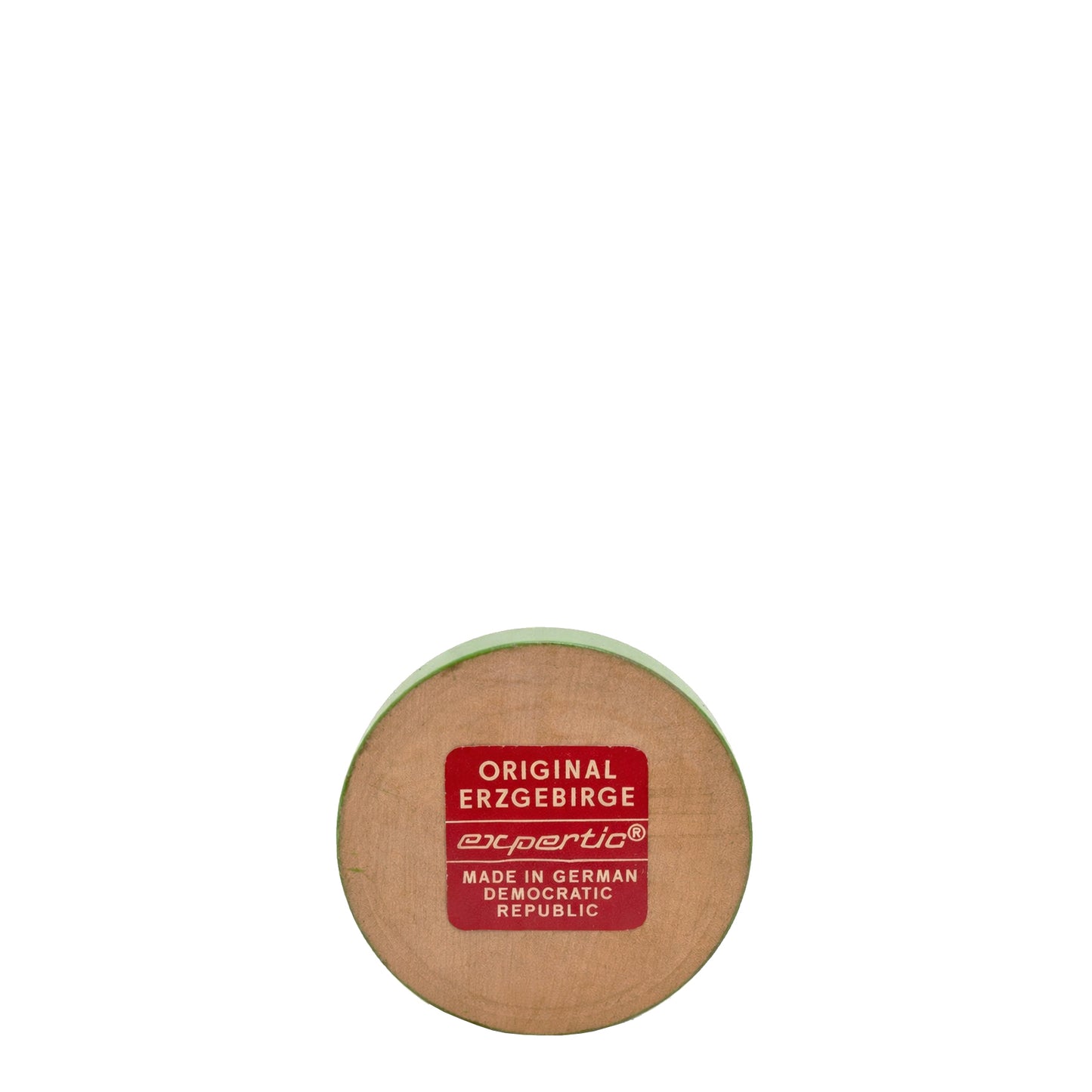
Wooden nutcracker figure representing a uniformed soldier, produced in the Erzgebirge region during the German Democratic Republic period, identified by the base label reading Original Erzgebirge expertic Made in German Democratic Republic. Constructed from multiple turned and block-carved hardwood elements organized around a traditional rear-lever jaw mechanism. Surfaces are finished in opaque polychrome lacquer with applied felt hat brim, synthetic hair, and feather ornament. Accessory knife and shoulder elements are attached components rather than carved integrally. The figure conforms to standardized late GDR export production models emphasizing recognizable costume over carving depth.
I. Timber Species & Material Integrity
Primary structural components are consistent with beech, the customary hardwood used in Erzgebirge nutcracker production for its uniform diffuse-porous grain and predictable dimensional behavior. Turned legs and cylindrical arms display straight grain orientation aligned with vertical load paths, minimizing cross-grain stress. The torso block is cut from stable stock with limited figure, selected for structural consistency rather than visual character. The circular base is solid, face-grain oriented, and free from cupping. Minor joint lines at limb insertions reflect seasonal compression at adhesive interfaces rather than structural cracking. No open splits or active checking are evident. Overall material integrity remains stable.
II. Carving Method & Tool Evidence
Production method is hybrid. Legs, arms, hat cone, and base are lathe-turned with repeatable symmetry indicative of batch manufacture. The head and torso are block-shaped and refined with controlled planar cuts; facial geometry is largely defined by paint rather than sculptural modeling. The nose is separately formed and affixed. Jaw aperture is cut cleanly to accommodate the mechanical mouth, with minimal undercutting. Surface preparation beneath lacquer suggests sanding to uniform smoothness rather than retention of visible gouge texture. Tool evidence supports workshop standardization rather than individual hand-carved variation.
III. Structural Engineering & Joinery
The figure is composite. Legs are tenoned into the lower torso assembly, which houses the vertical rear lever. The lever actuates the lower jaw through an internal pivot dowel, consistent with traditional Erzgebirge nutcracker engineering. Arms are cylindrical turnings inserted into shoulder mortises and secured with adhesive and dowel reinforcement. The head is mounted onto the torso via central dowel joinery. Shoulder epaulettes, knife accessory, and hat elements are separate pieces affixed after finishing. Joinery prioritizes mechanical function and efficient assembly. No later reinforcement or structural alteration is evident.
IV. Surface Treatment & Finish Stratigraphy
Surface finish consists of opaque lacquer applied over a primed ground. Brown, red, grey, and black areas are sharply delineated with consistent gloss, indicating original spray application rather than later overcoating. Facial features are stencil-assisted for eyes and teeth, with hand-applied moustache and cheek detailing. The red paint at the shoulder epaulettes exhibits localized abrasion exposing the lighter ground beneath, consistent with handling wear rather than repainting. The felt hat brim and synthetic hair are original applied materials. No evidence of refinishing, reglossing, or mismatched sheen is present.
V. Iconography or Formal Language
The subject represents a stylized soldier or guardsman, identifiable by epaulettes, conical hat with feather accent, and side knife accessory. Proportions adhere to established nutcracker typology: enlarged head, cylindrical limbs, compact torso, and pronounced jaw. The expression follows the conventional format of arched brows, exposed teeth, and moustache. Costume elements are simplified and graphic rather than naturalistic. Carving complexity remains moderate, with emphasis placed on painted uniform coding rather than deep sculptural articulation.
VI. Production Context & Market Position
The base label situates production within the GDR period prior to 1990, under cooperative or state-organized workshop structures using the expertic export mark. Manufacture involved segmented labor processes including turning, carving, painting, assembly, and application of textile elements. Figures of this type were produced in moderate to high quantities for seasonal decorative markets and export distribution. The object reflects continuity of 19th-century Erzgebirge nutcracker tradition under industrialized socialist production. Market positioning was decorative and symbolic rather than utilitarian.
VII. Preservation State & Intervention Evidence
Structural elements remain intact with no visible joint separation. The jaw mechanism alignment appears even, suggesting minimal internal wear. Surface abrasion is localized, particularly at red shoulder paint, and consistent with age-related handling. No filler, epoxy, or dowel repairs are evident at limb or base junctions. Felt brim and synthetic hair remain secure without evidence of replacement. Label on base remains adhered and legible, with minor edge wear appropriate to age. Condition supports classification as very good used, with stable aging and no structural compromise.
VIII. Market Standing & Value Estimation
Comparable GDR-era Erzgebirge soldier nutcrackers of similar scale and condition typically realize between 280 and 350 EUR in current secondary markets. Presence of original export label and intact textile elements supports valuation toward the upper portion of that range. Liquidity is moderate within seasonal decorative markets and among collectors of East German folk production. Replacement cost for newly manufactured Erzgebirge equivalents may exceed resale value due to contemporary labor costs, though historical examples remain governed by decorative demand and condition rather than rarity. Value is determined by preservation, label retention, and typological clarity.
Share