Bang & Olufsen (Denmark)
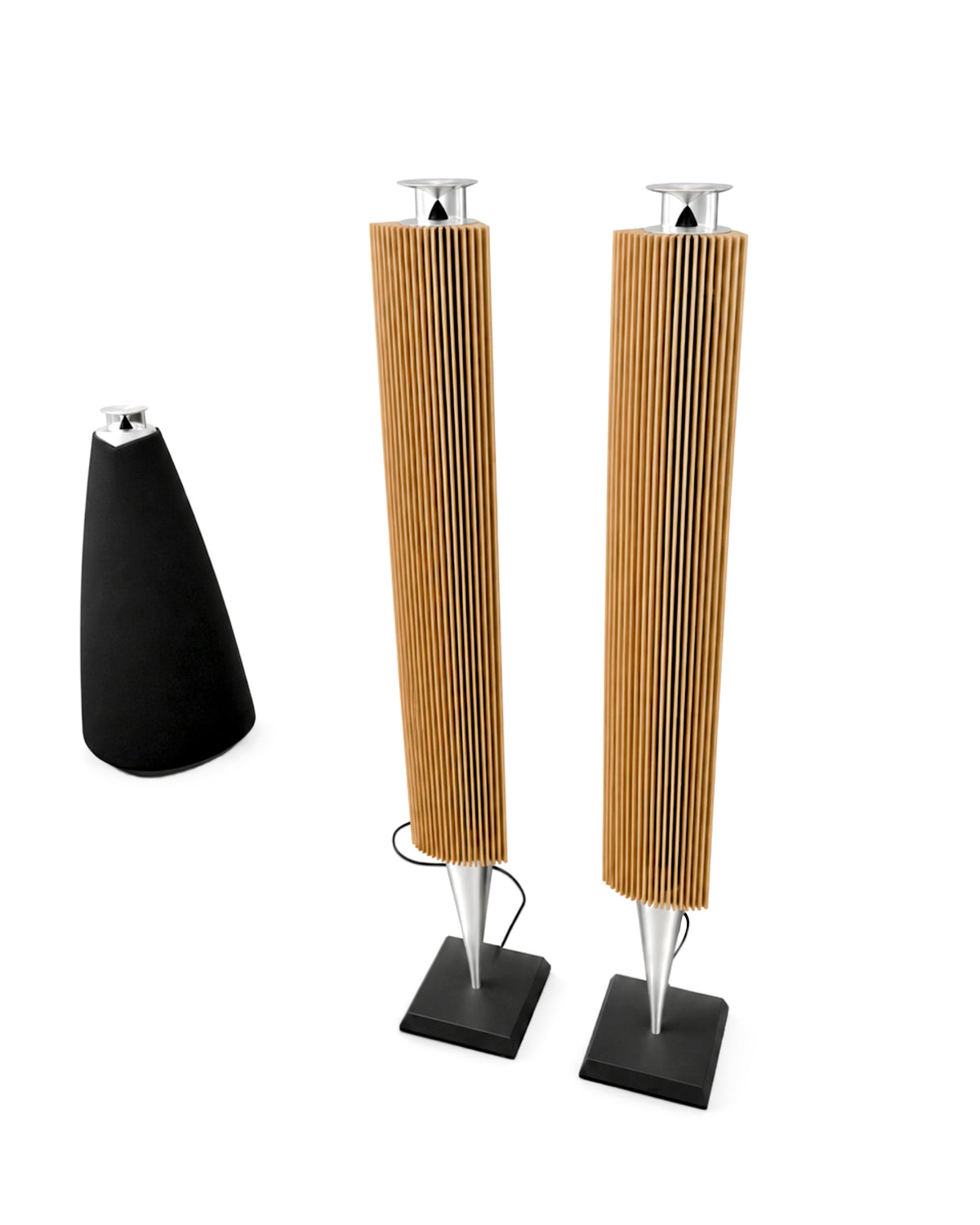
2013 or later, Bang & Olufsen Aluminium Beolab 18 Speaker Pair with Wood Slats
2013 or later, Bang & Olufsen Aluminium Beolab 18 Speaker Pair with Wood Slats
Couldn't load pickup availability
This is a pair of Bang & Olufsen Beolab 18 active floorstanding loudspeakers, dated 2013 or later on the evidence of the model’s introduction. Designed by Torsten Valeur at David Lewis Designers, the model combines integral amplification with wooden lamella fronts, exposed acoustic-lens crowns and tapered aluminium bodies. Its architecture places amplification within each column while leaving source selection and listening-level control elsewhere in the system. The wooden fronts give the equipment a furnishing character, while the exposed metal crowns make acoustic direction a visible part of its identity. The pair records the integration of domestic audio engineering, material contrast and a slender column form within an early twenty-first-century listening system.
Designer / Manufacturer – Device Type – Hardware / Construction Note
Industrial design: Torsten Valeur, David Lewis Designers; brand and documented manufacturer: Bang & Olufsen – Pair of Beolab 18 active floorstanding loudspeakers – Wooden lamella fronts, exposed acoustic-lens assemblies and tapered aluminium bodies on square bases; hardware revision unresolved
Dimensions and Mass
No unit dimensions or mass recorded. Published model dimensions for each floorstanding assembly are width 200 mm, height 1324 mm and depth 200 mm. The published mass of 9.2 kg per speaker excludes the base or wall bracket and therefore does not establish the mass of the complete floorstanding configuration present here. An earlier specification gives 8.5 kg without an equivalent configuration statement; that discrepancy remains unresolved.
Direct Inch Conversion
The published floorstanding dimensions convert directly at 25.4 mm per inch to width approximately 7.87 inches, height 52.13 inches and depth 7.87 inches per assembly. These are conversions of model specifications, not measurements of this pair.
Hardware Specifications & Compatibility Profile
The pair is identifiable as Beolab 18; regional type, production revision and installed firmware are unresolved. The documented model architecture comprises one nominal ¾-inch tweeter and two nominal 4-inch woofers per speaker, with separate Class D amplifier channels specified as 160 W for the tweeter and 160 W for the woofer section. These are manufacturer amplifier specifications without accompanying load or distortion conditions, rather than measured output or mains consumption. The published frequency range is 39–23,500 Hz without a stated response tolerance. The model’s documented supply requirement is 100–240 V AC, 50/60 Hz; the individual electrical labels remain unrecorded.
Beolab Transmitter 1 is a documented wireless counterpart. Operation requires the transmitter’s source connection, speaker association, wireless role selection and separate mains power for each speaker. Wired operation is documented through Power Link, optical or line connections, with listening-level regulation upstream. Compatibility of this particular pair remains untested.
I. Maker Identity, Model Attribution & Provenance
The combination of acoustic-lens assemblies, wooden fronts, curved lower bodies and square bases supports identification as Bang & Olufsen Beolab 18. Bang & Olufsen is the documented manufacturer, with its responsible company address in Struer, Denmark. That address establishes the manufacturer’s administrative location; the assembly factory of either speaker remains unresolved. No separate assembler, distributor or retailer is documented for the pair.
Serial numbers, regional type codes, purchase history and service records are unrecorded. The speakers form a visually matching set, but their original sale together and any subsequent replacement of fronts, electronics or stands remain unresolved.
II. Product History, Market Position & Industry Context
Introduced in 2013 alongside Beolab 17 and Beolab 19, Beolab 18 placed the slender domestic loudspeaker within a coordinated wireless-audio offering. Wireless reception reduced signal-cable requirements while retaining mains-powered amplification at each speaker. Each column could therefore operate as an independently powered endpoint within a larger listening system.
The model accommodated both floor and wall mounting. Separate mounting arrangements allowed the narrow acoustic body to serve different room layouts without requiring a different primary enclosure. This pair preserves the floorstanding configuration, in which the square base and tapered support become prominent parts of the composition.
III. Device Classification & Design Intent
The primary classification is an active floorstanding loudspeaker pair. Integral amplification distinguishes the model from a passive tower requiring an external loudspeaker-level amplifier. Its role as a receiving loudspeaker leaves programme selection and listening-level control to connected equipment. Stereo and wireless surround configurations are documented model uses; neither deployment is established for this pair.
The design addresses two linked problems: accommodating an amplified acoustic system in a narrow enclosure and giving that enclosure a deliberate presence within furnished space. Its height establishes a listening-room object, while its restricted width limits the frontal area occupied by equipment. The paired arrangement permits spatial separation without a continuous cabinet joining the speakers.
IV. Construction Methodology & Engineering
The exterior separates into a lamella-covered upper body, exposed lens crown, reflective tapered lower section and flat square base. The wooden blades create repeated openings rather than a continuous opaque front. Their arrangement mediates between the enclosed transducers and the room while concealing most of the machinery.
The documented aluminium-tube construction combines a continuous body with a separately articulated front assembly. The wood introduces a furniture-like surface within an otherwise metallic structure. Exact alloy, wood coating, joinery and manufacturing tolerances are unresolved for the individual examples.
V. Technical Design Elements & Interfaces
The exposed upper assembly is the model’s Acoustic Lens Technology feature. Its documented purpose is to distribute upper frequencies through a 180-degree horizontal field. The lens makes a sound-directing component visible above the enclosure, giving acoustic function a distinct position within the silhouette. That coverage describes the model’s intended performance; no radiation pattern has been measured for these speakers.
The documented connections include two RJ45 Power Link sockets, RCA line inputs and optical input/output. RJ45 identifies connector geometry here; its assigned function is Power Link. Published optical specifications list PCM input at 32, 44.1, 48 and 96 kHz with 16–24-bit words, and output at 48 kHz/24-bit. The installed connection panels, connector condition and successful operation of these interfaces remain unrecorded.
VI. Nomenclature & Product Lineage
“Column” describes the slender enclosure; “floorstanding” identifies its present support arrangement; “active” identifies the model’s integral amplification. “Lamellas” denotes the repeated front blades. Their wooden appearance does not independently establish species or originality.
The closest documented lineage is Beolab 8000. Beolab 18 was commissioned as a reinterpretation of that earlier speaker, retaining the aluminium-column concept while incorporating an acoustic lens, digital signal processing and wireless connectivity. The continuity lies in the narrow standing body. The exposed crown and fanned front change how the enclosure presents its acoustic work and material construction.
VII. Materials & Component Technology
The fronts display wood grain, warm brown coloration and narrow exposed edges. Their appearance is consistent with the documented natural-aluminium-and-oak configuration, but oak remains a probable identification for this pair. Exact species, surface treatment and replacement history are unresolved. The metallic bodies agree with the model’s documented aluminium construction without establishing a particular alloy or finishing sequence.
The material contrast has structural clarity. Repeated thin blades define the front, continuous curved surfaces define the body, and black bases provide a visually quieter footing. The composition of the individual bases is unverified.
The model’s two-way architecture assigns the tweeter and woofer section separate amplifier channels. This allows the amplification and signal processing to be coordinated with the installed transducers as a complete system. The condition and originality of those components remain unresolved for the pair.
VIII. Chassis, Board Layout & System Architecture
The documented service architecture distinguishes digital and analogue connector boards, power supply, digital sound engine, amplifier, wireless receiver, indicator and driver-temperature sensing modules. These establish a modular electronic system within the acoustic column. The pair’s installed boards, regional type and hardware revisions remain unidentified.
The enclosure accommodates both transducer volume and powered electronics. Its narrow package brings acoustic, electrical and mechanical requirements into a restricted cross-section. Exact cable routes, board population, damping condition and previous internal interventions remain unrecorded.
IX. Structural Integrity & Failure Mechanisms
The standing configuration places the column’s load through the narrowed lower support into the square base. The support-to-base connection is consequently important to stability, while the slender front blades are exposed to local handling forces. These are structural observations rather than findings of looseness or damage.
No confirmed fracture, detached blade or grossly displaced assembly is established. Fastener security, internal corrosion, driver suspension condition and electrical insulation remain unresolved. Reflections across the metal cannot establish surface cracking or fatigue, and an apparently complete exterior cannot establish functional condition.
X. Enclosure Finishing, Fastening & Service Access
The largely uninterrupted exterior conceals a staged service hierarchy. The documented procedure separates front components, base retention, screwed baffle and internal chassis, with a special tool specified for the base nut. The slim appearance therefore coexists with mechanical access through successive assemblies.
No disassembly or fastener condition is recorded for this pair. The originality of seals, integrity of internal connections and condition of concealed mounting points remain unresolved. No ingress rating is assigned.
XI. Manufacture, Assembly Tolerances & Service Ecosystem
Consistent blade spacing and alignment of the crown with the column are visually consequential. Irregularity would interrupt the front’s rhythm and the apparent continuity of the body. No numerical manufacturing tolerance or measured deviation is recorded.
The documented service system used module exchange, with defective assemblies returned for repair. Driver replacement required calibration, and affected seals required checking after disassembly. Repairability therefore depended on replacement assemblies and technical procedures beyond exterior fit. Present availability of exact replacement parts and service tools remains unresolved.
XII. Cultural Framing & Use Environments
The pair belongs to domestic listening equipment whose placement affects both sound and room composition. The model’s free, wall and corner settings acknowledge room boundaries as operating variables. The pair’s actual settings and listening arrangement remain unrecorded.
Separate columns allow the system to occupy two positions without a continuous equipment cabinet between them. Their wooden fronts give that separation a furnishing character, while the exposed metal crowns retain a conspicuously technical identity. The design makes room integration part of the equipment’s physical organization.
XIII. Industrial Design & Visual Composition
At whole-object scale, each speaker is organized as a tall, narrow shaft above a sharply diminishing support. The square base establishes a horizontal footing against which the vertical enclosure appears lighter. The crown terminates the ascent with a projecting disc, producing a clear sequence of base, taper, column and cap.
At closer range, the front breaks into alternating wooden edges and dark recesses. The blades turn around the enclosure, so apparent spacing and depth change across its width. Their repeated vertical lines elongate the body, while the circular lens plates introduce the principal horizontal interruption. Reflective metal registers the surrounding room; the wood supplies a more stable field of colour and texture.
The historically specific comparison is the Beolab 8000 design program. Beolab 18 develops that column silhouette through a more articulated front and exposed acoustic crown. Its documented design concept also uses brass-instrument analogies, associating the lower cone with a mouthpiece and the crown with a bell. These are compositional references rather than descriptions of the loudspeaker’s operating principle.
Within domestic use, the resulting hierarchy directs attention toward the visible lens while concealing most transducers behind a furnishing surface. Technical identity resides in the exposed metal assembly; domestic accommodation resides in the wooden rhythm and small footprint. The pair presents powered sound equipment as two slender room elements whose appearance makes selected aspects of acoustic function legible.
XIV. Dating & Historical Placement
The strongest chronological evidence concerns the model. Its conformity declaration was signed on 8 October 2013, and its public introduction followed that month. These events establish regulatory documentation and market introduction respectively. Neither dates the manufacture of the individual speakers.
Without serials, dated purchase evidence or verified production markings, a narrower manufacturing interval is unsupported. The pair’s historical significance lies in its embodiment of the column loudspeaker as an amplified, potentially wireless domestic endpoint, with acoustic direction and material finish integrated into its visible form. The catalogue date is a model-based earliest bound for possible unit manufacture: 2013 or later.
XV. Operation, Compatibility & Preservation
The documented operating arrangement requires a volume-controlled source, an appropriate signal connection and mains supply to each speaker. Wired operation uses left/right role selection; wireless operation uses the wireless role setting and association with a compatible transmitter. Optical connection follows the documented daisy-chain arrangement. The SERVICE socket is reserved for servicing. No source, transmitter, cable configuration or operating result is recorded for this pair.
Streaming functions associated with an added Beoconnect Core should not be assigned as native capabilities of the columns. The installed firmware remains unresolved. A documented update procedure uses Beolab Transmitter 1, but no successful update or installed software version is established for either speaker.
Preservation should retain blade alignment, original finishes and the relationship between removable fronts and enclosure. Wood can change colour and form over time. The documented care regime uses a soft dry cloth and low-suction brush cleaning, excludes alcohol and solvents, and directs lifting through the aluminium rear body. The intended configuration remains a separately powered speaker pair receiving a regulated audio signal; functional condition, individual electrical ratings and compatibility with a proposed installation remain unverified.
Share