(West Germany)
80s, Grid-Triangle Motif, Kandinsky, Early Computing
80s, Grid-Triangle Motif, Kandinsky, Early Computing
Couldn't load pickup availability
A wearable artifact of postmodern European design—this sweater merges abstract visual language with accessible commercial knitwear.
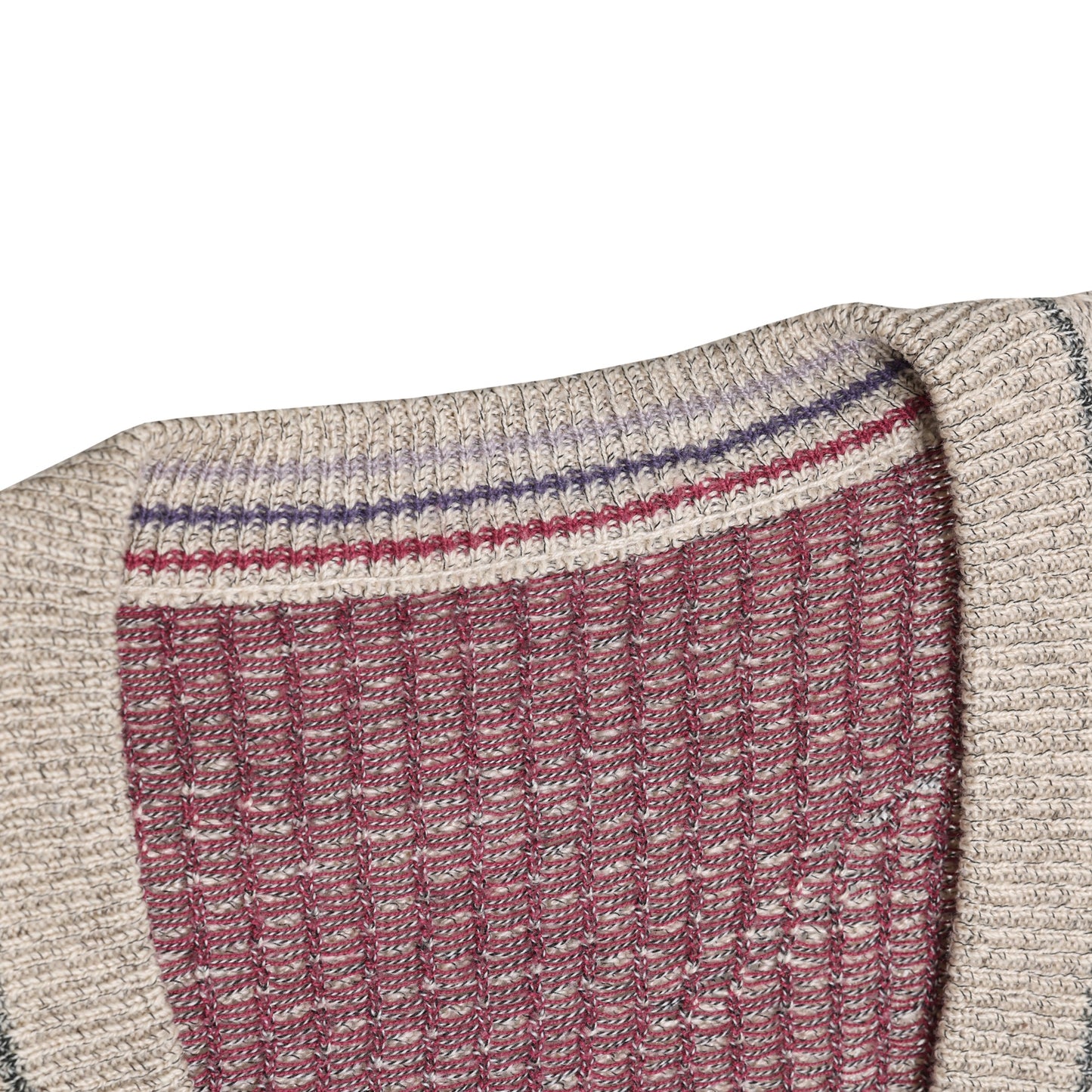
The V-neck jacquard knit sweater, likely produced between the late 1980s and early 1990s, reflects the convergence of mass-market accessibility and sophisticated visual abstraction that defined European knitwear during the postmodern design era. Though absent of a brand label, its construction, motif complexity, and fiber behavior align it with the output of West German or adjacent European knitwear mills—facilities that, by this period, had achieved industrial mastery of double-bed flat knitting and graphical jacquard programming, supplying both domestic retailers and international catalog operations such as Quelle and Otto. The sweater belongs to a generation of knitwear that translated modernist visual vocabularies into commercial apparel. Within its medium-gauge (approx. 7 GG) construction lies a high-precision jacquard motif composed of diagonally aligned triangle forms nested within grid-like overlays—executed through a two- or three-carrier intarsia-style technique. This level of pattern registration implies advanced mechanical programming, likely via punch-card or early digital jacquard systems, and marks the garment as a product of mills experienced in balancing graphic clarity with production efficiency. The reverse exhibits controlled yarn floats and no tension distortion, signaling both thoughtful float management and meticulous gauge calibration. Constructed as a casual layering piece, the sweater’s silhouette adheres to late 1980s knitwear conventions: a boxy, drop-shoulder fit with moderate volume through the torso and sleeves. The body panels are rectangular, joined with minimal shaping save for sleeve tapering and a slightly contoured V-neck. Sleeves are set in at the shoulder drop, tapering into fully ribbed cuffs that, along with the hem, feature tension-controlled 2x2 ribbing. A subtle contrast trim—executed via a tension-adjusted color transition—encircles the cuffs and hem, producing a graphic “outline” that subtly frames the base silhouette. The neckline band is neatly inset, rib-knit with a clean join at the apex of the V, reinforced at the interior with a contrast tuck-in rib—evidence of structural reinforcement designed to maintain neckline elasticity over time. The garment is fully fashioned, with shaped armholes and minimal seaming, assembled via overlocked joins and flatbed linking—a method that avoids bulky seam allowances and is consistent with industrial best practices of the period. At the underarm, the linked seams reveal no misalignment between panels, indicating careful pattern symmetry and stitch count matching. The neckline interior is bound with a yarn float finish that both softens the transition and guards against fraying—an example of thoughtful engineering despite the garment’s commercial positioning. Materially, the fiber composition is a blend of cotton, acrylic and polyester. The yarn is medium ply, high twist, producing a surface hand that is slightly dry with low pill formation and consistent loft. The acrylic content contributes to the garment’s dimensional color saturation and easy-care characteristics, while the natural fiber content introduces breathability and softness. The blend was standard across European knitwear in this era, prized for durability, dye receptivity, and cost-effectiveness in large-scale production. From a design perspective, the sweater articulates a postmodern visual logic. The motif—triangles intersected by linear grids—evokes early desktop digital aesthetics, yet retains references to 20th-century abstract art, specifically Bauhaus and Kandinsky’s geometries. This hybrid visual language aligns with the broader aesthetic climate of late-1980s knitwear, when emotional abstraction and non-representational patterning emerged as both artistic and commercial strategies. The chromatic decisions—beige/grey ground interrupted by muted purples and reds—are calculated to balance warmth and neutrality, eschewing bold contrast in favor of rhythmic harmony. Such color use reflects a European design sensibility of the time: understated but intentional, avoiding both visual clutter and chromatic banality. The garment’s construction logic favors volume and comfort over contouring. It is emblematic of hybrid home/street knitwear that could traverse informal domestic spaces and casual public settings. The emphasis is on textile communication—color, form, and motif—rather than tailored fit. This mode of knitwear became a staple in Western European wardrobes during the transition from analog to digital culture, offering wearers garments that felt tactile and expressive without being overtly trend-driven. Historically, this sweater is positioned squarely within the 1988–1993 window—a period marked by increasing integration of digital motifs into knit programming, the dominance of drop-shoulder silhouettes, and the continued rise of acrylic-blend yarns as durable, visually rich alternatives to pure wool. During this era, European mills were aggressively exporting to North America and Japan, with knitwear occupying a central place in catalog fashion and ready-to-wear distribution. Though not designer-led, pieces like this embodied the filtered influence of higher-concept brands such as Fiorucci, Esprit Europe, and early Benetton, making experimental knit graphics available to a broader consumer base. Today, the sweater holds clear value across multiple fashion domains. For vintage collectors and stylists, it offers a textbook example of postmodern knitwear architecture. For contemporary designers, it serves as a visual and technical reference—particularly relevant for those working in intarsia, colorwork, or textile abstraction (e.g., Missoni, AGR London, Marine Serre). Its motif discipline and material behavior can inform modern explorations of graphic knitwear, especially within collections rooted in digital nostalgia or retro-futurism. Within the resale market, its appeal lies not only in visual novelty but in construction integrity: the clean motif registration, resilient stitch work, and preserved elasticity all contribute to its continued wearability. In final evaluation, this V-neck jacquard pullover is a technically sound and aesthetically coherent artifact of late 20th-century European knitwear. It combines artistic intentionality with mass-market functionality, translating abstract visual forms into comfortable, durable apparel. Its medium gauge, controlled construction, and design alignment with postmodern visual language make it a viable candidate for editorial use, vintage resale (estimated at $75–$140 depending on condition), and archival study. It represents a moment when knitwear was not merely a medium for warmth, but a surface for cultural communication—engineered for softness, styled for modernity, and programmed with precision.
Measurements (cm):
Chest: 58
Length: 66
Shoulder: 46
Sleeve: 60
Size Conversion (approximate):
US Men’s Size: M
EU Men’s Size: 48
SKU: 015213
Share