G-Star (Netherlands)
2001–2005, Dutch Duck Cloth Carpenter with Sculpted Knee
2001–2005, Dutch Duck Cloth Carpenter with Sculpted Knee
Couldn't load pickup availability
~ EU 46–48, US 31
Waist (circumference x 2): 39
Outseam: 102
Inseam: 81
Opening: 24
SKU: 900932
This is an example of the G-Star Elwood 5620 trouser, one of the most influential exercises in three-dimensional industrial trouser drafting produced during the late 1990s and early 2000s. Constructed from a densely woven cotton duck cloth finished in a brown garment-dyed treatment, the piece translates workwear materials into an anatomically engineered silhouette. Its significance rests less in decoration than in pattern architecture, with the garment functioning as a study in panel manipulation, articulated mobility, and industrial pattern innovation. The construction combines conventional workwear durability with an unusually aggressive approach to leg shaping, producing a silhouette intended to conform to movement instead of remaining dependent upon flat drafting conventions. The surviving wash patterns and abrasion marks indicate genuine wear history, particularly at the knees, seat, and upper thigh stress zones.
I. Designer Origin & Brand Profile
G-Star emerged from the European denim sector during a period when workwear-derived garments were increasingly being reinterpreted through industrial design methodologies. The Elwood project became one of the firm’s defining products. While most denim manufacturers of the period concentrated on washes, distressing, or branding graphics, the Elwood program focused on altering the geometry of the garment itself.
The design philosophy centered upon anatomical adaptation. Traditional five-pocket jeans derive from remarkably conservative nineteenth-century drafting systems. The Elwood instead approached the leg as a moving structure requiring dedicated articulation zones. The resulting garment resembles industrial product design translated into apparel. One suspects the drafting table received considerably more attention than the mood board.
The design language consistently prioritized seam mapping, panel segmentation, and sculpted volume. Consequently, the garment’s identity resides in cut and construction more than branding.
II. Brand Heritage & Industry Influence
G-Star’s historical importance lies in its contribution to engineered denim and ergonomic trouser construction. During the late twentieth century, most commercial denim remained dependent upon variations of established American workwear templates. The Elwood introduced a visibly segmented leg architecture that influenced numerous subsequent manufacturers across both luxury and commercial sectors.
The garment occupies an important position within the evolution of technical casualwear. It demonstrated that pattern engineering itself could function as the primary design feature. Subsequent brands adopted articulated knees, rotated side seams, shaped inseams, and anatomical drafting systems that bear conceptual debt to the Elwood framework.
Its influence was particularly evident during the period when industrial design language migrated into mainstream menswear and utility-oriented fashion.
III. Garment Classification & Design Intent
The garment is best classified as an articulated utility trouser derived from workwear, military ergonomic principles, and denim construction traditions.
The intended function was everyday wear enhanced by increased mobility through engineered shaping. Unlike conventional work trousers designed primarily around durability, this example attempts to improve body movement through panel arrangement and pre-formed leg shaping.
The large angular pocket openings, segmented knee architecture, and diagonal panel transitions communicate a deliberate machine-age aesthetic. The garment was intended for active urban use while retaining visual references to industrial labor garments.
IV. Construction Methodology & Engineering
Construction relies predominantly upon lockstitch assembly with extensive topstitch reinforcement. Major seams appear double stitched with consistent spacing and industrial gauge thread selected to remain visually prominent against the dyed cloth.
The fly assembly follows conventional jean construction methodology. Riveted reinforcement appears at pocket stress points. Belt loops are bar-tacked at attachment zones, distributing strain generated by waistband tension.
The assembly sequence likely began with pocket construction, followed by segmented leg panel formation, fly installation, inseam and outseam joining, waistband application, and final topstitch operations.
The unusually large number of panels increases labor requirements relative to conventional five-pocket trousers. However, the pattern system creates the defining identity of the product and therefore justifies additional assembly complexity.
V. Technical Design Elements & Precision Detailing
The most notable feature is the angular panel segmentation extending across the upper thigh and knee region.
The diagonal upper leg seam interrupts conventional grain continuity and redirects visual emphasis toward movement zones. The articulated knee section introduces pre-shaped volume through curved seam geometry rather than through dart insertion.
Pocket openings depart from traditional Western jean configurations. Their extended diagonal placement integrates visually with surrounding seam architecture, producing a unified structural language.
Topstitch execution appears consistent and industrially controlled. Stitch length remains uniform across curved and straight sections, indicating competent factory execution and effective operator standardization.
VI. Style Nomenclature & Historical Evolution
This garment belongs within the lineage of articulated trousers, ergonomic utility pants, and engineered denim derivatives.
Historically, articulated leg construction developed first within military clothing, equestrian garments, protective workwear, and technical outdoor apparel. The Elwood adapted these concepts into fashion-oriented production.
Its closest relatives include motorcycle trousers, military combat trousers, and industrial uniforms incorporating movement-specific shaping. The distinction lies in the visibility of the engineering. Here the articulation becomes the aesthetic event.
The garment therefore occupies a hybrid category between workwear reproduction and industrial fashion design.
VII. Fabric Composition & Textile Engineering
The shell appears to be a dense cotton duck or canvas structure with substantial yarn size and a tightly packed plain-weave configuration.
Estimated fabric weight likely falls within approximately 350–450 GSM. The cloth exhibits moderate stiffness, strong abrasion resistance, and controlled drape characteristics. The surface reveals gradual abrasion at high-friction zones, producing tonal variation without catastrophic fiber breakdown.
The fabric demonstrates excellent dimensional stability and tensile performance. Recovery remains limited compared with elastic textiles, which explains the necessity for articulated shaping within the pattern itself.
The garment-dyed finish has produced uneven tonal development along seam ridges, pocket edges, and stress points. These localized shifts serve as a record of wear history and fabric response.
Pocketing fabric appears lighter and optimized for reduced bulk within the assembly.
VIII. Construction & Pattern Analysis
Pattern architecture represents the garment’s central achievement.
The front leg is divided into multiple shaped panels that redirect grain behavior around the knee. Instead of forcing a straight tube into movement, the pattern incorporates curvature before wear occurs.
The articulated knee section appears drafted with forward projection. This allows the garment to assume a naturally bent position when unworn, reducing strain during locomotion.
The side seam placement remains comparatively conventional, while the visual complexity is concentrated toward the front leg. This strategy balances manufacturing practicality against design ambition.
Pattern symmetry appears highly standardized, indicating industrial grading rather than individualized drafting.
IX. Structural Integrity & Panel Configuration
Structurally, the garment distributes stress efficiently through seam segmentation.
The knee area receives reinforcement not through additional layers but through geometric redistribution. Multiple intersecting seams diffuse tension generated during bending.
Pocket corners receive riveted support. Fly termination zones are reinforced through dense stitching concentrations. Belt-loop attachment points display bar-tack reinforcement suitable for repeated loading.
The waistband maintains dimensional stability through internal reinforcement. No evidence suggests excessive distortion despite visible wear history.
Stress management is particularly successful around the knee and upper thigh regions, where conventional trousers often experience premature strain.
X. Edge Finishing, Seam Termination & Closures
The hem treatment appears machine-folded and lockstitched with industrial consistency. Seam allowances are concealed and controlled.
Pocket edges are stabilized through topstitching and rivet placement. Fly edges demonstrate clean folding and predictable reinforcement.
The waistband assembly exhibits efficient industrial finishing with consistent stitch placement. Belt loops are inserted into the waistband seam and subsequently secured through bar-tack operations.
Closure hardware appears selected for durability rather than decorative emphasis. Metal components integrate effectively with the workwear vocabulary of the garment.
Because the garment lacks collar, lapel, and neckline elements, the structural attention normally allocated to those components is redirected toward waistband engineering, fly architecture, and articulation zones.
XI. Manufacturing Context, Production Scale & Industrial Feasibility
This garment was clearly intended for large-scale industrial production.
Despite the apparent complexity, the panel system was designed to remain repeatable through standardized cutting and assembly workflows. The increased seam count raises labor costs relative to conventional jeans, yet not beyond commercial feasibility.
Production efficiency benefits from repetitive seam operations and standardized topstitch programs. The complexity resides primarily within cutting and panel preparation rather than specialized tailoring techniques.
The garment represents a successful balance between industrial scalability and distinctive design identity. Many brands attempted visually technical garments during this period; fewer succeeded in making the engineering survive mass production.
XII. Conceptual Influence & Psychological Design Intent
The conceptual foundation derives from industrial ergonomics and mechanical anatomy.
The garment treats the body as an articulated system of joints and movement paths. Seams function almost as diagrammatic indicators of bodily mechanics.
The visual message communicates utility, movement, and engineered performance. Unlike traditional workwear, which tends to conceal its structural logic, this garment exposes it deliberately.
The wearer is invited to participate in a narrative of technical competence, whether or not any actual machinery is encountered during the day.
XIII. Artistic & Aesthetic Direction
The aesthetic direction aligns with industrial design modernism and late-twentieth-century technical fashion.
Visual interest emerges from seam trajectories, panel transitions, and volumetric shaping. Ornament is replaced by construction visibility.
The brown garment-dyed finish softens what could otherwise become an excessively mechanical composition. Abrasion patterns accumulated through wear further humanize the geometry.
The resulting object occupies a position between workwear, industrial product design, and engineered casualwear.
XIV. Historical Placement & Contextual Analysis
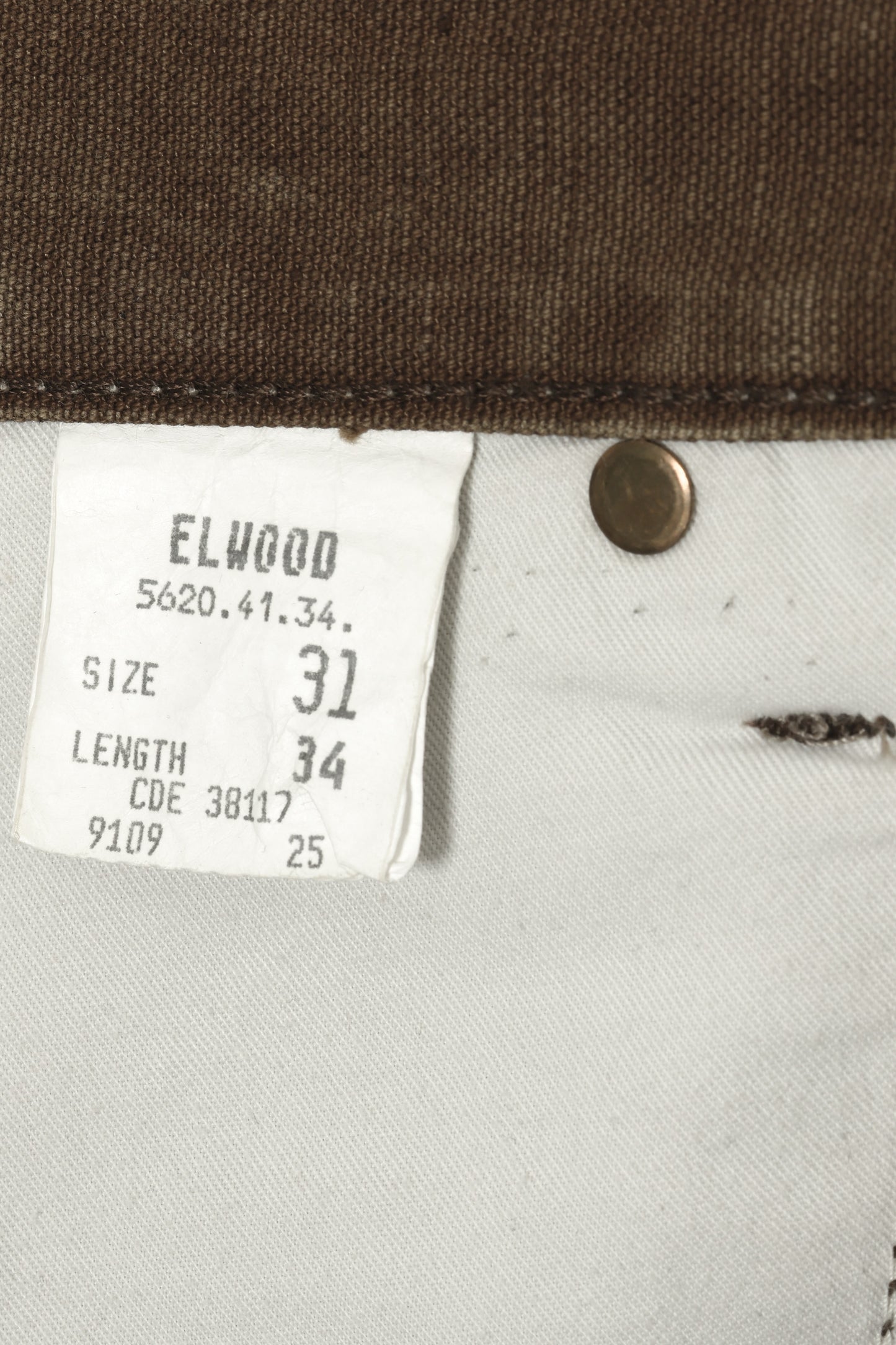
The garment most plausibly dates from the early 2000s, consistent with the G-Star Originals labeling system, Elwood 5620 designation, construction methodology, and finishing characteristics visible here.
The size ticket and production coding are consistent with industrial manufacturing practices of that period. The garment-dyed duck cloth and articulated panel system correspond closely with G-Star’s expansion of the Elwood concept beyond traditional denim fabrics.
Historically, the piece belongs to a moment when technical patternmaking became a commercial design strategy. The emphasis shifted from surface treatment toward engineered silhouette.
Within the broader history of trousers, the garment represents one of the more successful attempts to make pattern drafting itself the primary design language.
XV. Use Case
This trouser performs most effectively during prolonged movement through urban environments, workshop settings, travel, cycling-adjacent activity, and occupations involving frequent transitions between standing, walking, crouching, and seated positions.
Footwear selection is consequential. The relatively broad hem opening accommodates work boots, service shoes, and substantial leather footwear without disrupting balance. Slim minimalist footwear weakens the visual weight distribution established by the engineered leg.
Upper garments benefit from comparable structural conviction: chore coats, field jackets, industrial overshirts, and similarly robust outerwear.
Share