GE SPEKON (Germany)
1997, German Armed Forces Ripstop Quilted Barracks and Field Liner Jacket
1997, German Armed Forces Ripstop Quilted Barracks and Field Liner Jacket
Couldn't load pickup availability
~ EU 52–54, US XL
Measurements (cm):
shoulder to shoulder: 54
sleeve (shoulder to cuff): 61
chest (pit to pit): 66
length (collar to hem): 79
SKU: 900948
This garment is a military thermal liner jacket manufactured in 1997 under German government procurement specifications by GE SPEKON. The label includes contract references, dimensional coding, and a NATO Stock Number sequence, firmly placing the object within an institutional supply framework rather than civilian retail production. Constructed from a lightweight grid-structured shell enclosing insulating fill secured through engineered quilting, the garment functions as an intermediate thermal layer within a broader cold-weather clothing system. Rib-knit collar and cuff assemblies, a zip-front closure, and minimal external detailing indicate an emphasis on thermal efficiency, durability, and production economy. As an artifact, it represents the late twentieth-century shift toward modular military clothing systems in which warmth became distributed across interchangeable layers rather than concentrated in a single heavy outer garment.
I. Designer Origin & Brand Profile
GE SPEKON was not operating within a conventional fashion framework. The garment originates from a procurement environment where specification compliance, repeatability, and logistical compatibility supersede aesthetic authorship. The label designation, coding format, and NATO stock numbering identify a manufacturer participating in government contract production, where design authority is frequently shared among procurement agencies, military testing departments, and technical manufacturers.
The resulting garment reflects engineering priorities. There is no evidence of designer-led experimentation or commercial styling intervention. Every visible feature appears tied to a performance requirement. In such environments, success is measured by thermal retention, repair frequency, service life, and manufacturing consistency. Editorial praise would have carried considerably less weight than surviving repeated laundering cycles and warehouse storage.
II. Brand Heritage & Industry Influence
Manufacturers such as GE SPEKON occupied an important position within late twentieth-century European military production networks. Their work contributed to the evolution of layered clothing systems that replaced earlier heavy wool and field-cloth garments.
By the 1990s, military organizations increasingly embraced modularity. Rather than issuing a single all-purpose winter garment, forces adopted systems consisting of shell layers, insulation layers, moisture-management layers, and specialized weather protection components. Garments like this liner became central to that philosophy.
The influence of these systems later extended into civilian outdoor apparel, workwear, and technical sportswear. Contemporary quilted insulation jackets owe a significant debt to military development programs that prioritized thermal efficiency and weight reduction decades before such features became fashionable.
III. Garment Classification & Design Intent
This garment is best classified as a military thermal liner or intermediate insulation jacket. It functions as a standalone light-duty jacket but was almost certainly intended to integrate into a larger clothing system.
The generous chest measurement, relatively moderate sleeve length, and uncomplicated silhouette indicate accommodation of underlying garments. Its role is not weather protection in isolation but thermal augmentation within a layered ensemble.
The design intent prioritizes warmth retention, compressibility, ease of movement, and logistical standardization. Decorative content is effectively nonexistent. Even the quilting pattern serves engineering functions before visual ones.
IV. Construction Methodology & Engineering
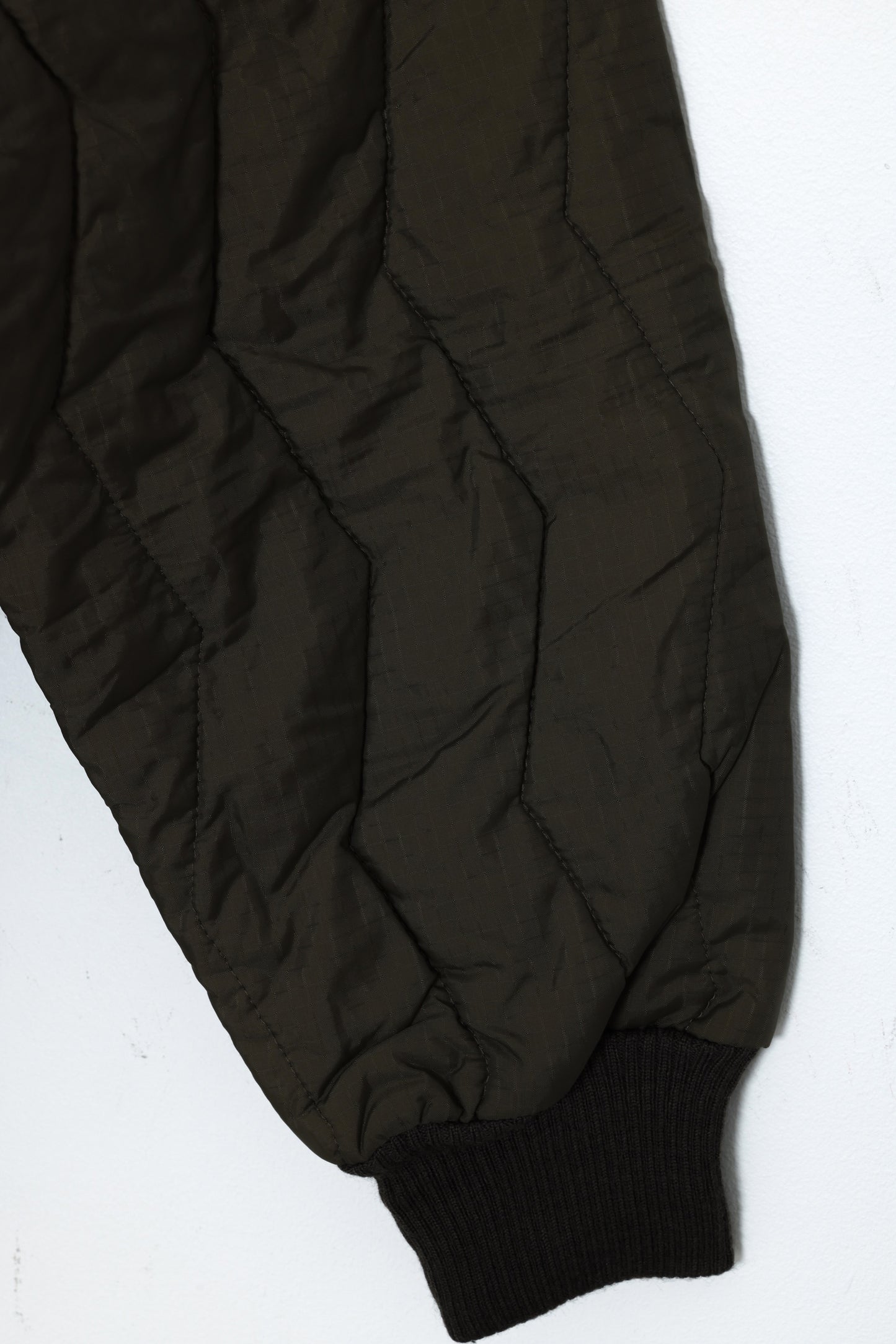
Construction centers upon a quilted composite system. An outer shell with visible micro-grid reinforcement contains insulating batting secured through continuous machine quilting. The quilting prevents insulation migration while stabilizing the shell during repeated use and laundering.
Assembly appears entirely machine executed using industrial lockstitch operations. Major seams are straightforward and optimized for repeatability. The zipper is inserted through a conventional center-front construction sequence, with supporting seam allowances enclosed within the garment structure.
The neckline architecture consists of a rib-knit stand collar integrated directly into the front opening. Unlike tailored collars requiring separate collar stands, pad stitching, and shaping operations, this assembly derives structure from knit elasticity and compression recovery.
V. Technical Design Elements & Precision Detailing
The most visually distinctive feature is the angular quilting geometry. Instead of simple horizontal channels, the garment employs elongated zigzag formations that create larger insulation compartments while improving stabilization across the body.
The chest pocket is notable. Constructed from a secondary material panel and secured externally, it introduces a functional storage zone without significantly disrupting production efficiency. The zipper insertion appears direct and uncomplicated, reflecting institutional priorities.
The rib-knit components deserve attention. Collar and cuffs serve as both closure interfaces and thermal seals. Their density appears substantial enough to maintain elasticity while resisting excessive deformation through extended wear.
VI. Style Nomenclature & Historical Evolution
This garment belongs to the lineage of military liner jackets developed after the Second World War and refined throughout the Cold War period. Earlier examples often relied upon blanket-weight wool or heavier quilted constructions. By the late twentieth century, improved insulation technologies permitted reduced bulk.
The jacket fits within the broader category of intermediate thermal layers. Comparable garments appeared throughout NATO-aligned military systems during the 1980s and 1990s.
Unlike bomber jackets or field jackets, which developed substantial civilian afterlives through subcultural adoption, thermal liners initially remained hidden components. Their later migration into fashion occurred largely because civilians eventually recognized that the military had inadvertently designed highly effective casual outerwear.
VII. Fabric Composition & Textile Engineering
The label identifies a shell blend comprising 55% polyamide and 45% polyester. The fabric presents as a lightweight woven structure incorporating visible reinforcement grids consistent with ripstop engineering.
The textile exhibits low surface reflectivity, moderate density, and controlled pliability. Its woven grid reduces propagation of tears while maintaining low overall weight. Tensile performance appears appropriate for institutional use where abrasion resistance must coexist with packability.
The insulation layer appears lightweight-to-medium weight and evenly distributed. The quilting geometry effectively limits migration while preserving loft.
Recovery characteristics appear satisfactory. Wrinkling is visible yet not structurally problematic, reflecting the material’s intended role as a functional service garment rather than a presentation-oriented uniform component.
VIII. Construction & Pattern Analysis
Pattern architecture is notably economical. Body panels are broad and rectangular, minimizing cutting complexity and maximizing material utilization. The silhouette relies on volume rather than sculpted shaping.
Sleeve construction appears conventional with generous circumference supporting layering requirements. Armhole geometry prioritizes comfort and production simplicity over anatomical refinement.
The collar assembly consists of a rib-knit stand collar inserted between front and back neckline sections. This approach significantly reduces labor compared with woven collar constructions.
Quilting lines are engineered before assembly, indicating that shell, insulation, and backing components were likely quilted as composite panels prior to garment construction. This sequence improves manufacturing speed and consistency.
IX. Structural Integrity & Panel Configuration
The garment’s structural performance derives less from the shell material itself than from the interaction between quilting and insulation. The quilted channels function as stabilizing ribs distributed across the garment surface.
Stress concentrations occur at zipper termini, cuff junctions, pocket corners, and armhole intersections. Visible construction suggests adequate reinforcement through seam layering and stitch density.
The collar-neckline transition appears robust. Rib knit absorbs tension generated during repeated donning and removal while reducing stress transfer into the woven shell.
The absence of elaborate shaping elements reflects the garment’s role as a support layer rather than a silhouette-defining outer garment.
X. Edge Finishing, Seam Termination & Closures
The center-front zipper serves as the principal closure mechanism. Installation appears efficient and durable, suitable for institutional maintenance cycles.
Cuff edges terminate into rib-knit assemblies that provide both thermal retention and mechanical flexibility. Such cuffs accommodate a wide range of wrist dimensions without requiring individualized adjustment systems.
The neckline is resolved through the integration of the rib-knit collar directly into the zipper assembly. This produces a continuous thermal seal when fully closed.
The hem incorporates an adjustable drawcord system. This feature allows wearers to reduce air exchange and improve insulation efficiency. It also compensates for the otherwise box-like silhouette.
XI. Manufacturing Context, Production Scale & Industrial Feasibility
This garment exemplifies high-volume government contract manufacturing. Every aspect of the design reflects careful balancing of performance, durability, and production economy.
The quilting pattern, though visually complex, is highly compatible with automated manufacturing processes. Once programmed, quilting operations could be executed rapidly and consistently.
Labor-intensive tailoring operations are absent. There are no facings, lapels, shaped collars, canvases, or hand-finished details. Material handling requirements remain straightforward, enabling large-scale production without specialized tailoring expertise.
The resulting garment demonstrates a sophisticated understanding of cost control. Complexity is concentrated where performance benefits justify it and eliminated where it does not.
XII. Conceptual Influence & Psychological Design Intent
The conceptual basis is institutional efficiency. The garment is designed to disappear into a system rather than assert individual identity.
Its visual language communicates utility through repetition and modularity. The wearer becomes part of an operational framework rather than a stylistic narrative. The jacket’s success depends upon being reliable enough that its existence is rarely discussed.
There is a curious honesty to such garments. Unlike fashion products that occasionally invent problems in order to solve them decoratively, military liners address a singular question: how does one remain warm with the least possible burden in weight, maintenance, and cost?
XIII. Artistic & Aesthetic Direction
Any aesthetic value emerges from engineering decisions. The zigzag quilting pattern generates an unexpectedly dynamic surface, producing rhythm across otherwise plain panel structures.
The rib-knit collar frames the neckline without creating excessive bulk. Its low-profile stand establishes a compact visual anchor at the upper torso.
The silhouette remains intentionally neutral. Visual emphasis falls upon texture, quilting geometry, and proportion rather than shape manipulation. In contemporary fashion contexts, precisely these characteristics have become desirable because they were never designed to attract attention in the first place.
XIV. Historical Placement & Contextual Analysis
The label explicitly dates the garment to 1997, eliminating the chronological uncertainty that often complicates military textile analysis. This places production within a mature phase of post-Cold War military modernization.
By this period, German military clothing systems increasingly reflected international developments in modular insulation technology. Heavy singular winter garments were being supplemented or replaced by interchangeable layered systems capable of adaptation across varied climates.
The garment therefore occupies an important transitional moment. It remains fundamentally institutional in design yet anticipates many characteristics now common within outdoor and technical apparel markets.
Its rib-knit collar typology also reflects this transition. Traditional military tunics and field jackets often relied upon woven stand collars, whereas modular insulation garments increasingly adopted knit structures for comfort, flexibility, and manufacturing efficiency.
XV. Use Case
The jacket is intended for prolonged activity within cool to cold environments where insulation must adapt to changing operational conditions. It performs effectively beneath shell garments, field jackets, or weatherproof outer layers, yet remains capable of independent use during moderate temperatures.
The wearer is defined by operational requirements. They expect fluctuating weather, periods of inactivity followed by movement, and the need to carry equipment. The garment accommodates these conditions through low weight, thermal retention, and unrestricted layering compatibility.
Adjacent garments must cooperate with its dimensions. Outer shells require sufficient ease to accommodate loft. Base layers must manage moisture accumulation. The liner functions as an intermediary.
Share