(Unattributed)
1995–2005, Yarn-Dyed Herringbone Plaid Flannel Overshirt
1995–2005, Yarn-Dyed Herringbone Plaid Flannel Overshirt
Couldn't load pickup availability
This garment is a button-front heavy casual shirt or shirt-jacket made from a brushed yarn-dyed herringbone twill plaid in blue, red, ecru, and muted grey tones. The most defensible production range is circa 1995–2005, supported by the generic commercial label language, casual “shirt department” branding, plastic buttons, boxy cut, and late twentieth-century outdoor-casual market vocabulary. Fiber content remains unverified, though the cloth behavior is consistent with a medium-to-heavy brushed flannel, probably cotton-rich or blended, structured through a herringbone twill weave rather than a printed surface. The construction system is industrial shirt manufacture: convertible collar, front button placket, single patch chest pocket, set-in long sleeves, buttoned cuffs, machine-stitched seams, and a lined or faced upper interior in dark blue twill. Its significance rests in its position within mass casual shirting, where heritage workwear codes, plaid flannel cloth, and simplified shirt-jacket engineering were adapted into everyday commercial dress.
I. Designer Origin & Brand Profile
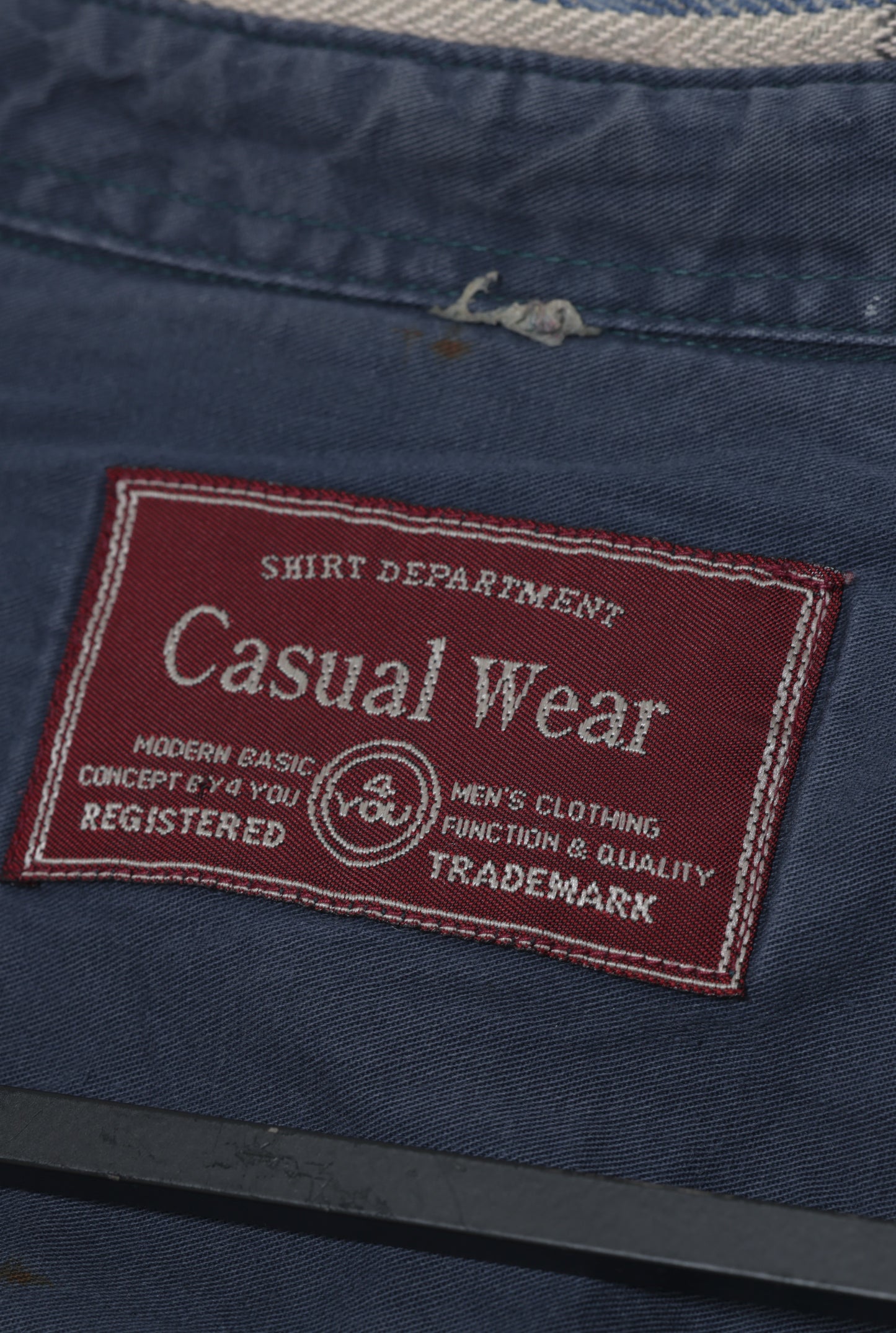
The label reads “Shirt Department,” “Casual Wear,” “Modern Basic Concept by 4 You,” “Men’s Clothing,” “Function & Quality,” “Registered,” and “Trademark.” This does not establish a documented designer house; it establishes a commercial label system oriented toward department-style casual shirting. The object should therefore be attributed to a generic or private-label casual wear production framework, not to a named design author. The garment’s design principles are consistent with volume-market shirting: a familiar plaid cloth, moderate overshirt weight, a convertible collar, a simple front opening, and a single chest pocket placed within the plaid grid. The label language frames the piece as basic casual dress with functional claims, and the construction follows that claim through standardized parts, low ornament, and repeatable assembly.
II. Brand Heritage & Industry Influence
The available label evidence supports a commercial shirt-department identity but not a traceable heritage brand history. Its industry placement belongs to the broad late twentieth-century expansion of casual flannel shirts and shirt-jackets into mall, catalogue, and department-store wardrobes. The textile vocabulary draws from older workwear and outdoor traditions: yarn-dyed plaid, brushed flannel handle, herringbone twill structure, patch pocket, and cuffed sleeves. These features connect the garment to lumber, field, and utility shirt typologies, but the execution is commercial casual manufacture, not occupational uniform production. The object’s market sphere is best read as urban and suburban casual apparel using workwear-derived textile codes in a softened, everyday format.
III. Garment Classification & Design Intent
The garment is a heavy casual shirt or light shirt-jacket, positioned between standard shirting and unstructured outer layering. Its intended function is casual upper-body coverage over a T-shirt, knit top, thermal layer, or lighter shirt. The cut is broad through the body, the shoulder line is relaxed, and the hem is straight, giving the piece a layerable format rather than a close dress-shirt profile. The plaid supplies the primary design system, with wide blue blocks, red vertical bands, ecru striping, and herringbone texture producing a work-casual surface. The design intent is durability, warmth, and informal wear, achieved through cloth weight and simple industrial construction rather than tailoring complexity.
IV. Construction Methodology & Engineering
The assembly follows an industrial shirt sequence: body panels cut in plaid yardage, shoulder seams joined, sleeves set, side and sleeve seams closed, front edges formed for buttoning, pocket applied, collar and cuffs attached, and hem finished. The front closure uses plastic buttons with machine-made buttonholes; the button spacing is conventional for a casual shirt of this weight. The collar is a convertible shirt collar with a soft fall and a modest stand formed through the neck seam and collar band/facing relationship, without tailoring canvas or lapel structuring. The chest pocket is patch-applied by machine stitching, with stress concentrated at the upper corners and stabilized by stitch reinforcement. Edge and seam handling appear industrial and serviceable, with the brushed twill requiring control of fray, bulk, and seam allowance thickness during assembly.
V. Technical Design Elements & Detailing
The defining technical detail is the yarn-dyed herringbone plaid, where the woven twill direction remains active across color bands. The plaid matching is partial, adequate for commercial casual production, with the front and pocket using the grid as a surface system while accepting some displacement at seams and applied components. The single chest pocket is cut from the same cloth and set into the plaid field, allowing the pocket to recede into the body surface while still performing as a utility detail. The cuffs use the plaid horizontally at the turnback, creating a directional change at the wrist. The collar uses the same cloth and is shaped with broad points, giving the neckline a substantial casual frame without formal collar stiffness.
VI. Style Nomenclature & Historical Evolution
The appropriate style classification is a plaid flannel shirt-jacket or heavy overshirt. Its lineage runs through wool and cotton flannel work shirts, outdoor overshirts, field shirts, and postwar leisure shirting. By the 1970s and 1980s, plaid flannel had moved strongly through youth, workwear, outdoor, and casual retail channels; by the 1990s, boxier flannel shirts became a major commercial category across streetwear, grunge-adjacent dress, outdoor casual wear, and department-store basics. This garment reflects that mature market stage: the workwear reference remains legible, but the label and cut place it in casual apparel distribution. The herringbone twill gives the cloth more textile depth than plain plaid flannel, linking it to older woven utility cloth traditions while remaining suitable for mass casual shirting.
VII. Fabric Composition & Textile Engineering
Fiber content is unverified; no fiber-content label is present in the supplied object record. The textile structure is the stronger evidence: a yarn-dyed herringbone twill plaid with a brushed flannel surface. The herringbone formation is integral to the weave, producing alternating diagonal ribs that create a broken twill effect across the blue, red, ecru, and grey areas. The brushed surface softens the yarn boundaries, raises a light nap, and increases warmth by trapping air at the cloth face. The probable weight sits in a shirt-jacket range, heavier than standard shirting and lighter than coating, likely around a medium-to-heavy flannel handle. The cloth has enough body to form a collar, cuff, placket, and patch pocket without heavy internal support, while still draping with casual collapse at the body and sleeve. Abrasion risk is concentrated at the cuffs, collar edge, pocket corners, and hem; pilling and nap wear are ordinary concerns for brushed flannel surfaces.
VIII. Construction & Pattern Analysis
The pattern is based on a straight-cut shirt block adapted for overshirt wear. The body panels are broad, with minimal waist suppression and a relaxed shoulder relationship; this reduces fitting complexity and improves size tolerance across a commercial production run. The sleeves are long set-in sleeves, cut with enough ease for movement and layering. The collar is drafted as a soft convertible shirt collar, with the fall extending into pointed ends and the neckline shaped to allow the top button area to open casually. There is no lapel in the tailored sense; the front opening creates a soft shirt break when the upper button is left undone. The pocket is a rectangular patch form with a shaped upper edge, machine-applied after body cutting and before full body closure, a sequence compatible with efficient industrial shirt assembly.
IX. Structural Integrity & Panel Configuration
The garment’s structural strength is derived primarily from the twill cloth, doubled areas, and seam placement. The shoulder seam, armscye, cuff join, button placket, collar seam, and pocket corners are the principal stress zones. The relaxed cut reduces strain across the chest and upper back, while the straight side seams and broad body make the piece tolerant of movement. The interior upper back and neck area include a dark blue twill facing or yoke-related layer, adding stability where the hanger loop, label, collar, and shoulder tension converge. The collar points and cuff edges depend on cloth density and internal turning rather than heavy interfacing. Wear evidence and small disruptions around the interior neck area indicate prior use at a high-contact zone, consistent with abrasion, laundering, and hanger stress.
X. Edge Finishing, Seam Termination & Closures
The front opening is resolved through a buttoned shirt closure, with machine-made buttonholes and plastic buttons. The front edges are turned or placketed to carry the closure load, and the buttonholes are set through the reinforced front band. The collar edge is turned and stitched, with soft roll behavior; the collar does not require pad stitching, canvas, or a formal break line. The cuffs are buttoned and shaped as standard shirt cuffs, with edge stitching securing the turned layers. The hem is straight and comparatively short, with some edge wear and fraying at lower front areas, suggesting both use and the vulnerability of brushed twill at exposed cut-and-turned edges. Repairability is good: buttons, pocket corners, cuff edges, and hem wear can be addressed without disturbing the full garment structure.
XI. Edge Treatment, Wearability & Manufacturing Context
The manufacturing context is medium-to-large-scale casual shirt production. Cost control appears in the standardized shirt block, single patch pocket, ordinary plastic buttons, minimal internal support, and a cloth pattern that tolerates imperfect matching. The labor-sensitive operations are collar setting, cuff attachment, buttonhole spacing, pocket placement, and management of plaid alignment at the front opening. Material yield would be affected by the large plaid repeat; the maker has accepted some pattern displacement instead of cutting each component for strict matching, which conserves cloth and time. Wearability depends on the soft collar, roomy body, warm brushed surface, and cuffed sleeves. The neckline can be worn open or buttoned higher, with the collar forming a casual frame rather than a formal stand.
XII. Conceptual Influence & Psychological Design Intent
The design draws on established associations between plaid flannel, outdoor labor, informal leisure, and durable everyday clothing. Its conceptual system is material rather than narrative: brushed surface for warmth, herringbone twill for texture, plaid for heritage coding, boxy cut for layering, and simple closures for daily use. The blue-red-ecru palette belongs to familiar casual shirting rather than seasonal novelty. The garment uses workwear-derived signs without occupational reinforcement at the level of a true uniform shirt. Its cultural position is therefore late twentieth-century casualization: a utility-derived textile language translated into accessible everyday dress.
XIII. Artistic & Aesthetic Direction
The aesthetic direction is heritage casual, built from scale, texture, and repetition. The broad blue blocks give mass to the garment, while the red and ecru vertical bands lengthen the front and sleeves. The herringbone twill interrupts flat plaid geometry by adding directional woven texture inside each color field. The collar is broad enough to balance the heavy cloth and relaxed body, with pointed ends that sit within the 1990s-to-early-2000s casual shirt vocabulary. The neckline treatment is open and soft, allowing the garment to function as a layer instead of a closed dress shirt. The result is a surface-led design in which cloth selection carries most of the aesthetic burden, while the pattern remains intentionally familiar and repeatable.
XIV. Historical Placement & Contextual Analysis
The probable production period is circa 1995–2005. The date range is supported by the generic commercial label design, the “modern basic” wording, the relaxed overshirt cut, the plastic buttons, the brushed plaid flannel surface, and the late twentieth-century casual retail language around function and quality. The garment aligns with the post-1980s expansion of plaid flannel beyond outdoor and workwear settings into broad casual clothing markets. The herringbone twill structure adds a textile reference to older woollen and cotton work cloth traditions, though the garment itself belongs to commercial casual shirting rather than specialized occupational dress. The label’s “men’s clothing” text establishes market-sex classification at retail level, but the object’s technical classification remains a heavy casual shirt-jacket. Origin is not established by country-of-manufacture evidence; the market sphere is best described as generic international casual apparel distribution.
XV. Use Case
The garment is suited to a cool-weather casual day as a mid-layer over a T-shirt, thermal top, or lightweight knit. The brushed herringbone flannel supplies warmth without the bulk of a lined jacket, and the button front allows ventilation across changing indoor and outdoor conditions. The relaxed body permits arm movement, seated wear, and light manual activity, while the cuffs can be buttoned to contain sleeve volume at the wrist. The collar gives neck coverage when raised or buttoned higher, but its soft construction keeps it compatible with outer jackets. Adjacent garments need to accommodate the shirt’s boxy hem, broad sleeve, and textured surface; narrow outer layers may compress the sleeve and collar, while chore jackets, parkas, denim jackets, and loose coats would accept its volume. Care demands are those of brushed flannel: laundering should control shrinkage, nap abrasion, button stress, and distortion along the collar, cuffs, and front edge.
Share