(Unattributed)
1995–2005, Italian Lamb Leather Blouson with Rib-Knit Waistband
1995–2005, Italian Lamb Leather Blouson with Rib-Knit Waistband
Couldn't load pickup availability
… approximate size: EU 40–42, US L
Measurements (cm):
shoulder to shoulder: 46
sleeve (shoulder to cuff): 62
chest (pit to pit): 56
length (collar to hem): 64
SKU: 900093
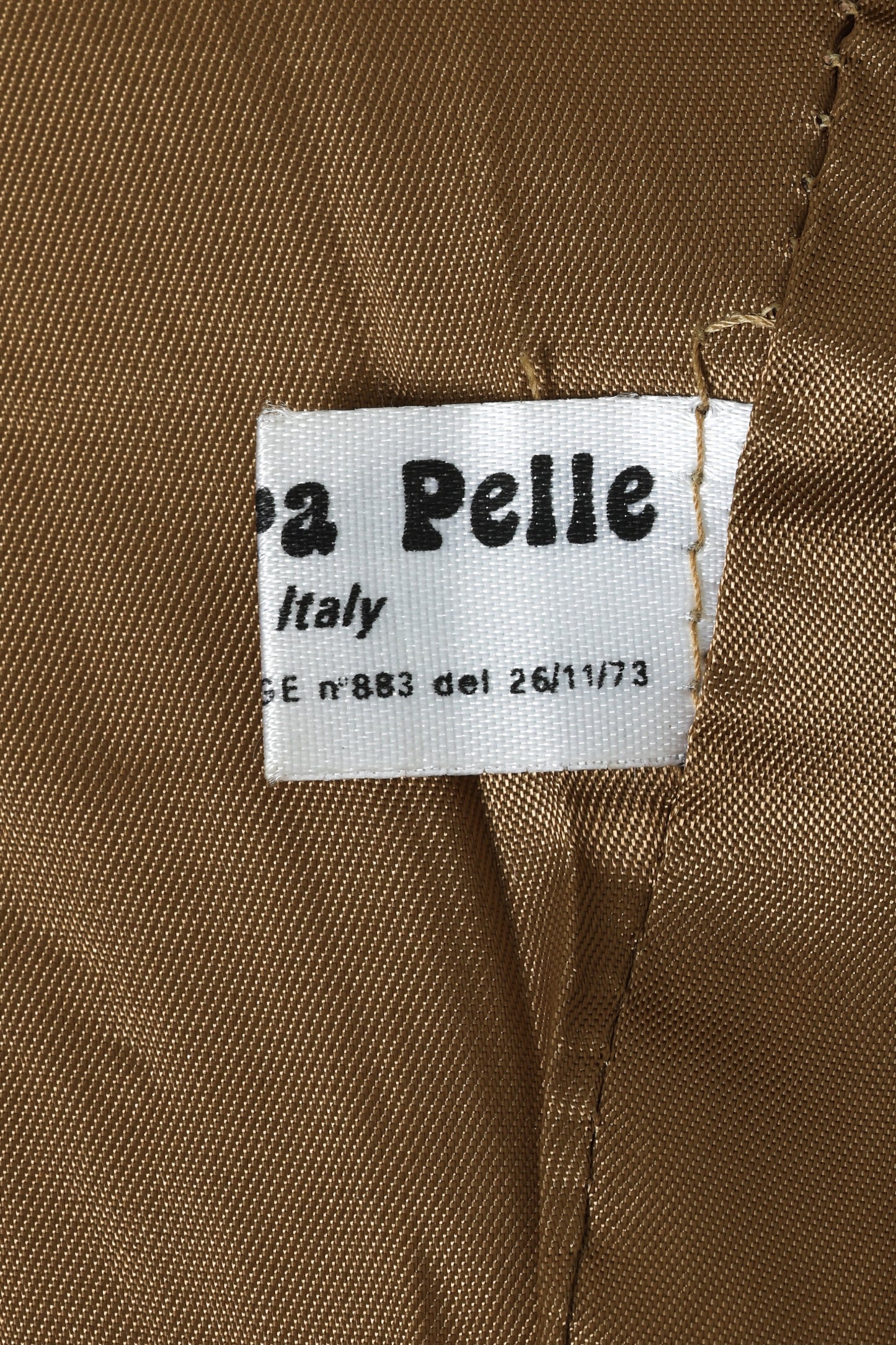
This is an Italian-made leather blouson produced most plausibly between the late 1990s and early 2000s. The shell consists of a lightweight garment leather displaying a smooth, fine-grained surface, moderate luster, and substantial drape. Construction follows established European leather sportswear manufacturing practices, combining a zip-front closure, convertible shirt-style collar, rib-knit waistband, and simplified panel layout intended for efficient factory production. Label evidence referencing Italian leather standards and “100% vera pelle” confirms genuine leather construction while situating manufacture within the regulated Italian leather goods sector. The jacket represents a mature phase of European leather casualwear, when leather blousons increasingly adopted the visual language of lightweight sports jackets and relaxed urban outerwear.
1. Designer Origin & Brand Profile
No surviving commercial brand identity is visible beyond regulatory and material labels. This absence is itself informative. Many Italian leather manufacturers of the late twentieth century produced garments for wholesalers, department stores, regional retailers, and private-label programs. Such garments often carried removable retail branding while retaining permanent compliance labels.
The jacket reflects a manufacturer familiar with high-volume leather production rather than couture-level experimentation. The design vocabulary prioritizes wearability, broad market appeal, and material presentation. The leather itself functions as the primary selling proposition.
From a design perspective, the garment exhibits confidence in surface and proportion. Decorative interventions are minimized. The silhouette depends upon the interaction between supple leather, rib compression at the waist, and the framing effect of the collar.
2. Brand Heritage & Industry Influence
Italian leatherwear production occupied a dominant position in European outerwear manufacturing throughout the latter decades of the twentieth century. Regional clusters specializing in tanning, cutting, and garment assembly supplied both domestic and international markets.
This jacket reflects the mature industrial phase of that system. By the late 1990s, manufacturers increasingly abandoned the heavier, aggressively styled leather jackets associated with the 1980s. In their place appeared lighter garments emphasizing comfort, flexibility, and everyday integration.
The garment demonstrates how Italian producers successfully merged sportswear pattern systems with leather fabrication. Such designs helped normalize leather jackets as routine wardrobe components rather than occasional statement purchases.
3. Garment Classification & Design Intent
This garment is properly classified as a leather blouson with rib-knit waistband.
More specifically, it belongs to the family of zip-front sports jackets derived from mid-century golf jackets, civilian flight jackets, and European leisurewear outerwear.
The intended function was daily urban wear in mild to cool weather. The jacket offers moderate thermal protection while maintaining a lightweight wearing experience.
The design objective centers on accessibility. Unlike motorcycle jackets, military reproductions, or heavily structured leather coats, this garment seeks integration into ordinary wardrobes with minimal effort from the wearer.
4. Construction Methodology & Engineering
Construction follows established industrial leather garment practices.
The shell appears assembled using lockstitch machinery calibrated for garment leather. Stitch density is moderate, avoiding excessive perforation that could weaken seam integrity.
Assembly order likely proceeded through shoulder and sleeve preparation, front and back joining, pocket installation, collar assembly, zipper insertion, waistband attachment, lining preparation, and final shell-lining integration.
The visible interior pocket treatment demonstrates factory-level organization. Pocket openings are bound with leather strips, creating a durable edge capable of resisting abrasion generated by repeated hand insertion.
Production engineering reveals an emphasis on reducing unnecessary operations while preserving visual completeness.
5. Technical Design Elements & Precision Detailing
The most significant design element is the shoulder treatment.
Rather than employing a conventional shoulder seam terminating directly at the shoulder point, the garment uses a raglan-influenced seam path extending from neckline toward the upper arm. This arrangement softens shoulder definition and enhances mobility.
The front body remains largely uninterrupted by shaping seams. Such simplicity allows the leather surface itself to dominate the visual composition.
The waistband introduces the primary structural intervention. The rib-knit section compresses the hem circumference and creates the characteristic blouson silhouette.
Pocket openings are discreetly integrated into side seam regions, preserving surface continuity.
6. Style Nomenclature & Historical Evolution
This jacket belongs to the European leather sports blouson lineage.
Its ancestry can be traced through mid-century golf jackets, postwar civilian leisure jackets, and aviation-influenced sportswear. By the late twentieth century these influences had merged into a generalized category of leather casual outerwear.
The collar deserves particular attention. Unlike the funnel-neck configuration seen in many 1980s leather jackets, this example returns to a convertible shirt-style collar. This shift reflects broader menswear developments during the late 1990s, when softer, less aggressive neck treatments gained prominence.
The result is a garment situated between traditional sportswear and contemporary casualwear.
7. Fabric Composition & Textile Engineering
The leather exhibits characteristics associated with lightweight garment-grade skins. Surface observation reveals a smooth grain, modest reflectivity, and relatively fine pore structure.
Material behavior suggests high flexibility, rapid conformity to body movement, and limited structural rigidity.
The shell displays visible creasing and wear patterns developed through use. These folds indicate a material capable of accommodating repeated stress without significant cracking.
The lining appears to be a tightly woven filament textile with pronounced surface sheen. The weave structure resembles a balanced plain weave or tightly packed derivative suitable for lining applications.
Its performance characteristics include low friction, dimensional stability, and efficient garment-on-garment movement during dressing.
8. Construction & Pattern Analysis
Pattern architecture is notably economical.
The front body panels are cut with minimal interruption. Unlike the Finnish example previously examined, this garment relies less upon shaping seams and more upon material behavior.
The shoulder system uses raglan-derived geometry. This drafting approach increases mobility while reducing stress concentration at the shoulder point.
The collar consists of a separate collar stand-and-fall configuration integrated directly into the neckline.
Pattern grading appears standardized and industrial. There is no evidence of individualized drafting or made-to-measure modification.
Material yield efficiency would have been relatively favorable, an important consideration when working with costly leather hides.
9. Structural Integrity & Panel Configuration
Structural support derives primarily from seam placement, zipper stabilization, waistband compression, and collar reinforcement.
The neckline functions as a major load-bearing zone. Stress generated through repeated opening and closing of the zipper is distributed through the collar base and center-front seam structure.
The rib-knit waistband acts as both silhouette control and structural anchor. By maintaining inward tension at the hem, it stabilizes the lower garment perimeter and prevents uncontrolled distortion.
The raglan-derived shoulder system distributes movement loads across a broader seam pathway than conventional set-in sleeves.
Wear patterns visible on the shell indicate normal use history without evidence of catastrophic material failure.
10. Edge Finishing, Seam Termination & Closures
The center-front zipper is inserted with narrow leather facings that create a clean visual edge and protect the zipper tape.
The collar edges are turned and topstitched. Roll behavior is soft and natural, reflecting limited internal reinforcement.
Unlike tailored lapels, the collar operates through fold memory and leather drape. It can remain upright in adverse weather or fold outward in conventional shirt-collar fashion.
Cuffs employ narrow turned finishes secured through machine stitching.
The waistband integration demonstrates competent execution. The junction between leather shell and rib knit is balanced and visually consistent.
Interior pocket edges receive leather binding, improving durability and providing a finished appearance.
11. Manufacturing Context, Production Scale & Industrial Feasibility
This garment was clearly designed for repeatable industrial production.
Labor-intensive tailoring operations are absent. There is no evidence of extensive hand-finishing, pad stitching, canvas structuring, or other techniques associated with high-end tailoring systems.
Instead, manufacturing complexity is concentrated in leather handling and assembly sequencing.
The collar design is especially efficient. It achieves visual completeness while requiring comparatively few operations.
The rib-knit waistband introduces a specialized component but simultaneously simplifies lower-body shaping requirements.
Production volume was likely moderate to large, consistent with commercial leatherwear distribution networks operating throughout Europe at the turn of the millennium.
12. Conceptual Influence & Psychological Design Intent
The garment reflects a period in which leather was increasingly presented as familiar rather than aspirational.
Its design language avoids overt references to military, motorcycle, aviation, or countercultural archetypes. Instead, leather functions as a material enhancement of an otherwise familiar sports jacket.
The psychological appeal derives from tactile value and durability. The wearer acquires the sensory experience associated with leather without accepting the visual obligations often imposed by more historically coded leather garments.
This is a jacket designed to participate in ordinary life. There is a certain confidence in that decision, although one suspects marketing departments would have preferred more dramatic language.
13. Artistic & Aesthetic Direction
The visual composition is rooted in late-modern commercial minimalism.
Large uninterrupted leather surfaces create a calm visual field. The eye moves vertically along the zipper before encountering the collar and horizontally across the waistband.
The collar plays a central role in framing the upper torso. Its rounded points soften the geometry established by the zipper and shoulder seams.
Unlike notched or peaked lapel systems, the convertible collar creates a compact neckline architecture. Visual emphasis remains concentrated around the face without introducing the hierarchy associated with tailored jackets.
The rib-knit waistband provides the primary contrast in texture. This juxtaposition between smooth leather and rib structure creates visual tension while preserving coherence.
14. Historical Placement & Contextual Analysis
Multiple indicators support dating between approximately 1998 and 2005.
The collar shape, shoulder treatment, rib-knit waistband, zipper profile, leather finish, and label typography all align with European casualwear production during this period.
The jacket diverges from the exaggerated proportions frequently encountered during the late 1980s and early 1990s. Shoulders are moderated. Collar dimensions are reduced. Surface detailing is minimized.
At the same time, it predates the increasingly technical outerwear aesthetics that would become prominent later in the decade.
Within the historical development of leather outerwear, the garment occupies a transitional stage where traditional leather craftsmanship intersects with increasingly streamlined sportswear design.
Use Case
The jacket performs best during an ordinary working day conducted across multiple environments. It leaves the house in cool morning conditions, accompanies its wearer through transit, remains acceptable in casual office settings, and survives the evening without demanding explanation.
The wearer appears to prioritize familiarity over novelty. The pattern of decisions suggested by the garment points toward someone who values material quality, moderate durability, and adaptability across circumstances.
The rib-knit waistband requires adjacent garments to cooperate. Trousers with excessive rise or volume compete with the compressed hem. Moderate-rise denim, wool trousers, or cotton twill trousers create the most successful relationship.
The collar encourages open-neck shirts, fine-gauge knitwear, and lightweight layering pieces.
Share