(Unattributed)
1990s Zip-Front Leather Jacket, Waist Panel Break, Straight Collar
1990s Zip-Front Leather Jacket, Waist Panel Break, Straight Collar
Couldn't load pickup availability
Approximate Size: EU 40–42, US L
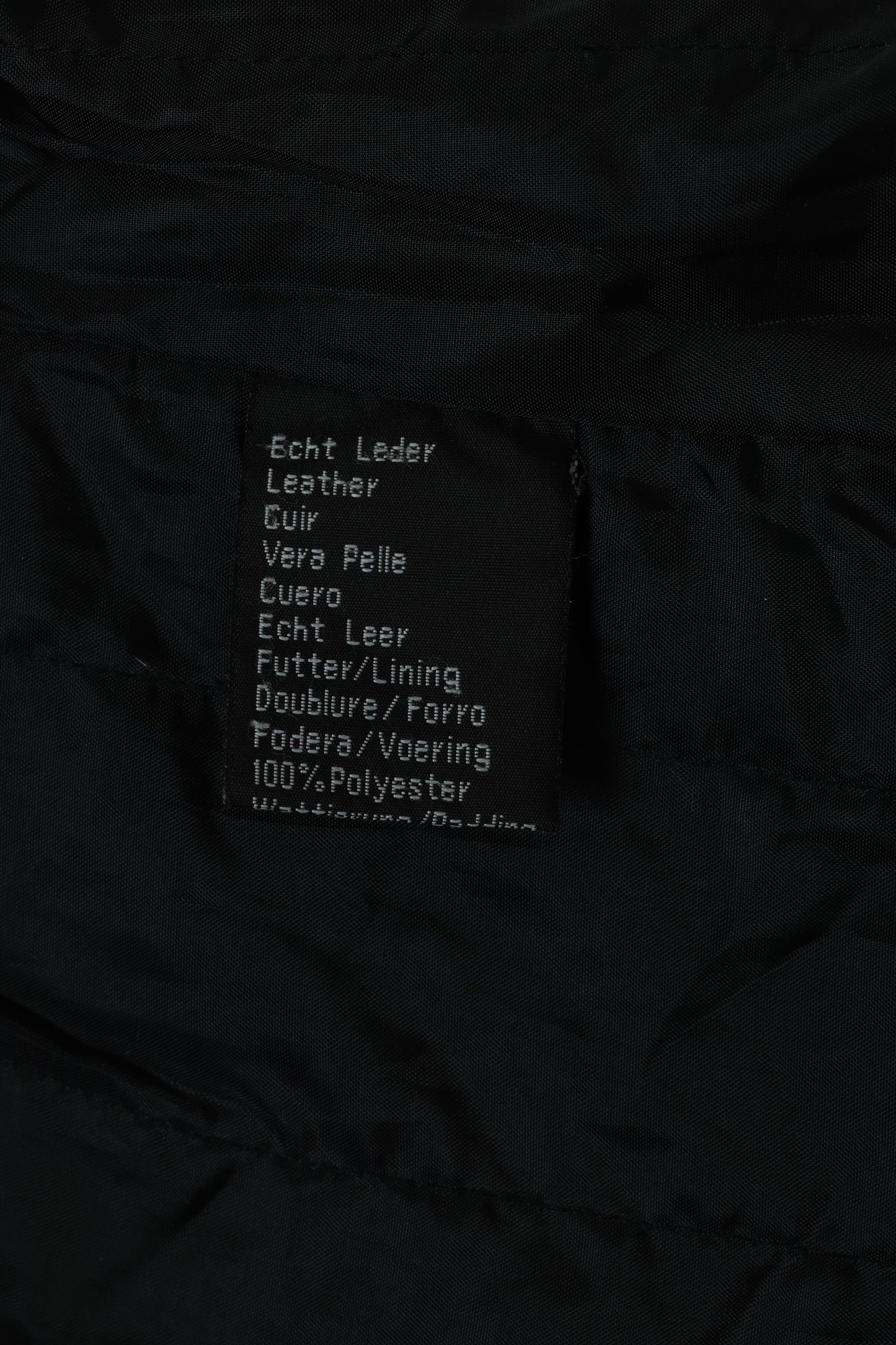
This is a black leather jacket produced approximately between the late 1980s and mid-1990s, based on labeling conventions, construction methods, and silhouette. The exterior is composed of genuine leather, confirmed by multilingual fiber labeling, with a fully synthetic polyester lining system. The garment is industrially manufactured, with machine stitching, standardized panel cutting, and a commercially integrated zipper closure. The configuration reflects late 20th century European-market distribution, where multi-language labeling corresponds to cross-border retail compliance. Its significance lies not in authorship but in its adherence to a widely distributed leather outerwear program that balanced cost-controlled production with the visual authority of leather as a material.
I. Primary Materials, Textile Structure & Fabric Performance
The outer shell is composed of finished leather, most likely corrected or lightly top-coated hide, given the uniform surface reflectivity and absence of pronounced grain irregularity. The leather appears mid-weight, with sufficient pliability to accommodate panel shaping while retaining enough body to hold a defined silhouette. The lining is explicitly identified as 100% polyester, a common industrial lining choice for cost stability, abrasion resistance, and ease of assembly. The lining fabric presents as a lightweight plain weave or low-denier synthetic, with minimal structural contribution beyond internal coverage and seam concealment. No evidence of traditional tailoring canvasing is present; structural integrity relies on the inherent strength of the leather and seam placement. The leather shows mild surface creasing consistent with storage compression rather than fiber fatigue, suggesting retained tensile integrity.
II. Construction Method, Pattern Development & Production Discipline
The garment is machine-assembled using standardized industrial processes. Panel construction is evident across the torso, including vertical shaping seams and a horizontal waist seam that introduces mild contouring without reliance on darting. Stitching is consistent, evenly spaced, and executed with industrial lockstitch machinery. Seam finishing within the lining appears overlocked or folded and secured, typical of factory production rather than hand-finished work. The pattern reflects flat-cut development rather than draped or bespoke shaping, with symmetrical panel repetition indicating batch production. No visible evidence suggests post-production alteration; seam lines appear original and uninterrupted.
III. Structural Design, Silhouette Engineering & Technical Resolution
The jacket follows a moderately fitted silhouette, structured through panel segmentation rather than internal support systems. The waist seam acts as a visual and structural break, allowing slight shaping through the midsection. The collar is a simple turn-down form, integrated without additional collar stand complexity, reinforcing its industrial pattern origin. The front closure is a centered zipper, likely metal-toothed, integrated directly into the front panels with minimal facing extension. Sleeve construction is straightforward, with a set-in sleeve and no visible sleeve head reinforcement. Load distribution is managed through the leather’s inherent durability rather than supplemental internal architecture.
IV. Surface Treatment, Finish, Coloration & Material Handling
The leather surface is finished in a uniform black dye with a slight sheen, suggesting either a pigmented topcoat or semi-aniline finish. The surface reflects light evenly, indicating controlled finishing rather than untreated hide. Minor creasing and surface undulation are visible, consistent with storage folding rather than extended wear. The lining exhibits pronounced wrinkling, likely from prolonged compression rather than repeated use. No evidence of conditioning treatments, recoloring, or repair is visible. The finish appears intact, with no cracking or delamination, suggesting stable storage conditions.
V. Garment Type, Formal Design Language & Fashion Historical Placement
This is a leather jacket positioned within late 20th century casual outerwear traditions, drawing from simplified tailoring rather than motorcycle or utility-derived forms. The absence of aggressive hardware, belting, or asymmetry places it within a restrained commercial category aimed at broad market appeal. The silhouette aligns with late 1980s to 1990s preferences for moderately fitted outerwear with minimal ornamentation. The waist seam and panel shaping reflect a transitional period where leather garments adopted tailored cues without fully entering structured tailoring traditions.
VI. Designer, Brand, Manufacturing Context & Market Position
No designer or brand attribution is visible. The multilingual label suggests production intended for European distribution, likely manufactured under a contract system supplying multiple retail outlets. The construction quality indicates mid-tier commercial production rather than luxury atelier or low-grade disposable manufacture. This places the garment within a broad category of leather outerwear produced for department stores or specialty retailers during the late 20th century. It is neither singular nor anonymous in a meaningful way; it is representative of a system designed for scale.
VII. Probable Origin, Provenance Framework & Attribution Threshold
The multilingual fiber label includes German, English, French, Dutch, and Spanish terminology, indicating compliance with European textile labeling standards. This strongly suggests production for the European Economic Area market. The absence of a brand label complicates attribution, leaving the garment within a category of contract-manufactured goods distributed under various retail identities. No internal markings, union tags, or workshop identifiers are visible. Attribution remains at the level of regional production framework rather than specific manufacturer.
VIII. Preservation Indicators
The garment presents with characteristics consistent with limited use or extended storage. The lining’s creasing suggests prolonged folding, while the leather’s surface lacks the wear patterns typically associated with repeated movement, such as elbow creasing or collar edge breakdown. The zipper shows no visible degradation or polish loss from repeated handling. There are no attached retail tags, but the overall condition suggests either back-room storage or minimal wear rather than active use. The condition aligns more closely with lightly handled stock than with fully circulated garments.
IX. Market Standing, Comparative Category Placement & Value Estimation
Estimated current market range: $80–180. This valuation reflects the absence of designer attribution, balanced against genuine leather construction and stable condition. Comparable garments from the same production tier occupy a saturated segment of the vintage market, where differentiation is limited. The value is supported primarily by material rather than authorship or rarity. Liquidity is moderate within general vintage resale contexts but limited within specialist or institutional acquisition frameworks.
X. Wear Guidance, Styling Framework & Contextual Use
The jacket should be worn with attention to its intended proportional balance: mid-weight layering beneath, avoiding excessive bulk that would stress the panel seams. It functions within casual to semi-structured contexts, pairing with trousers or skirts that maintain a clean vertical line rather than exaggerated volume. Closure should be handled carefully to avoid zipper strain, particularly given the leather’s age. Conditioning of the leather prior to wear is advisable to maintain flexibility. The garment is suitable for regular use, provided that environmental exposure is controlled and structural stress remains within the limits of its original construction.
Share