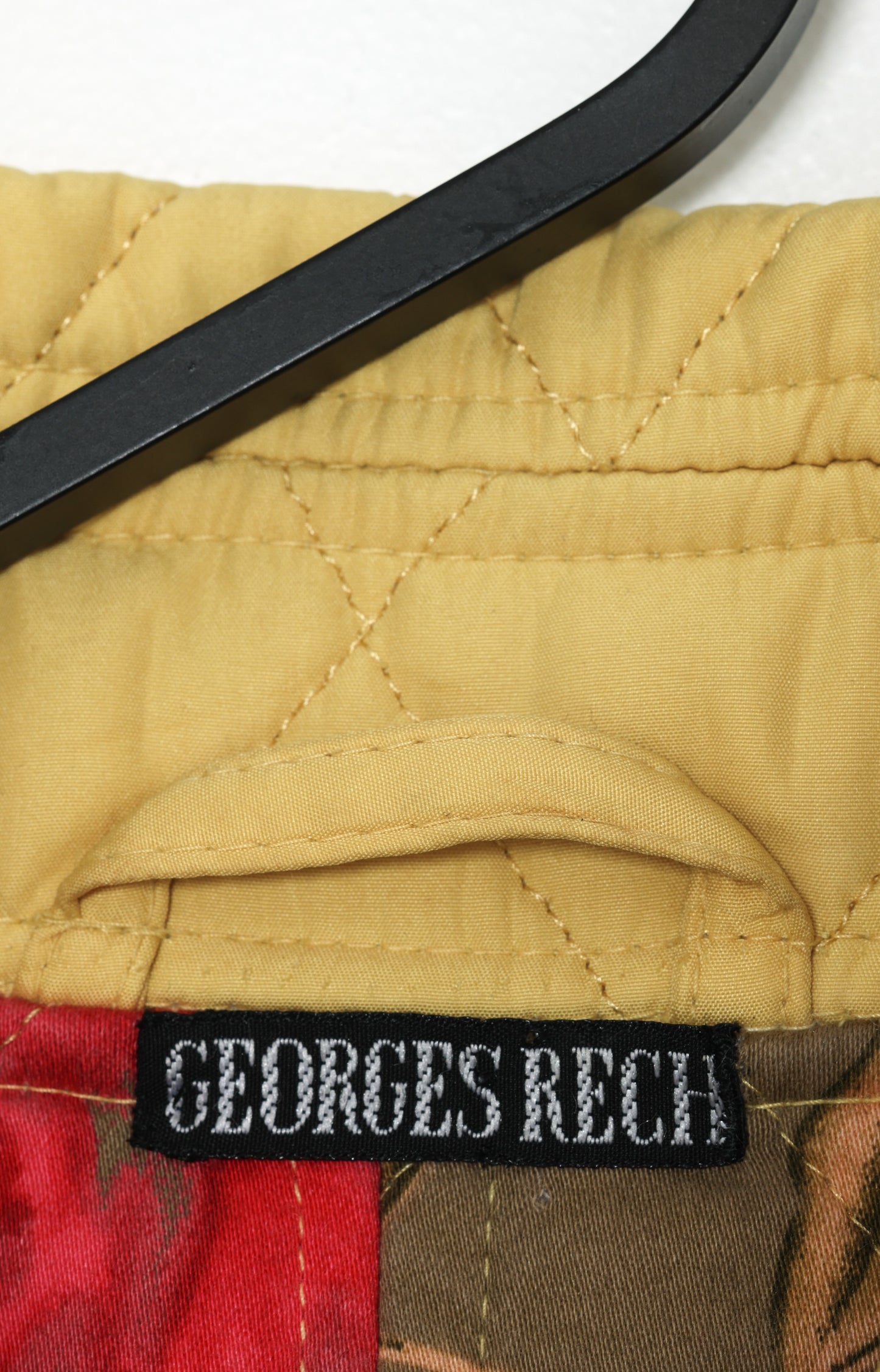
Georges Rech (France)
1990s, Storm Front, Technical Twill, Channel Quilting, Panel-Shaped Waist Suppression
1990s, Storm Front, Technical Twill, Channel Quilting, Panel-Shaped Waist Suppression
Couldn't load pickup availability
approximate size: EU 40, US M-L
Measurements (cm):
Chest: 56
Length: 64
Shoulder: 40
Sleeve: 62
SKU: 900747
This garment is a lightly insulated quilted transitional jacket produced under the Georges Rech label, likely dating between the late 1990s and early 2000s, during the period in which European urban sportswear absorbed equestrian and country-derived quilting systems into metropolitan womenswear. The jacket combines diamond-channel machine quilting with a short double-breasted storm-front arrangement, shaped vertical body seams, and waist-adjustment side tabs intended to impose controlled suppression onto an otherwise utilitarian padded silhouette. The shell textile presents as a tightly woven matte filament-faced cloth with moderate density, low luster, and sufficient tensile stability to support uninterrupted quilting without distortion or seam torque. Construction methods indicate industrial-scale boutique production with attention directed toward visual coherence and moderate weather protection instead of tailoring depth or heavy structural engineering. The oversized collar, broad lapel spread, and softened neckline architecture situate the garment within the transitional fashion vocabulary that sat awkwardly but persistently between equestrian references, suburban mobility, and continental “active elegance,” a category responsible for more airport lounges than memorable revolutions.
1. Designer Origin & Brand Profile
Georges Rech emerged within the French fashion market as a label positioned between upper commercial fashion and accessible designer licensing structures, operating most visibly from the 1970s onward through boutique distribution and department-store penetration. The brand cultivated a distinctly Parisian interpretation of softened tailoring and urban leisurewear directed toward professional women seeking polished day garments without the disciplinary rigor associated with couture tailoring houses. By the late 1990s, Georges Rech occupied a market segment heavily invested in adaptable wardrobe systems: lightly structured jackets, insulated outerwear, softened suiting, and hybrid garments capable of moving from automobile to office to restaurant terrace without requiring a costume change or ideological commitment.
The present garment reflects that positioning precisely. The jacket borrows from British riding and country quilting traditions but translates them through a French commercial lens emphasizing softened body contouring and metropolitan wearability. The exaggerated collar points and double-breasted front produce an illusion of tailored authority, though the underlying engineering remains intentionally lightweight. The garment avoids hard military references despite the storm-front arrangement, choosing instead a softened semi-domestic refinement associated with continental winter sportswear and urban commuting attire.
From a design perspective, the coat demonstrates a preference for visual organization through quilting geometry rather than through aggressive tailoring seams. The designer relies on repetitive diamond quilting to stabilize surface rhythm while allowing the shaped princess-style seam trajectories to establish vertical movement. The result is visually controlled but physically forgiving. It is the kind of jacket intended for movement through moderately cold climates while carrying handbags large enough to contain administrative paperwork and perhaps resentment.
2. Brand Heritage & Industry Influence
Georges Rech participated in the broader European democratization of designer-associated fashion during the late twentieth century, when labels increasingly balanced aspirational branding with scalable industrial manufacturing. Unlike couture houses that maintained highly protected atelier systems, brands such as Georges Rech operated through distributed manufacturing networks capable of producing garments at mid-tier luxury volumes while preserving enough visual sophistication to maintain brand distinction.
The label’s influence resides less in radical innovation than in its role within the commercial refinement of womenswear categories derived from utility garments. Quilted jackets such as this one reflect the diffusion of rural and sporting references into urban fashion markets during the 1980s and 1990s. British equestrian quilted coats, originally designed for insulation and mobility in damp outdoor environments, became detached from their original agricultural and riding contexts and repurposed as markers of subdued bourgeois mobility. Georges Rech translated that language into a more fitted, feminine silhouette suited to European citywear.
The garment also reflects broader manufacturing shifts occurring during the period. Quilted outerwear increasingly benefited from advancements in lightweight insulation materials and industrial quilting machinery capable of maintaining stable stitch consistency across large production runs. The jacket’s surface regularity indicates standardized quilting operations performed prior to assembly, minimizing distortion during panel integration and improving production throughput. Such garments represent the period in which outerwear ceased pretending to belong exclusively to either sport or fashion and simply became logistical equipment for middle-class weather management.
3. Garment Classification & Design Intent
The garment is best classified as a women’s quilted transitional utility jacket with double-breasted storm closure and semi-tailored shaping. It occupies the category between insulated sportswear and urban leisure outerwear, intended for cool-weather day use rather than severe winter protection.
The jacket’s shortened body length indicates compatibility with automobile travel and active urban movement. The side waist tabs permit adjustable shaping while preserving insulation continuity. The double-breasted closure references trench and riding coat systems, though executed here in abbreviated form. The oversized collar functions both aesthetically and structurally, framing the face while extending weather protection across the upper chest.
Design intent centers on presenting controlled sophistication through accessible construction methods. The garment seeks to communicate competence and polish without entering overtly formal territory. The diamond quilting performs dual labor: thermal stabilization and decorative surface organization. Unlike military quilting, which privileges durability above all else, the quilting here prioritizes visual regularity and silhouette management. The wearer was expected to appear organized, active, and mildly expensive without alarming colleagues.
4. Construction Methodology & Engineering
The jacket is assembled through industrial machine-quilted panel construction using a layered shell, batting, and interior lining system. The quilting appears executed prior to final garment assembly, allowing consistent diamond alignment across major panels while reducing bulk accumulation at seam intersections.
Stitching is executed primarily through lockstitch construction with medium stitch density calibrated for padded textiles. The quilting lines appear approximately 3–4 mm in stitch length, sufficient to compress the batting while avoiding perforation stress across the shell textile. The seam architecture suggests an assembly sequence beginning with quilted panel fabrication, followed by body panel integration, sleeve insertion, collar attachment, front facing installation, and closure application.
The princess seam shaping is structurally important. These seams interrupt the otherwise uninterrupted quilt matrix and allow the garment to transition from cylindrical utility form into controlled feminine contouring. The seams are narrow and efficiently topstitched, likely serving both reinforcement and flattening purposes. Bulk management appears competent, though not couture-level. Industrial pressing systems were clearly employed during construction to maintain edge compression and quilting continuity.
The front closure system utilizes double-breasted snap hardware integrated into overlapping front extensions. The hardware anchoring appears reinforced internally, likely through hidden backing patches or interfacing zones designed to prevent tearing under repeated strain. The collar contains internal support sufficient to maintain standing posture without rigid tailoring canvas. This is achieved through compressed interfacing layers and quilting density rather than traditional pad-stitched tailoring methods.
5. Technical Design Elements & Precision Detailing
The dominant technical feature is the diamond quilting matrix, executed with relatively disciplined alignment across body and sleeve panels. Maintaining visual continuity in quilted garments requires careful pattern planning because even minor rotational deviation becomes immediately visible. Here, the diamonds remain generally coherent across the front body, suggesting reasonably accurate cutting and feed control during quilting operations.
The shaped side panels create an illusion of articulated tailoring despite the garment’s fundamentally padded structure. The designer introduces elongated curved seams extending from underarm toward hem, visually narrowing the waist while preserving insulation volume. This is a familiar maneuver in late-1990s women’s outerwear: contour without commitment.
The side adjustment tabs are structurally simple but visually important. Their placement interrupts the otherwise uninterrupted verticality of the garment and introduces controlled horizontal compression at the waistline. Hardware selection remains conservative, likely zinc alloy or plated base metal snaps and buckle elements selected for production efficiency rather than longevity.
The collar construction deserves particular attention. The collar is oversized relative to body scale, with broad pointed ends extending laterally beyond the neckline. The collar stand is integrated softly into the neckline without aggressive roll suppression. This produces a partially collapsing roll line characteristic of lightly structured outerwear. The neckline itself sits relatively high, allowing the collar to frame the face when opened while preserving weather coverage when fastened. The absence of heavy pad stitching or tailored undercollar shaping confirms industrial fashion construction rather than tailoring-house methodology.
6. Style Nomenclature & Historical Evolution
This garment belongs to the lineage of quilted riding and field jackets originating in British countrywear traditions of the mid-twentieth century. Early quilted jackets prioritized thermal insulation for equestrian and agricultural use, employing lightweight padded constructions suitable for damp climates and active movement.
By the 1980s, diamond quilting migrated into fashion systems through luxury countrywear brands and eventually broader commercial adoption. European womenswear labels adapted these garments by introducing waist shaping, shortened lengths, and decorative closure systems. The present jacket reflects this urbanized evolution. The double-breasted front borrows trench-derived authority while the quilting references equestrian practicality. Neither function is pursued to its logical extreme. Fashion frequently survives through partial commitments.
The oversized collar points align with late-1990s outerwear proportions, during which neckline exaggeration and broad collar spreads appeared across both tailoring and casualwear. This was partly a reaction against the compressed minimalism of early-1990s styling and partly the unavoidable consequence of designers rediscovering that human necks exist.
7. Fabric Composition & Textile Engineering
The shell textile appears to be a tightly woven filament-faced cloth with moderate density and matte surface behavior. The fabric demonstrates low pile, smooth hand, and controlled rigidity sufficient to maintain quilting geometry without collapsing into excessive drape. Surface reflectivity remains subdued, indicating either mechanical texturing or finishing treatments designed to reduce sheen.
Estimated fabric weight likely falls between 140–190 GSM for the shell layer, combined with lightweight internal batting. The batting appears thin and compressible, prioritizing mobility over substantial insulation. Compression recovery appears moderate; the quilting channels maintain loft consistency without severe migration.
The textile demonstrates suitable abrasion resistance for urban outerwear applications. Seam tension remains stable despite extensive quilting perforation, indicating reasonable tear resistance. The fabric’s low elasticity assists in maintaining seam accuracy and geometric quilting integrity. Breathability is likely limited compared to natural-fiber field jackets, though the lightweight insulation partially compensates by preventing overheating during moderate activity.
The interior lining visible near the neckline introduces a contrasting floral print textile with softer drape and higher surface fluidity. This insertion functions primarily as decorative contrast and brand positioning rather than structural necessity. The red floral interior is unexpectedly dramatic relative to the exterior discipline, like discovering opera tickets inside an accountant’s raincoat.
8. Construction & Pattern Analysis
Pattern architecture relies on a relatively efficient industrial block modified through vertical seam shaping and quilt stabilization. The front body consists of multiple vertically oriented panels allowing waist suppression while preserving balanced grain orientation. The quilting itself likely occurred on larger textile sheets before pattern cutting, a standard production method minimizing labor and improving consistency.
Sleeves appear two-piece or partially articulated through subtle seam shaping, though the available imagery limits full confirmation. Sleeve pitch is moderately forward, suitable for urban mobility and driving posture. The shoulder line remains narrow relative to body width, reinforcing the fitted silhouette.
Collar drafting reveals broad pointed collar leaves attached to a low integrated stand. The collar roll emerges softly from the neckline due to minimal internal tailoring structure. The break line lacks the sculpted spring associated with pad-stitched tailored collars, instead depending on quilting compression and interfacing stiffness. This produces a somewhat flattened but visually stable collar behavior appropriate for lightweight insulated garments.
Assembly sequencing appears industrially optimized. Quilted shell units were likely assembled separately from lining units before integration at front edges and neckline. Seam allowances appear compressed and topstitched where necessary to prevent bulk accumulation. Production efficiency clearly governed many engineering decisions, though without catastrophic compromise.
9. Structural Integrity & Panel Configuration
The jacket’s structural integrity depends primarily on quilting stabilization and seam distribution rather than on internal tailoring frameworks. Stress loads are distributed across multiple vertical seams, reducing concentrated tension at the waist and front closure.
The princess-style seam configuration is essential to silhouette control. Without these seams, the garment would collapse into tubular utility wear. Instead, the shaping creates moderate waist suppression while allowing sufficient ease for layered wear beneath. The side tabs provide secondary adjustment, though their structural contribution is modest.
The front overlap distributes closure strain effectively across the double-breasted configuration. Snap placement appears balanced to prevent diagonal pulling during wear. The collar-neckline intersection is reinforced through layered seam integration, though likely without substantial hidden tape stabilization.
The hemline remains relatively soft and unweighted, allowing slight upward movement during wear. This contributes to comfort but reduces long-term silhouette discipline. The jacket was engineered for repeated seasonal use rather than archival immortality, which is fortunate because very few garments survive on optimism alone.
10. Edge Finishing, Seam Termination & Closures
Edge finishing throughout the garment appears machine turned and topstitched, with compressed seam allowances integrated into the quilted structure. Front edges are stabilized through facing integration and repeated topstitch channels designed to flatten bulk and maintain closure alignment.
The collar edges are cleanly turned with narrow seam margins, producing relatively crisp points despite padded construction. Achieving sharp collar points in quilted garments requires careful trimming and controlled turn manipulation; excessive bulk immediately rounds the tips. Here the points remain acceptably defined.
The lapel-equivalent front extension lacks true tailored lapel construction but behaves visually as a storm-front overlap. Roll behavior remains soft and slightly collapsing, characteristic of lightweight fused support systems. The neckline edge integrates effectively into the collar stand without visible puckering, indicating competent feed management during assembly.
Closure hardware appears mechanically pressed rather than hand-set. Anchoring likely includes hidden reinforcement discs or interfacing patches beneath the shell. The waist buckle hardware is similarly production-oriented, selected for visual coherence and assembly efficiency instead of artisanal distinction.
11. Manufacturing Context, Production Scale & Industrial Feasibility
This garment was almost certainly produced within a medium-scale industrial manufacturing environment servicing European boutique distribution networks. The construction methods indicate production volumes substantial enough to justify dedicated quilting operations but not so massive as to eliminate all shaping sophistication.
Labor input is moderate. Quilted garments reduce certain tailoring complexities while introducing material management challenges. Matching quilt alignment across seams requires precision cutting and disciplined sewing operations, though significantly less specialized labor than traditional tailoring.
The garment reflects cost-conscious engineering decisions throughout. Quilting provides visual richness while concealing structural simplifications. The use of lightweight internal supports instead of full tailoring canvases reduces labor hours substantially. The collar achieves apparent dimensionality through proportion and quilting rather than expensive tailoring techniques.
Manufacturing feasibility is high. The pattern could be efficiently graded across sizes, and the modular panel structure simplifies assembly sequencing. The garment represents commercially intelligent production balancing visual sophistication against manageable labor costs. One suspects production meetings filled with phrases like “elevated lifestyle outerwear,” followed immediately by spreadsheets.
12. Conceptual Influence & Psychological Design Intent
The garment draws heavily from the visual language of equestrian utility wear filtered through late-twentieth-century urban femininity. It seeks to associate the wearer with competence, movement, and controlled leisure without requiring actual proximity to horses, mud, or meaningful weather exposure.
The diamond quilting evokes durability and field use, while the fitted waist and oversized collar redirect the garment toward metropolitan presentation. The psychological proposition is mobility combined with composure. The wearer remains active but visually organized, insulated but not burdened, feminine but not fragile.
The ochre coloration is notable. It occupies an ambiguous zone between military khaki, faded mustard, and softened camel tones. Such colors proliferated during the late 1990s in European outerwear markets because they concealed moderate wear while suggesting understated refinement. Dirt, after all, is the final collaborator in many outerwear histories.
13. Artistic & Aesthetic Direction
Aesthetically, the jacket sits within the continuum of softened utilitarian minimalism that characterized substantial portions of late-1990s European womenswear. The silhouette rejects aggressive exaggeration in favor of moderated geometry. Visual interest derives from repetition, proportion, and surface engineering rather than ornament.
The quilting creates an all-over geometric field functioning almost as textile architecture. The collar interrupts this repetition through enlarged angular planes, establishing hierarchy at the neckline and face. The broad collar spread frames the upper torso and visually widens the shoulder line, balancing the fitted waist.
The garment exhibits mild echoes of postmodern reinterpretations of rural dress, though executed commercially rather than intellectually. It borrows signifiers of utility while carefully avoiding genuine hardship. The resulting aesthetic is polished but faintly defensive, like a garment anticipating both rain and conversation.
14. Historical Placement & Contextual Analysis
Material evidence, silhouette, closure treatment, and collar proportion strongly support a production date between approximately 1997 and 2003. The quilting style aligns with the widespread commercialization of equestrian-derived outerwear during this period, particularly within French and broader European boutique fashion sectors.
The oversized pointed collar is especially indicative of late-1990s proportion systems. Earlier quilted jackets from the 1970s and 1980s generally retained smaller, more functionally scaled collars derived directly from countrywear precedents. Here the collar expands into a fashion statement while preserving technical utility.
The shaped paneling and abbreviated body length also correspond to turn-of-the-millennium womenswear priorities emphasizing controlled waist shaping without rigid tailoring infrastructure. This period increasingly favored garments capable of adapting to hybrid urban lifestyles involving driving, office wear, and social transition across variable climates.
Use Case
The jacket belongs to a narrow but highly recognizable category of urban transitional outerwear intended for movement across moderately cold metropolitan environments where weather exists primarily as inconvenience rather than existential threat. It performs effectively during commutes, daytime retail movement, terrace dining, automobile travel, and administrative labor conducted outside heavily formal institutions.
The wearer is not a fictional personality but a sequence of logistical decisions. She values garments capable of compressing social categories: polished enough for business-casual environments, insulated enough for damp mornings, fitted enough to preserve silhouette continuity when removed indoors. Beneath the jacket, knitwear must remain relatively lightweight due to the fitted armhole and controlled shoulder width. Bulky tailoring beneath would distort the front closure balance and compromise mobility through the sleeve head.
The collar functions especially well in transitional climates, allowing the neckline to alternate between open framing and partial weather shielding. Scarves would need to remain thin and compressible to avoid disrupting the collar roll. Large structured handbags pair naturally with the silhouette because the jacket’s visual order benefits from adjacent accessories possessing equivalent geometric discipline.
The garment begins to fail under conditions demanding either genuine thermal protection or true formal authority. It is not a winter coat and does not pretend convincingly to be tailoring. Its success lies precisely in occupying the enormous commercial territory between those conditions, where most modern outerwear quietly lives out its life in train stations, parking structures, and mildly expensive coffee establishments.
Share