Golden Gent (Vienna)
1975–1985, Austrian Flower-Field Print Leisure Shirt, Spear-Point Collar
1975–1985, Austrian Flower-Field Print Leisure Shirt, Spear-Point Collar
Couldn't load pickup availability
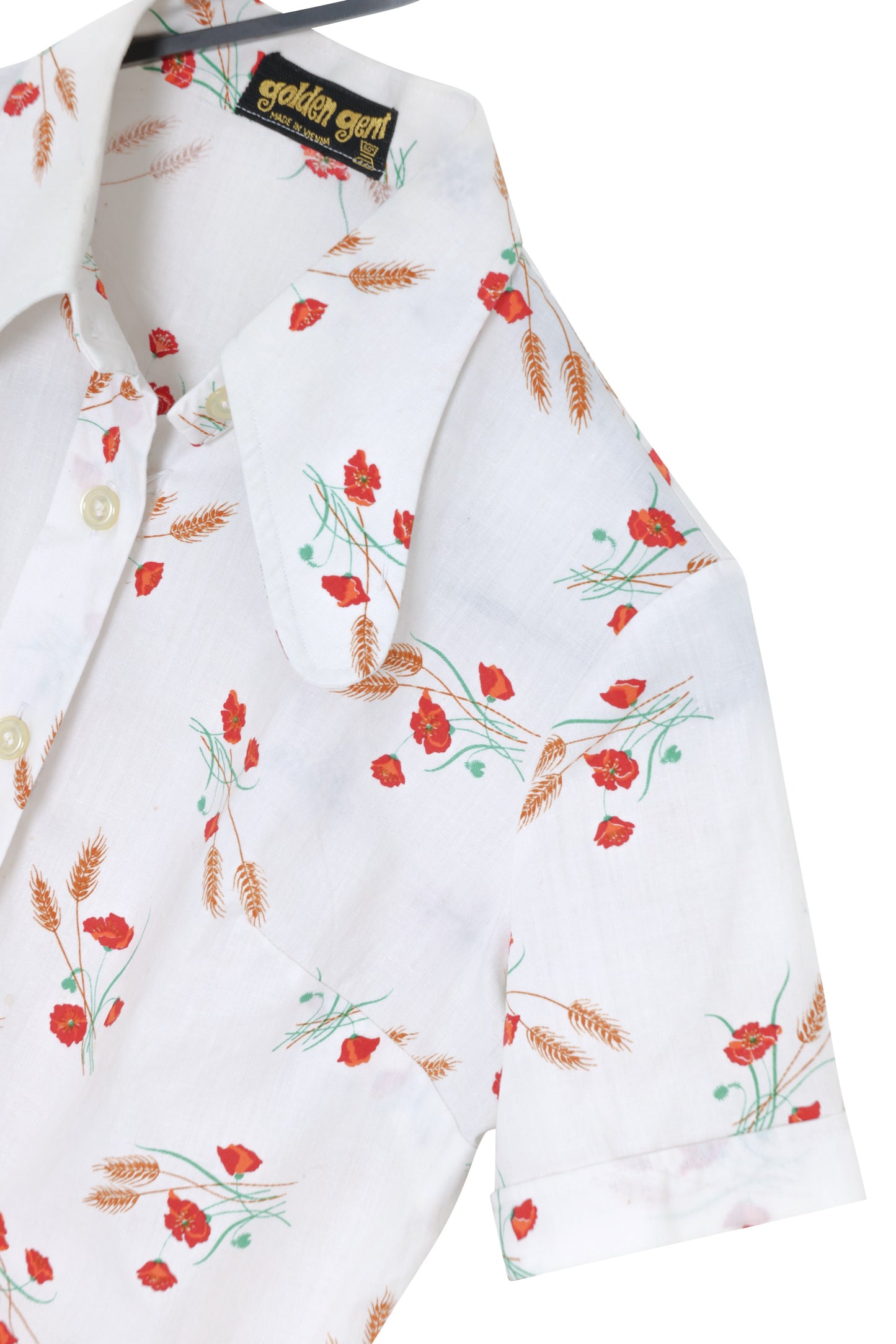
This garment is a short-sleeve button-front leisure shirt carrying a Golden Gent label and a Made in Vienna origin statement. The most defensible production range is circa 1975–1985, supported by the elongated spear-point collar, leisure-shirt format, lightweight printed white cloth, and Central European commercial menswear label style. The textile is a lightweight plain-weave, broadcloth-type or poplin-adjacent shirt cloth with a printed field motif of red poppies, green stems, and ochre wheat heads; fiber content remains unverified. Construction is industrial shirt manufacture with a shaped convertible collar, front button stand, short set-in sleeves, turned sleeve bands, and machine-stitched edge control. Its material importance lies in the intersection of Austrian urban commercial shirting, 1970s leisurewear codes, and a rural botanical print translated into light summer dress.
I. Designer Origin & Brand Profile
The label establishes Golden Gent as the commercial name and Made in Vienna as the manufacturing origin. The object record does not establish a named individual designer, design office archive, or couture authorship, so attribution should remain with the maker or label rather than a personal designer claim. Golden Gent presents itself through a black woven label with gold lettering, a branding formula suited to small or mid-market Central European menswear distribution. The shirt’s design language supports that attribution: it is not a tailoring exercise, but a retail leisure shirt built from standardized shirt components and a high-impact printed cloth. The Vienna origin matters because it places the garment within an Austrian commercial apparel setting, where city-based manufacture and retail labeling could coexist with modest production runs and locally distributed menswear.
II. Brand Heritage & Industry Influence
No extended brand history is established beyond the Golden Gent label and Vienna origin. The garment is best situated within Austrian and German-speaking Central European casual menswear of the 1970s and early 1980s, when leisure shirts with elongated collars, synthetic or cotton-blend shirting cloths, and printed novelty motifs were widely present in summer wardrobes. The shirt participates in the broader European sport-shirt tradition, distinct from formal dress shirting through its open collar behavior, short sleeves, botanical print, and relaxed body. Vienna’s relevance is not merely geographic; it indicates a Central European retail and manufacturing sphere in which locally labeled shirts could absorb international leisurewear silhouettes while retaining regional commercial identity. The wheat and poppy print introduces an agrarian field vocabulary into an urban leisure garment, a familiar late twentieth-century maneuver in casual shirting.
III. Garment Classification & Design Intent
The garment is a short-sleeve leisure shirt, also classifiable as a sport shirt or casual summer shirt. It is designed for warm-weather wear, informal social settings, travel, resort-adjacent use, or everyday leisure dress rather than office shirting. The defining features are the full button front, lightweight white ground, repeated floral-and-grain print, short set-in sleeves, and extended spear-point collar. The collar is central to the shirt’s period placement: its long points and generous fall create the 1970s-derived neckline geometry that separates it from later compact casual collars. The design intent is decorative ease with basic shirt functionality, using print scale and collar proportion to give presence to an otherwise simple body block.
IV. Construction Methodology & Engineering
The shirt is constructed through standard industrial shirt assembly. The front panels carry a buttoned closure with a narrow formed front stand or placket treatment, set with light-colored plastic buttons and machine-made buttonholes. The collar is cut as a long-point convertible form, probably with a light fusible or sewn-in support sufficient to hold the point shape without producing formal dress-shirt stiffness. The sleeve seams and side seams are machine joined, with short sleeves finished by turned bands or cuff-like hems. The shoulder and armscye relationships indicate a conventional set-in sleeve shirt block with moderate ease. The cloth’s lightweight plain weave requires controlled seam tension, as excessive needle heat or thread pull would distort the white ground and print surface.
V. Technical Design Elements & Detailing
The primary technical detail is the printed botanical field motif. Red poppy heads, ochre wheat ears, and green stems are distributed across the white ground in spaced repeat, allowing the shirt to remain visually light despite its saturated red accents. The motif is not engineered to match across seams; it functions as an allover print compatible with economical cutting. The spear-point collar is the strongest structural detail, with long tapered points, a broad fall, and a soft roll at the neckline. The short sleeve bands are finished as clean turned edges, giving the sleeve a slightly framed termination. The button choice is modest and commercially standard, selected to support function without competing with the print.
VI. Style Nomenclature & Historical Evolution
The correct style nomenclature is printed leisure shirt, short-sleeve sport shirt, or summer casual shirt with a spear-point convertible collar. Its historical lineage descends from postwar sport shirts, open-collar leisure shirts, resort shirts, and 1970s printed casual menswear. The long collar point has precedents in late 1960s and 1970s shirting, when collar points lengthened and neck openings became more expressive across casual and dress categories. By the late 1970s and early 1980s, this collar language continued in commercial shirts even as body blocks remained simple. The printed white ground links the garment to summer shirting and leisurewear rather than occupational or formal use. The wheat-and-poppy motif gives it a field-print character related to botanical novelty shirting, not Hawaiian, military, workwear, or western shirt categories.
VII. Fabric Composition & Textile Engineering
Fiber content remains unverified. The cloth structure is best identified as a lightweight plain-weave shirting, broadcloth-type or poplin-adjacent in handle, with a smooth white ground and printed surface decoration. It should not be treated as jersey, rib, interlock, twill, satin, or crepe; the surface reads as a fine woven shirting cloth with low pile, modest opacity, and enough stability to support a pointed collar and button front. The cloth likely sits in a summer shirting range, light enough for short-sleeve wear but not sheer to the point of instability. The print is surface-applied in discrete colors, with red, ochre, green, and small yellow accents forming the botanical repeat. Breathability, wash behavior, and wrinkle response would depend on fiber content; the structural evidence supports a cotton-handle or cotton-blend reading, but the exact fiber cannot be named without label confirmation. The white ground increases the importance of laundering history, underarm discoloration checks, collar soil, and print retention.
VIII. Construction & Pattern Analysis
The pattern architecture is a conventional straight shirt block with short sleeves and minimal body shaping. The front and back panels are cut for ease rather than close contouring, suitable for warm-weather movement and untucked wear. The collar is drafted with extended points and a soft stand relationship, producing a convertible neckline that can sit open without a tie. The collar fall is proportionally large in relation to the upper chest, a period marker and a key part of the shirt’s design architecture. The sleeve is a set-in short sleeve with a simple hem band, requiring less labor than a separate cuff and placket system. Assembly sequence likely followed collar preparation, shoulder joining, collar setting, sleeve setting, side closure, front finishing, hem finishing, buttonholing, and button attachment.
IX. Structural Integrity & Panel Configuration
The garment’s structural demands are moderate because the cloth is light and the intended use is casual. The main strain zones are the collar seam, front button stand, sleeve hems, armscyes, underarm seams, and lower hem. The long collar points require either light internal support or careful cloth doubling to prevent collapse and curling after laundering. The front closure must maintain alignment across a lightweight body cloth, so button spacing and placket stability are important. The short sleeves reduce cuff stress but place more responsibility on the sleeve hem band to resist rolling and abrasion. The shoulder seams and armscyes carry normal movement load, and the loose shirt block reduces strain across the chest and back.
X. Edge Finishing, Seam Termination & Closures
The edges are resolved through machine-stitched shirt finishing. The collar edges are turned, stitched, and shaped into long points, with the seam allowances graded sufficiently to avoid bulky tips. The front closure uses pale plastic buttons and machine buttonholes, anchored through a formed front band. The short sleeve edges are finished by turned bands or cuff-like hems, stitched flat for a neat termination. The lower hem appears straight and light, compatible with casual untucked wear. There is no lapel construction in the tailored sense; the front opening and collar fall create a shirt neckline break, not a jacket lapel. The neckline is finished through the collar attachment seam and interior label area, where the neck edge must manage both collar roll and hanger abrasion.
XI. Edge Treatment, Wearability & Manufacturing Context
The manufacturing context is small-to-medium commercial shirt production, likely for Austrian or German-speaking Central European retail. Production efficiency is supported by the simple body block, short sleeves, allover print, standard buttons, and absence of pockets or complex yokes in the documented object record. Labor is concentrated in collar point accuracy, front buttonhole alignment, sleeve hem regularity, and clean handling of the white cloth during sewing. The long collar increases cutting and pressing demands because uneven point shaping would be immediately apparent. The allover print reduces the need for matched cutting, improving material yield. Wearability is high in warm conditions: the cloth is light, the collar opens easily, the short sleeves reduce heat retention, and the straight body allows airflow.
XII. Conceptual Influence & Psychological Design Intent
The shirt’s conceptual framework rests on leisure, summer dress, and botanical field imagery. The red poppy and wheat print draws from rural flora and grain motifs but is rendered in a simplified commercial repeat suitable for casual menswear. The white ground gives the print an open field and keeps the garment aligned with warm-weather use. The spear-point collar adds period-specific sharpness to a soft leisure garment, connecting the shirt to 1970s dress codes without formalizing it. The design does not require a documented artistic movement to be meaningful; its cultural reading comes from the meeting of Central European manufacture, sport-shirt construction, and decorative field-print cloth.
XIII. Artistic & Aesthetic Direction
The aesthetic direction is late twentieth-century leisure classicism with botanical novelty print. The composition depends on contrast between the white ground and the small red poppy heads, with ochre wheat sprays and green stems adding linear movement across the cloth. The print scale is small enough to preserve shirt readability from a distance and detailed enough to reward close inspection. The collar’s long points create the main body-framing element, drawing attention to the neckline and upper chest. The absence of a chest pocket keeps the print field uninterrupted and reduces construction complexity. The garment’s design value lies in the balance between period collar geometry, light summer cloth, and repeated botanical motifs.
XIV. Historical Placement & Contextual Analysis
The strongest production range is circa 1975–1985. The long spear-point collar, short-sleeve leisure shirt format, light printed woven cloth, and gold-on-black label design all support a late 1970s to early 1980s placement more strongly than a later 1990s-to-2010 reading. Made in Vienna places the shirt within Austrian commercial garment production or local branded distribution, with the possibility of city-based retail manufacture or contract production for a Vienna label. The garment belongs to a period when European casual menswear adopted decorative prints, open collars, and softer leisure formats while retaining conventional shirt construction. It aligns with postwar sport-shirt evolution and the 1970s enlargement of collar proportions. The print’s poppy-and-wheat field vocabulary also suits Central European summer dress, where botanical and rural motifs could be absorbed into casual urban wardrobes.
XV. Use Case
The shirt is suited to warm-weather daywear: outdoor meals, travel, resort-adjacent use, casual retail or café settings, and informal summer social wear. It would sit naturally over light trousers, denim, cotton shorts, or summer-weight slacks, with the collar worn open to reduce neck heat and maintain the intended leisure silhouette. The short sleeves allow arm movement and ventilation, while the straight body accommodates seated wear and untucked styling. Layering should remain light; a heavy jacket would crush the long collar points and interrupt the print, while a light cardigan, linen jacket, or unstructured cotton jacket could accommodate the shirt if the collar is arranged carefully. Care demands center on the white ground, printed surface, collar points, and underarm area: laundering must control yellowing, print fading, button stress, and distortion of the long collar edge.
Share