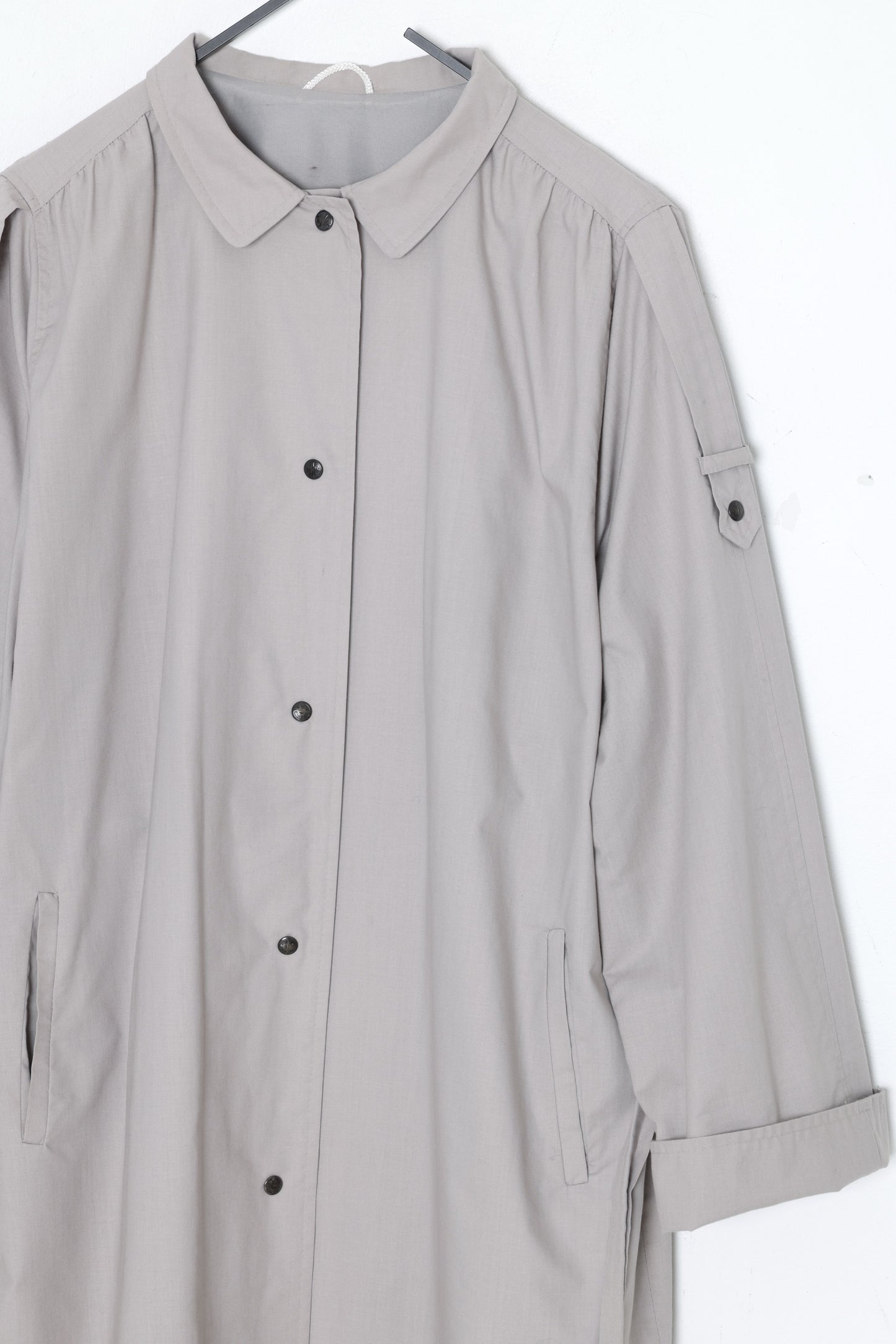
(Unattributed)
1988–1995, Swedish Duster in Technical Plain-Weave
1988–1995, Swedish Duster in Technical Plain-Weave
Couldn't load pickup availability
... approximate size: EU 38–40, US 6–8
Measurements (cm):
shoulder to shoulder: 42
sleeve (shoulder to cuff): 64
chest (pit to pit): 65
length (collar to hem): 115
SKU: 900933
This is a lightweight single-breasted utility raincoat or travel coat executed in a pale grey micro-textured woven cloth. The design belongs to a category of transitional-weather outerwear that became widespread during the late 1980s and early 1990s, particularly within European and Japanese commercial markets where understated functional clothing occupied an increasingly important segment between formal tailoring and sportswear. The coat combines a concealed front closure, shirt-derived collar architecture, sleeve-retention tabs, and a generously cut body intended to accommodate layered dressing. Construction evidence suggests factory manufacture with efficiency-driven assembly methods and moderate attention to durability. As an artifact, it represents a period in which outerwear increasingly abandoned overt military quotation in favor of simplified utility language intended for daily urban movement.
1. Designer Origin & Brand Profile
No identifying label is visible, preventing attribution to a specific designer or manufacturer. Nevertheless, the garment demonstrates a coherent design philosophy common among commercially successful outerwear producers of the late twentieth century.
The coat prioritizes adaptability. Every major decision concerns accommodation: room for layering, weather flexibility, ease of movement, simplified maintenance, and compatibility with multiple wardrobes. The aesthetic objective is not dramatic silhouette creation but reduction of visual interference. Such garments were often marketed toward professional adults requiring reliable transitional-weather clothing without the visual assertiveness associated with trench coats or tailored overcoats.
From a design perspective, the garment belongs to a lineage of anonymous competence. Entire sectors of the apparel industry have been sustained by clothing that attracts little attention on a hanger and considerably more appreciation after three consecutive days of inconvenient weather.
2. Brand Heritage & Industry Influence
Although attribution remains unavailable, the garment reflects broader shifts occurring in commercial outerwear during the late 1980s and early 1990s.
Traditional rainwear categories increasingly merged with travel clothing, commuter outerwear, and casual city coats. Manufacturers responded by reducing tailoring requirements, simplifying silhouettes, and incorporating adaptable details such as roll-up sleeves, concealed plackets, and lighter-weight fabrics.
The garment illustrates this transition effectively. It occupies territory once controlled by structured raincoats and trench derivatives but does so through considerably simplified engineering. The resulting product required fewer labor hours, lower material consumption, and broader customer appeal.
3. Garment Classification & Design Intent
This garment is best classified as a lightweight raincoat, travel coat, or utility walking coat.
Its purpose appears directed toward mild to moderate weather conditions. The length provides protection extending below the hip and toward the knee while maintaining sufficient mobility for commuting, travel, and daily use.
The concealed front closure establishes visual continuity across the center front. Sleeve retention tabs indicate intended adaptability between full-length and rolled-sleeve configurations. The relaxed body shape suggests accommodation of layered garments beneath.
The design intent favors versatility over silhouette control. The wearer is expected to move through changing environments rather than remain within a single formal setting.
4. Construction Methodology & Engineering
Construction appears entirely machine assembled using conventional woven-garment production methods.
The garment likely follows a straightforward industrial sequence beginning with front and back body preparation, pocket insertion, sleeve construction, collar assembly, placket preparation, and final body integration.
Visible seams appear relatively fine and consistent. Stitch density suggests medium-weight lockstitch construction throughout. No evidence indicates extensive hand-finishing.
The concealed placket introduces a modest increase in manufacturing complexity because closure components must be integrated between front layers while maintaining accurate alignment. However, the remainder of the garment demonstrates efficient production planning.
The coat appears intentionally designed to minimize labor-intensive operations while preserving a finished appearance.
5. Technical Design Elements & Precision Detailing
The defining technical feature is the concealed front closure system.
By hiding the button stand behind a clean front extension, the designer removes visual interruption and creates a continuous vertical plane. This approach also offers modest protection against wind and moisture penetration.
Sleeve-retention tabs positioned along the upper arm represent a secondary functional detail. These allow sleeves to be rolled and secured during warmer conditions. Such features became increasingly common in travel garments during the late twentieth century.
The gathered shoulder treatment deserves attention. Soft gathering introduced beneath the shoulder panel creates additional sleeve volume without relying on pleating or dart systems. This increases mobility while maintaining a clean upper-body appearance.
The pockets are integrated discreetly into the front body with vertical openings that preserve the garment’s minimal visual language.
6. Style Nomenclature & Historical Evolution
The garment belongs to a family of raincoats and travel coats derived indirectly from twentieth-century utility outerwear.
Unlike traditional trench coats, it lacks storm shields, epaulettes, belt systems, throat latches, and extensive military detailing. Unlike classic car coats, it extends further in length and adopts a softer silhouette.
Its closest relatives appear among late-century commuter outerwear, Japanese travel garments, Scandinavian utility coats, and European casual rainwear.
The concealed placket, simplified collar, and relaxed fit align strongly with design directions emerging between approximately 1987 and 1995, when outerwear increasingly emphasized adaptability and reduced visual complexity.
7. Fabric Composition & Textile Engineering
The textile displays a finely textured micro-grid surface visible throughout the garment.
The cloth appears lightweight to medium weight, likely within approximately 120–180 GSM. Surface characteristics include a dry hand, low luster, modest body, and controlled drape. The fabric maintains shape sufficiently to preserve garment outline while remaining flexible enough to gather softly at the shoulders and sleeves.
The weave structure appears tightly constructed with fine yarns producing subtle textural regularity. Such construction would improve dimensional stability and moderate wind resistance while remaining comfortable during prolonged wear.
The fabric’s performance profile aligns appropriately with transitional-weather use. It balances airflow, movement, and structural retention without introducing excessive bulk.
8. Construction & Pattern Analysis
Pattern engineering reveals a garment designed around ease and accommodation.
The body appears substantially rectangular through the torso with minimal waist suppression. This choice increases fit tolerance across multiple body types and simplifies grading procedures during production.
The shoulder structure combines a horizontal shoulder panel with gathered body fullness beneath. This arrangement allows volume distribution without requiring elaborate armhole manipulation.
Collar construction consists of a soft shirt-style fall collar supported by a relatively low stand. The neckline is moderately open and designed to sit close to the base of the neck when fully buttoned.
Unlike tailored outerwear, no lapel system exists. The front opening resolves directly into the concealed placket. This dramatically simplifies pattern drafting because the designer avoids the additional geometries associated with revers, break lines, facings, and lapel roll management.
The collar is drafted to operate as a continuation of the neckline rather than as an independent sculptural element.
9. Structural Integrity & Panel Configuration
Structurally, the garment depends primarily on fabric integrity and seam placement.
Stress distribution occurs through the shoulder seams, armhole junctions, pocket openings, cuff edges, and front closure points. Because the garment lacks substantial internal reinforcement, balance depends heavily upon accurate pattern geometry and seam execution.
The gathered shoulder treatment reduces stress concentration during arm movement by introducing controlled surplus fabric.
Pocket openings appear reinforced through folded welts or integrated facings. The front placket likely contains interfacing or stabilizing material preventing distortion around button placements.
The collar-neck junction appears well balanced and free from visible twisting or collapse.
10. Edge Finishing, Seam Termination & Closures
Edge finishing appears efficient and industrially appropriate.
The concealed front closure utilizes a folded front extension enclosing buttonholes and reducing exposure of fastening elements. This improves appearance while protecting closure hardware.
The collar edges are cleanly turned and stitched, likely containing lightweight fusible reinforcement to maintain shape.
Cuffs are finished through broad turned hems capable of being rolled without excessive bulk accumulation. This directly supports the sleeve-conversion function.
Hem treatment is not fully visible but appears to utilize a conventional turned finish suitable for lightweight outerwear.
The closure system consists of visible buttons mounted beneath the concealed extension. Attachment appears machine-compatible and serviceable.
11. Manufacturing Context, Production Scale & Industrial Feasibility
Production characteristics strongly indicate medium- to large-scale factory manufacture.
The pattern is economically drafted, requiring relatively few components. The absence of lapels, extensive tailoring, complex pocket systems, or articulated sleeve construction significantly reduces labor expenditure.
Gathered shoulder insertion requires some operator attention but remains efficient compared with tailored sleeve heads.
The concealed placket introduces moderate complexity while delivering substantial visual refinement. Manufacturers appreciate such features because customers often perceive them as evidence of sophistication despite their relatively modest production cost.
Overall labor input appears carefully managed. The garment achieves a finished appearance without demanding heroic intervention from sewing operators.
12. Conceptual Influence & Psychological Design Intent
The garment reflects a late-century preference for adaptable clothing positioned between formality and leisure.
Its design language suggests movement, travel, and flexibility. Nothing within the garment insists upon a specific social environment. It is equally compatible with commuting, shopping, office travel, or casual urban use.
Psychologically, concealed closures and reduced ornamentation project competence without announcing it. The garment avoids status signaling in favor of utility signaling. This distinction became increasingly important as professional dress codes loosened during the final decades of the twentieth century.
13. Artistic & Aesthetic Direction
The aesthetic direction can be described as late-modern functional minimalism.
Visual interest derives from proportion, surface texture, and subtle construction details rather than decorative additions. The shoulder gathers provide gentle volume. The concealed placket creates uninterrupted vertical continuity. The collar supplies a modest framing device around the neckline.
The coat exhibits affinities with Scandinavian functionalism, Japanese casual design, and European commuter outerwear of the same era. Its visual system is disciplined and intentionally uneventful.
One suspects the designer regarded overt embellishment with approximately the same enthusiasm normally reserved for administrative audits.
14. Historical Placement & Contextual Analysis
The strongest dating indicators are the silhouette, concealed closure treatment, shoulder gathering, sleeve-conversion tabs, and collar proportions.
These elements collectively support a production period most plausibly situated between approximately 1988 and 1996.
The garment differs from earlier rainwear traditions through its reduced structure and absence of military-derived components. It also predates the highly technical laminated-shell outerwear that gained wider market penetration during the late 1990s and early 2000s.
Its construction methods, silhouette, and detailing align convincingly with late twentieth-century commercial outerwear intended for broad urban consumption.
Use Case
This garment is designed for transitional weather and extended daily wear. Its ideal environment is movement between interior and exterior settings where temperature variation, light precipitation, and changing activity levels require adaptable clothing.
The wearer demonstrates a preference for flexibility over strict formality. Layering garments beneath must remain relatively lightweight to preserve drape through the torso. Shirts, lightweight knitwear, and unstructured jackets integrate comfortably. Heavier tailored garments would begin competing with the coat’s intended volume distribution.
On the moving body, the coat performs through ease. The shoulder gathers release tension during reach and stride. The concealed placket preserves visual continuity while the broad sleeve hems allow adjustment according to temperature.
Share