adidas (Germany)
1988–1994, adidas Trefoil Weather-Shell Parka, Storm Placket
1988–1994, adidas Trefoil Weather-Shell Parka, Storm Placket
Couldn't load pickup availability
This is an adidas long utility parka or stadium-length sports outerwear coat, cut with an elongated straight body, dropped shoulders, concealed front fastening, diagonal zip-entry upper pockets, large lower patch pockets, and adjustable buckled sleeve straps. The most defensible production range is late 1980s to early 1990s, supported by the Trefoil branding, international flag size label, black-on-black sports-utility styling, and industrial machine construction typical of Adidas outerwear during that period. The shell is a compact, matte, plain-weave technical textile with a dry-to-smooth hand, light surface crinkle, moderate density, and enough body to sustain the coat’s vertical fall without tailoring canvas. Construction is serial industrial manufacture, not bespoke tailoring: the value rests in pattern economy, utility detailing, durable stitch execution, and brand-coded sportswear provenance. Its significance lies in the period when athletic companies extended beyond training kit into urban outerwear, producing garments that borrowed from military parkas, stadium coats, and commuter rainwear without troubling the wearer with unnecessary romance.
I. Designer Origin & Brand Profile
Adidas was founded in Germany by Adolf Dassler and developed from performance footwear into a broad sportswear house whose visual identity became inseparable from engineered athletic function and immediately legible marks. By the period suggested here, the Trefoil was no longer merely a badge of sport; it had become a cultural sign shared by athletes, terrace dress, hip-hop dress codes, campus wardrobes, and urban outerwear customers who wanted sports authority without wearing a competition uniform. This coat belongs to that expansionary Adidas world, where the brand converted training vocabulary into coats suitable for travel, sideline use, and city weather. Its authorship resides in an industrial sportswear design office, with priorities divided among coverage, pocket access, branding, packable utility, and manufacturable repeatability. From a designer’s perspective, the black monochrome surface reduces visual interruption so that proportion, pocket angles, collar scale, and cuff straps carry the garment’s character. From the patternmaker’s view, the coat is built from a broad rectangular torso block, dropped sleeve placement, and minimal close body shaping. From the sewing technician’s view, the object is a sequence of topstitched edges, zipper insertions, applied pockets, faced openings, and strap assemblies. From the production manager’s view, it is a costed garment with brand value concentrated in the label, patch, hardware, and functional outerwear details.
II. Brand Heritage & Industry Influence
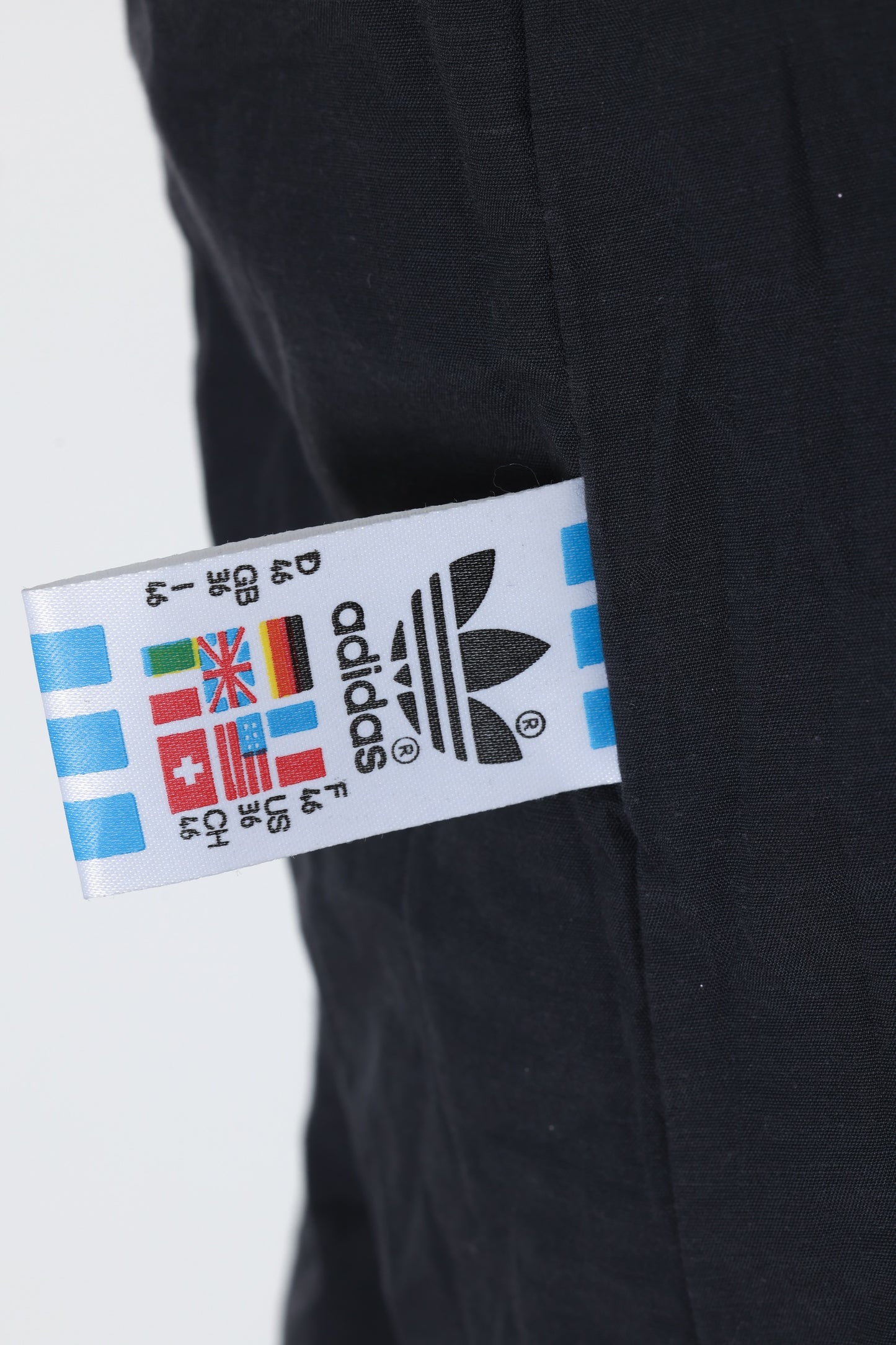
Adidas’ heritage is grounded in sport-specific equipment, but by the late twentieth century its influence reached beyond courts, tracks, and pitches. The Trefoil label visible inside this coat places the object within the brand’s heritage sportswear phase, before the later segmentation of performance, originals, and lifestyle categories became more sharply divided in retail language. The international size label with multiple country conversions indicates distribution across more than one market, consistent with a company operating through standardized global garment programs.
This coat reflects the era when sportswear companies helped normalize technical outerwear as everyday clothing. The industry influence here is not a singular runway event but a broader shift: athletic manufacturers gained authority in coats, shells, warm-ups, and city garments because their customers trusted them to understand movement, weather, and durable laundering. Manufacturing methodology was industrial, modular, and repeatable. The brand’s contribution lies in turning functional outerwear into a branded object with cultural portability. The small sleeve badge and interior Trefoil patch do the necessary heraldic work, sparing the garment the indignity of oversized decoration.
III. Garment Classification & Design Intent
The garment is best classified as a long utility parka, sports stadium coat, or weather-shell outerwear coat. It is not a formal overcoat, not a tailored car coat, and not a military parka in strict service terms, though it borrows from all three at selected points. The intended setting is outdoor transit, sideline wear, casual urban weather protection, and layered winter or transitional dressing. Its length suggests coverage over jackets, knitwear, or track clothing; its pocketing suggests hand warming and small-item carriage; its adjustable cuffs suggest wind management and sleeve-volume control.
The design intent is functional anonymity sharpened by sportswear codes. The black compact shell lets the garment sit across age, gender, and context with minimal visual conflict. The long vertical body gives coverage, while the dropped shoulder and straight side line allow layering beneath. The collar frames the face and neck with more structure than a hooded anorak would provide, and the concealed front closure turns the zipper into infrastructure, not ornament. In commercial terms, this is an outerwear piece designed to broaden Adidas’ wardrobe presence beyond training, a useful ambition, if not exactly a philosophical crisis.
IV. Construction Methodology & Engineering
The coat is machine assembled with visible double rows of topstitching at major seams, pocket edges, collar perimeter, front placket, sleeve straps, and hem zones. The stitching appears consistent in density and placement, suggesting industrial lockstitch production with edge guides used for parallel stitch rows. Seams visible at the shoulder, sleeve head, yoke-like upper chest panels, pocket applications, and cuff bands are topstitched for flattening and reinforcement. The stitch type is most plausibly single-needle lockstitch for exposed seams, with internal seam finishing likely overlocked or bound where raw edges require containment.
The front closure combines a full-length molded-tooth zipper with an overlying storm placket. The placket is stitched down along the front edge and secured near the neckline with at least one snap fastener visible on the inner flap. This closure system distributes wind and moisture resistance between the mechanical zipper and the fabric shield. The diagonal upper pockets are zipper-set into the front panels, with narrow welts or turned-edge zipper guards stitched around the opening. The lower pockets are applied patch forms, topstitched along the perimeter, with shaped upper edge integration into the coat’s horizontal body seam.
The collar is a major structural component. It is a convertible point collar with a broad fall, likely made as a two-piece collar or folded collar unit with internal support. The collar edges are turned, pressed, and topstitched with at least two rows near the perimeter, producing enough firmness to keep the points extended and the fall stable. There is no lapel formation in the tailored sense. Instead, the front facings and storm placket create a closed-front neckline architecture, with the collar sitting over the upper front and back neck seam. The collar roll is soft and functional, not pad-stitched; it is governed by fabric body, seam turn, internal support, and topstitching.
V. Technical Design Elements & Precision Detailing
The defining details are the diagonal zip-entry chest pockets, oversized lower applied pockets, concealed front placket, buckled cuff straps, dropped shoulder construction, and multiple brand identifiers. The diagonal pocket angle improves access when the arms hang naturally, especially for a wearer carrying a bag or wearing gloves. The zipper insertion is neatly controlled, with stitching lines close enough to secure the zipper tape without excessive puckering. The zip pullers are small and dark, consistent with a black utility design where hardware is present but not visually loud.
The lower patch pockets are large, rectangular, and slightly softened by the shell textile’s drape. Their top edges appear integrated with a horizontal seam or flap-like panel, giving both reinforcement and visual width across the lower torso. From a patternmaking perspective, this horizontal division helps break the long body panel, limiting distortion in a long coat cut from lightweight shell cloth. From a sewing standpoint, the pocket perimeter stitching must manage fabric creep; the visible result suggests competent factory handling, though the slight rippling is normal for this material type and length of seam.
The cuff straps are especially informative. Each sleeve has a fabric strap threaded through dark metal rectangular hardware, with several parallel stitch rows running lengthwise through the strap and cuff band. These rows add body, prevent the strap from collapsing, and echo military and trench-coat cuff vocabulary. The strap ends are turned and topstitched; the hardware attachment points are stress zones and appear reinforced through multiple fabric layers. This is decorative utility: it adjusts little in a severe technical sense, but it tells the sleeve to behave.
VI. Style Nomenclature & Historical Evolution
The correct style nomenclature is long parka, utility parka, stadium coat, or sports outerwear coat. The garment descends from several twentieth-century outerwear types: military parkas with protective length and storm closures, trench coats with belted cuffs, field coats with applied pocketing, and stadium coats intended for warmth and coverage during outdoor sporting activity. Adidas translates those sources into a branded sportswear object using lighter shell construction, standardized sizing, and logo placement.
The collar belongs to the lineage of convertible coat collars and shirt-derived point collars used on raincoats, macs, work coats, and casual parkas. Unlike a tailored notched lapel coat, this design does not create a chest-exposing V or a formal break line. Its neckline system is closed and protective. The absence of lapels is historically meaningful: this is not a garment asking to be read as tailoring. It prioritizes zipped closure, collar coverage, and weather-facing posture. Within late twentieth-century fashion, such coats gained urban relevance because they bridged sportswear, commuting, and casual dress with less ceremony than wool overcoats.
VII. Fabric Composition & Textile Engineering
The shell textile is a black compact plain weave with a matte surface, slight dry sheen under angled light, and visible fine crosswise and lengthwise yarn structure. It has light crinkle memory and moderate density, indicating a tightly woven technical cloth designed for outerwear use. Fiber content is not visible in the provided label images; because the textile presents with the smooth, compact, low-absorbency behavior associated with late twentieth-century technical shell fabrics, the fiber name should not be asserted without a content label or burn/microscopy test. The observable properties are more valuable here than guesswork in a lab coat.
Estimated fabric mass, by visual behavior, falls in the light-to-mid outerwear range, approximately 110–180 GSM for the shell alone, though this cannot be confirmed without weighing a measured sample. The cloth resists limp collapse but does not have the heavy hand of cotton drill or wool coating. It supports long vertical panels with some surface wrinkling, indicating enough tensile stability for a coat length but limited inherent sculptural capacity. Abrasion resistance is likely adequate for urban outerwear, particularly at sleeves and pocket areas, but long-term wear would be expected at cuff edges, zipper guards, strap folds, and pocket corners.
Secondary materials include zipper tapes and molded teeth, snap hardware, dark metal strap hardware, woven labels, sleeve patch embroidery or woven appliqué, and probable internal facings. The collar and cuffs appear to contain additional internal support or layered shell fabric, giving them more thickness than the body panels. If an interlining or light insulation is present, it is not aggressively lofted; the garment reads as a weather coat with mild padding or structured layering, not a deep winter down parka.
VIII. Construction & Pattern Analysis
The pattern architecture is based on a generous straight body block with dropped shoulders and long set-in sleeves. The shoulder seam sits low on the upper arm, reducing the need for precise shoulder fit and increasing accommodation for layered clothing underneath. The torso panels appear broad, with minimal darting and little waist suppression. The front is divided by a central zipper and storm placket; upper diagonal zip pockets are inserted into the front panels; lower patch pockets are applied below a horizontal seam line. The back is not fully visible, but the front evidence suggests a simple long coat block designed for material yield and production repeatability.
Grain orientation appears vertical through the center front and body panels, with sleeve grain running along sleeve length. The collar is likely cut with its fall on stable grain or slightly shaped grain to keep the points from twisting. The collar attachment requires a controlled neckline curve: back neck, shoulder neck points, and front opening must align so the collar can sit flat when open and close adequately when zipped. The topstitched collar edge stabilizes the perimeter and compensates for any softness in the shell textile. No lapel components are drafted. The front facing and placket are the substitutes for lapel structure, creating a protective center-front spine.
Assembly likely followed an efficient factory sequence: construct pockets and zipper openings on front panels; join shoulder and body seams; set sleeves; assemble collar; attach collar to neckline with facing or binding; set front zipper; apply storm placket; finish cuffs with strap assemblies; close side and sleeve seams where sequencing permits; attach lower pockets if not already applied; finish hem; add labels and brand patches. Stitch density appears moderate, probably in the range of 8–11 stitches per inch on visible topstitching, consistent with outerwear shell cloth. Thread appears dark and medium weight, selected for durability and visual absorption into the black surface.
IX. Structural Integrity & Panel Configuration
The coat’s structural integrity depends less on tailoring internals and more on distributed topstitching, layered edges, reinforced pockets, and hardware anchoring. The long body panels are vulnerable to vertical wrinkling and handling distortion, but the horizontal seam above the lower pockets and the central placket interrupt the expanse and stabilize the front. The dropped shoulder increases mobility by sacrificing tailored shoulder definition, a trade any production manager would approve before lunch. Arm mobility is aided by the oversized sleeve cap and generous sleeve circumference, though the long coat length may restrict stride slightly if the hem circumference is not broad enough.
Stress concentrates at the zipper base, top snap, pocket-entry ends, cuff-strap anchors, shoulder-sleeve junctions, and collar-neckline intersection. The diagonal zip pockets have bar-tack-like reinforcement or dense stitching at the ends, or at minimum close stitch termination; these zones require reinforcement because diagonal openings pull under hand entry. The applied lower pockets distribute load through perimeter topstitching, but their upper corners remain probable abrasion and strain points. The collar neckline is reinforced through seam layering and topstitching, and the rear hanging loop visible inside adds another stress point at the back neck. The loop is useful, but if the coat is repeatedly hung wet or loaded, it can stress the back-neck seam. The garment will tolerate ordinary use; it should not be treated as mountaineering equipment, however sternly it dresses in black.
X. Edge Finishing, Seam Termination & Closures
The major edges are resolved through turned-and-stitched construction. The collar perimeter is turned, internally supported, and topstitched in parallel rows, producing a flat, firm edge. The front storm placket is similarly turned and stitched, with its edge thickness controlled well enough to lie straight along the zipper. Sleeve cuffs are finished with a hemmed edge and an additional strap band system; the cuff strap ends are folded inward and topstitched, minimizing raw-edge exposure. The hem appears machine turned and stitched, likely with internal seam allowance enclosed within the fold.
Closures include a full-length central zipper, at least one snap at the upper placket, zippered diagonal pockets, an interior zip pocket, and adjustable sleeve strap hardware. The central zipper is the primary closure; the storm flap protects it and visually suppresses it. The molded zipper teeth are appropriate for outerwear because they resist distortion better than fine coil in heavier use, though they are more visually present when exposed. The pocket zippers use smaller teeth or coil construction and narrow zipper tapes, reducing bulk at the chest. The sleeve hardware is darkened metal, rectangular, and sewn into fabric channels; its durability depends on the strength of the strap attachment and the abrasion behavior of the strap fabric as it passes through the hardware.
There are no lapel edges, no gorge seam, no break line, and no pad-stitched roll. The neckline is resolved through collar attachment and front facing integration. The collar’s roll behavior is soft, with the collar fall lying over the upper chest when open. When closed, the front zipper and snap bring the neckline inward, allowing the collar to stand partially around the neck. This hybrid open-closed capacity is the defining feature of the convertible collar in this garment.
XI. Edge Techniques, Neckline Wearability & Manufacturing Context
The visible finishing system favors machine efficiency: turned edges, topstitching, zipper tape insertion, applied patch pockets, and hardware straps. There is no evidence of hand tailoring, hand-rolled edges, bound couture seam allowances, or canvas shaping. If internal seam allowances are overlocked, that would be consistent with industrial outerwear manufacture of the period. If they are turned under at selected exposed locations, that would be a localized finishing decision for areas visible when the garment hangs open.
The neckline depth is high because the zipper closes toward the base of the collar, giving weather protection across the upper chest. The collar can frame the neck without needing a hood, making the coat compatible with scarves, crew-neck knits, collared shirts, and track tops. The cuffs are adjustable, though their wide strap format is also a style marker borrowed from trench and military vocabulary. The hem is long and straight, placing the garment in the category of coverage outerwear; wearability depends on layering and stride allowance.
Manufacturing scale was almost certainly industrial serial production. The garment contains multiple operations, but none requires couture-level hand labor. Cost resides in pocket zippers, main zipper length, collar construction, cuff hardware, labels, and the labor time needed for strap quilting and pocket insertion. The collar setting is more demanding than a hooded drawstring neckline because the collar must sit evenly at the neck and align symmetrically with the front opening. The absence of lapel pad stitching reduces labor. The production manager would see a moderately complex outerwear style: more costly than a simple coach jacket, less complex than a fully insulated expedition parka or tailored overcoat.
XII. Conceptual Influence & Psychological Design Intent
The garment communicates protection, anonymity, and branded competence through black surface, long coverage, concealed closure, and controlled hardware. Its conceptual sources are not hidden: sports sideline coats, city rainwear, field-utility garments, and late twentieth-century monochrome street dressing all sit within the design. The psychological effect is produced by coverage and enclosure. The wearer is not displayed by the coat so much as contained by it.
The Trefoil mark softens the severity of the black utility form by connecting it to sports culture. This matters. A plain black long coat can suggest bureaucracy, security work, clerical gloom, or a person with strong opinions about doors. The Adidas branding moves the reading toward athletic leisure, streetwear, and casual outerwear. The diagonal pockets add action to the front plane, while the cuff straps suggest adjustment and equipment. The concept is therefore not luxury and not uniform, but sports-derived urban utility.
XIII. Artistic & Aesthetic Direction
Aesthetically, the coat belongs to late twentieth-century sports minimalism and utility monochrome. Its composition is built from vertical center-front structure, diagonal pocket cuts, horizontal lower-pocket division, and repeated topstitching. The black surface reduces color hierarchy, forcing the eye to read seam lines, hardware, patch placement, and silhouette. The garment has neither avant-garde distortion nor classical tailoring discipline; it occupies the middle territory where industrial design and everyday wear negotiate tolerably well.
The collar is central to the visual system. A hood would have pushed the garment toward anorak or expedition parka typology. A notched lapel would have falsely invoked tailoring. The point collar gives the coat a workwear-raincoat ancestry while preserving sportswear utility. Its scale is broad enough to frame the face and shoulders, and the topstitched edge supplies graphic definition. The lack of lapels keeps the front uninterrupted and reinforces the central placket as the visual spine. The neckline treatment therefore controls the garment’s identity: closed, protective, and casual, with no interest in pretending to be a suit coat.
XIV. Historical Placement & Contextual Analysis
The probable production date is circa late 1980s to early 1990s. Evidence includes the Trefoil label, the multi-country size tag using D, GB, F, I, US, and CH conversions, the black sports-utility styling, the long stadium-coat format, and the industrial construction vocabulary. The garment aligns with a period when sports brands expanded heavily into outerwear and when monochrome, oversized, logo-bearing garments circulated through streetwear, terrace culture, campus clothing, and travel wardrobes.
Historically, the garment belongs to the evolution of the parka from military and expedition use into commercial sportswear. Its long body recalls stadium coats and cold-weather team outerwear. Its collar and storm placket recall raincoats and field coats. Its cuff straps borrow from trench-coat adjustment systems, though in simplified sportswear form. The diagonal zip pockets reflect late twentieth-century outerwear design, where pocket access became a visible graphic device. The object is period-relevant because it records the moment when athletic branding and utility outerwear became ordinary companions, a partnership that has shown remarkable stamina and no small amount of retail confidence.
XV. Use Case
This coat performs best in a day involving transit, outdoor waiting, light weather exposure, and layered casual clothing. It begins at the front door, over a sweatshirt, track jacket, wool jumper, or shirt and cardigan combination, with the zipper drawn partway up and the collar allowed to fall open until wind makes manners irrelevant. It functions on a train platform, at a weekend match, during a walk across a wet campus, or in an urban commute where pockets must accept keys, gloves, wallet, tickets, and hands seeking temporary refuge.
Share