(Poland)
1988–1993, Polish Velvet Leisure Trouser with High Waist Suppression
1988–1993, Polish Velvet Leisure Trouser with High Waist Suppression
Couldn't load pickup availability
~ EU 34–36, US S
SKU: 909956
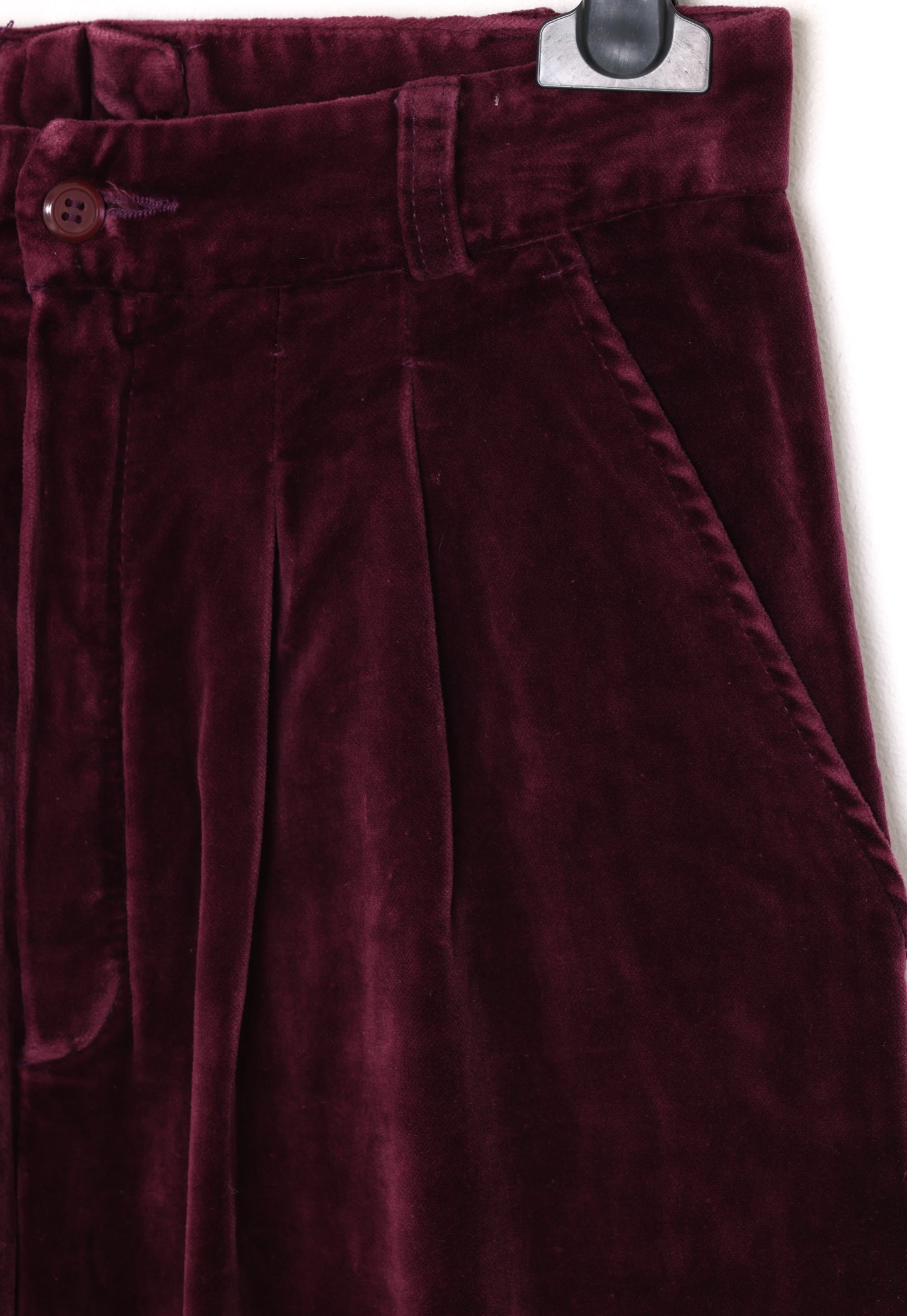
This is a high-rise pleated trouser constructed from a cotton velvet textile characterized by a dense cut pile and pronounced directional nap. The label identifies the garment as 100% bomull and manufactured in Poland. Based on silhouette, waist treatment, pleat configuration, and overall proportion, a production window spanning the late 1980s through early 1990s appears most defensible. The garment combines traditional tailored trouser drafting principles with the softer volume preferences that emerged in European casual and leisurewear during the final decades of the twentieth century. Although industrially produced, the cut demonstrates an understanding of controlled fullness, using front pleats and a tapered leg to balance comfort with a disciplined silhouette.
I. Designer Origin & Brand Profile
The garment should be approached as an anonymous industrial artifact originating from the Polish manufacturing sector during the post-socialist transition period or its immediate precursor. Such garments frequently occupied a space between formal tailoring and leisure dressing, borrowing pattern structures from menswear while adapting them for a broader commercial audience.
From a design perspective, the defining decision is the juxtaposition of a traditionally tailored trouser block with a textile normally associated with eveningwear, loungewear, or seasonal luxury dressing. The silhouette privileges volume in the upper leg before gradually reducing circumference toward the hem. This distribution suggests a designer or production team familiar with European tailoring traditions but attentive to changing preferences toward softer and less rigid body shaping.
II. Brand Heritage & Industry Influence
Without a surviving maker’s identification, the garment’s historical significance derives from manufacturing context rather than brand prestige. Polish apparel production during the late twentieth century occupied an important position within European garment supply networks. Factories routinely produced apparel for domestic consumption as well as export contracts, often utilizing pattern systems derived from Western European tailoring traditions.
The garment demonstrates a manufacturing culture that valued efficient assembly while retaining recognizable tailoring conventions. It belongs to a category of clothing that helped bridge the gap between structured postwar dress standards and the increasingly relaxed dressing practices of the late twentieth century. Its influence is therefore indirect, reflecting broader industrial shifts rather than originating them.
III. Garment Classification & Design Intent
The garment is most accurately classified as a high-rise double-pleated tapered trouser executed in cotton velvet. It occupies the territory between casual tailoring and elevated leisurewear.
Its intended function appears to be social and semi-formal use during cooler seasons. The pile surface introduces visual richness, while the relatively conservative waistband, fly arrangement, and pocket treatment maintain familiarity. The designer’s objective was not experimentation but controlled enhancement of an established trouser form through material selection and proportion management.
The silhouette places visual emphasis on the upper body and waist region through pleat expansion, then directs the eye downward through gradual reduction of volume. This method produces a balanced profile that remains wearable despite the inherently substantial visual presence of velvet.
IV. Construction Methodology & Engineering
Visible evidence indicates conventional industrial trouser assembly. The waistband appears separately constructed and attached following completion of major body assembly. Belt loops are inserted into the waistband seam in a standard production sequence.
The center-front closure is concealed behind a fly shield. A button closure appears present at the waistband. The pleats are sharply integrated into the waistband seam, suggesting assembly after careful pressing and stabilization.
Pocket entries are formed along diagonal side seams extending from the waist toward the hip. This configuration distributes stress effectively while reducing interruption of the front visual field.
Construction appears optimized for repeatability. No evidence suggests couture hand-finishing or bespoke methods. The engineering objective was durability, production efficiency, and silhouette control.
V. Technical Design Elements & Precision Detailing
The garment’s primary design feature is the pair of forward-facing pleats positioned on each side of the fly front. These pleats introduce fullness at the waist while maintaining visual order.
The velvet surface functions as an active design element. Because pile fabrics change appearance according to light direction and wear, the material generates tonal variation without requiring printed decoration or applied embellishment.
The side pockets are integrated cleanly into the silhouette. Their placement prevents excessive interruption of the pile surface while maintaining utility.
A noteworthy detail is the apparent depth of the rise. This creates additional room through the seat and upper thigh, allowing the pleats to function structurally rather than merely decoratively.
VI. Style Nomenclature & Historical Evolution
The garment belongs to the family of pleated tapered trousers descended from tailored menswear traditions of the early twentieth century.
The pleated trouser emerged as a dominant tailoring form during the 1920s and 1930s, when increased fullness and ease became fashionable. Subsequent decades alternated between fuller and narrower silhouettes. During the late 1980s and early 1990s, pleated trousers experienced renewed popularity across both menswear and womenswear.
This example aligns most closely with the European relaxed tailoring movement of that period. The combination of generous upper-leg volume and narrowing hem reflects contemporary interpretations of classical pleated trousers while avoiding the exaggerated proportions sometimes associated with fashion-forward variants.
VII. Fabric Composition & Textile Engineering
The label identifies the shell as 100% cotton. The textile exhibits the characteristics of cotton velvet, including dense pile formation, directional reflectivity, substantial body, and variable tonal depth created by changes in nap orientation.
Estimated fabric weight likely falls within a medium-to-heavy apparel range suitable for autumn and winter wear. The cloth demonstrates moderate drape while retaining enough structural integrity to support pleat definition.
Abrasion resistance in cotton velvet is generally concentrated in the ground weave rather than the pile surface. Areas subject to repeated friction typically exhibit pile compression before structural degradation occurs. The submitted example shows characteristic nap variation consistent with handling and prior use.
The fabric choice supports the garment’s intended function. The material provides visual richness while preserving breathability beyond what would typically be expected from denser pile textiles.
VIII. Construction & Pattern Analysis
Pattern architecture appears rooted in a conventional four-panel trouser system consisting of paired front and back leg sections. The fullness is introduced primarily through pleating and upper-leg circumference rather than through extreme side-seam manipulation.
Grain orientation appears straightforward and efficient. The pile direction seems consistently aligned throughout the visible sections, indicating attention to velvet cutting protocols. Failure to maintain consistent nap orientation produces immediate visual disruption, a problem apparently avoided here.
The front panels accommodate volume through two pleats per side. This permits substantial waist suppression without excessive shaping seams. The resulting geometry allows expansion across the abdomen and thigh while preserving a relatively clean exterior appearance.
The taper appears gradual and controlled, suggesting pattern reduction distributed along inseam and side seam simultaneously rather than concentrated at a single point.
IX. Structural Integrity & Panel Configuration
The structural system depends primarily upon fabric stability, waistband support, and pleat engineering. Unlike tailored jackets, trousers possess limited internal reinforcement opportunities, making pattern balance particularly important.
Stress concentration occurs at the waistband, fly opening, pocket entries, crotch junction, and seat seam. The waistband functions as the principal load-bearing component, distributing tension generated during wear.
The pleats perform both aesthetic and mechanical roles. They create expansion capacity while reducing strain across the front rise. The generous upper-leg dimensions further reduce localized stress concentrations.
From a patternmaking perspective, the garment demonstrates competent proportional control. The volume is concentrated where mobility demands it and reduced where excessive fullness would compromise visual balance.
X. Edge Finishing, Seam Termination & Closures
The waistband appears finished with a conventional button closure. The fly construction likely incorporates a zipper concealed beneath a fly extension, consistent with industrial practice during the period.
Pocket openings appear reinforced through seam integration rather than visible topstitching. This method improves visual continuity across pile fabrics, where excessive stitching can interrupt surface uniformity.
The hems are turned and machine secured. Their moderate depth provides weight at the lower edge, assisting vertical hang and reducing twisting.
Seam terminations likely utilize overlocked seam allowances internally, reflecting common European production methods. Such finishing offers durability while minimizing bulk, particularly important when working with velvet fabrics.
XI. Manufacturing Context, Production Scale & Industrial Feasibility
Everything visible suggests medium-scale industrial production. The garment contains sufficient complexity to require skilled operators but lacks the labor intensity associated with bespoke or atelier manufacture.
Pleat formation, fly assembly, waistband construction, pocket insertion, and pile-fabric handling all require competent production sequencing. Velvet introduces additional cutting and quality-control demands because mismatched nap orientation becomes immediately apparent.
Material consumption exceeds that of a narrow trouser due to the generous upper-leg volume. Nevertheless, the pattern remains economically viable for industrial manufacturing.
The garment represents a commercially sensible balance between elevated material selection and standardized production methodology.
XII. Conceptual Influence & Psychological Design Intent
The conceptual foundation is rooted in familiar tailoring forms elevated through textile choice. Velvet historically carries associations with formality, domestic luxury, artistic dress, and seasonal elegance. By applying that material to a relaxed pleated trouser, the designer introduces visual richness without fundamentally altering the garment’s function.
Psychologically, the garment offers comfort disguised as formality. The wearer experiences ease through volume while projecting greater intentionality through the textile surface. Fashion history contains many examples of this arrangement; comfort often arrives disguised as sophistication to secure social approval.
XIII. Artistic & Aesthetic Direction
The aesthetic direction is best understood as late twentieth-century European soft tailoring. The visual language avoids overt decoration and instead relies upon silhouette and surface.
The deep wine coloration interacts dramatically with the pile structure, creating shifting areas of light absorption and reflection. This visual instability gives the garment greater presence than its underlying pattern would otherwise achieve.
Its aesthetic success depends upon proportion. A narrower leg would produce excessive visual density; a wider hem would risk excessive mass. The existing balance preserves coherence.
XIV. Historical Placement & Contextual Analysis
The strongest historical indicators point toward the late 1980s or early 1990s. These indicators include the high rise, pleated front, relaxed thigh circumference, tapered lower leg, and use of richly colored velvet in casual tailoring contexts.
The garment reflects a moment when tailoring traditions remained influential but were increasingly interpreted through softer silhouettes and less formal contexts. It stands between the rigid dress codes of earlier decades and the more casual apparel systems that would dominate the early twenty-first century.
As a typological object, it occupies a recognizable position within European leisure tailoring. It is neither formal evening dress nor conventional workwear. Its purpose lies in social dressing where texture carries as much significance as silhouette.
XV. Use Case
The garment functions most effectively in environments where surface richness can be appreciated at conversational distance. It belongs to galleries, restaurants, winter gatherings, small cultural events, and urban social settings. It has little interest in manual labor and would regard athletic activity with visible irritation.
The wearer is not defined by occupation but by a sequence of decisions. They have chosen texture over graphic display, volume over compression, and material character over technical performance. Adjacent garments must accommodate these choices. Jackets benefit from abbreviated lengths or softly structured cuts. Footwear requires enough visual weight to anchor the expanded upper leg. Lightweight tops risk becoming subordinate to the density of the velvet surface.
Share