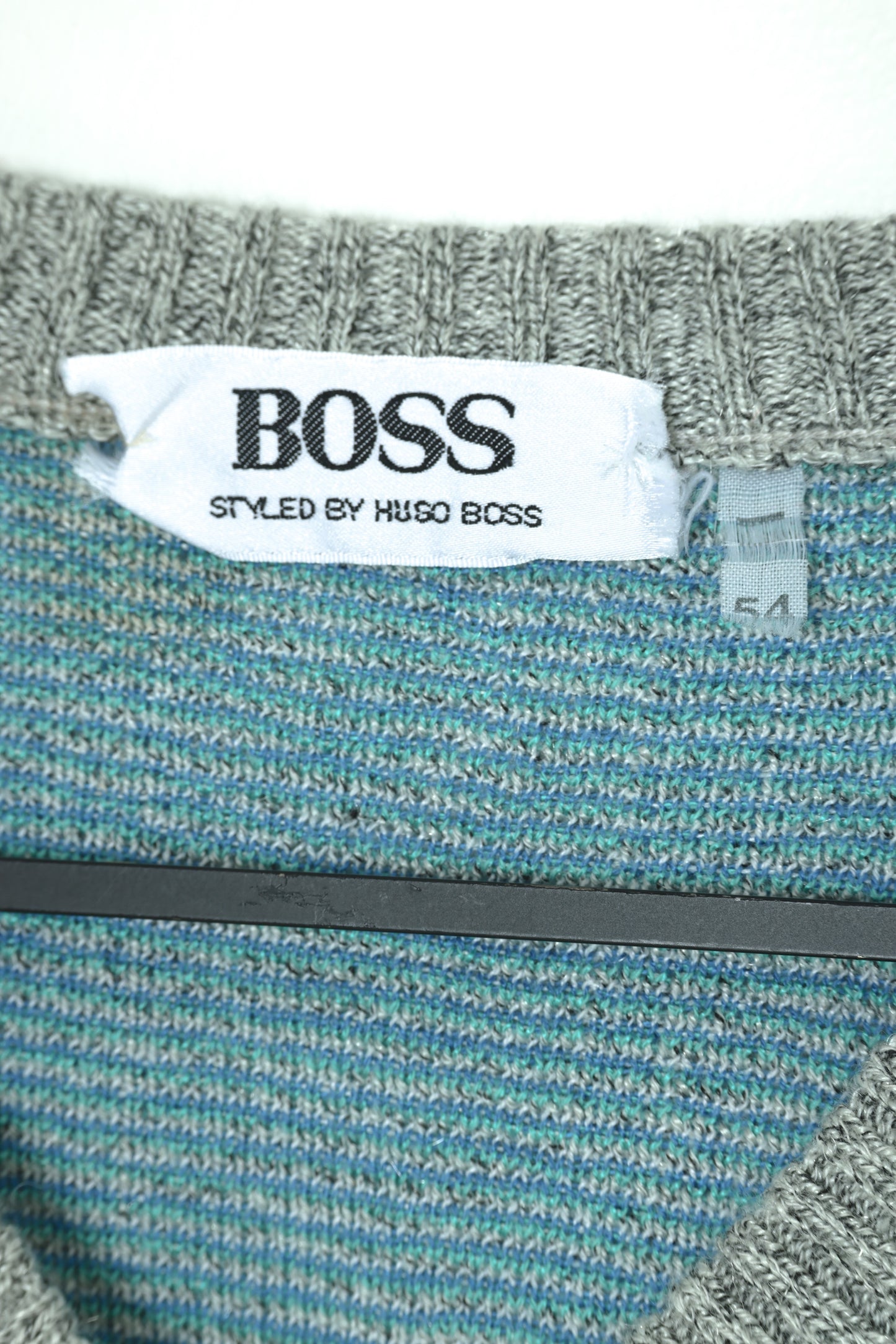
HUGO BOSS (West Germany)
1988–1993, German Gauge-Engineered Float-Jacquard Flame Knit
1988–1993, German Gauge-Engineered Float-Jacquard Flame Knit
Couldn't load pickup availability
~ EU 50–54, US L–XL
Measurements (cm):
shoulder to shoulder: 52
sleeve (shoulder to cuff): 59
chest (pit to pit): 60
length (collar to hem): 68
SKU: 900955
This is a V-neck patterned sweater produced under the BOSS Styled by Hugo Boss label, most plausibly dating from the late 1980s through the early 1990s. The garment is executed in a machine-knitted jacquard structure utilizing multiple colored yarn systems to generate an abstract vertical motif combining marl effects, stripe organization, and ikat-like visual fragmentation. Its proportions correspond closely to the relaxed upper-body silhouette prevalent in continental European menswear during the transitional period between late 1980s executive sportswear and early 1990s leisure dressing. Construction indicates industrial flat-bed knitwear production with integral pattern programming, ribbed stabilization zones, and efficient assembly techniques suitable for medium-to-large production runs. The sweater represents a moment when premium menswear brands sought visual complexity through knit engineering instead of tailoring, offering pattern density and chromatic variation as substitutes for conventional surface embellishment.
I. Designer Origin & Brand Profile
The BOSS label emerged as the principal menswear division of Hugo Boss during a period when the company was establishing itself as a major European producer of businesswear, sportswear, and coordinated lifestyle apparel. By the late 1980s the brand had expanded beyond its tailoring foundations and increasingly invested in knitwear programs designed to accompany jackets, outerwear, and casual separates. The label designation “BOSS Styled by Hugo Boss” is particularly associated with an era when branding architecture within the company emphasized contemporary European menswear with broad commercial appeal.
Design philosophy during this period focused on disciplined silhouettes supplemented by controlled visual interest. Whereas tailoring divisions expressed authority through shoulder architecture and cloth selection, knitwear divisions frequently relied upon engineered surface design. This sweater exemplifies that approach. Its visual identity is generated through programmed textile construction rather than applied ornament. The pattern functions as the garment’s primary design event, leaving the silhouette itself comparatively straightforward.
II. Brand Heritage & Industry Influence
Hugo Boss occupies a notable position within postwar German menswear development. By the 1980s and early 1990s the company had become associated with structured executive dressing, helping define the visual language of European professional menswear during an era of expanding corporate culture. Its influence extended beyond tailoring into coordinated sportswear systems that allowed consumers to assemble complete wardrobes under a single brand identity.
This sweater belongs to that broader expansion. It reflects the industry’s increasing reliance upon knitwear as a category capable of carrying fashion content without requiring radical silhouette changes. The garment demonstrates how premium menswear manufacturers adopted increasingly sophisticated computerized knitting technologies during the late twentieth century. While not avant-garde, such pieces helped normalize highly engineered knit surfaces within mainstream menswear markets.
III. Garment Classification & Design Intent
The garment is properly classified as a men’s V-neck jacquard pullover sweater. More specifically, it belongs to the category of patterned leisure knitwear intended for casual and semi-casual use.
The deep ribbed V-neck suggests layering over collared shirts, lightweight turtlenecks, or crew-neck undergarments. The dropped shoulder line and generous chest measurement indicate comfort-oriented proportions intended for movement and relaxed wear. The design objective was not athletic performance nor formal presentation. Instead, it occupied the territory between office-adjacent leisurewear and weekend sportswear.
Visual emphasis rests upon vertical pattern organization. The stripe framework elongates the torso while simultaneously containing irregular abstract forms that prevent the design from becoming excessively rigid. Such balancing acts occupied many knitwear designers of the period. One suspects several meetings were devoted to determining precisely how many stripes were required before management considered the pattern sufficiently expensive-looking.
IV. Construction Methodology & Engineering
The garment appears produced on an industrial flat-bed knitting system utilizing programmed jacquard patterning. The body and sleeves are knitted as separate panels and subsequently linked together during assembly.
The neckline is formed through a separately knitted rib band attached after body construction. The V apex exhibits linked assembly at the center front point, producing a stable neckline intersection. Rib construction appears approximately 1x1 or fine 2x2 configuration, providing recovery and dimensional control.
Shoulder seams appear linked rather than sewn using conventional lockstitch methods. This is consistent with quality knitwear manufacturing of the period. Sleeve attachment likely utilizes overedge linking, creating flexibility while minimizing seam bulk.
The cuff and hem bands function as structural stabilizers. Their reduced circumference relative to body dimensions creates controlled blousing above the waist and wrists. This technique contributes substantially to silhouette formation without requiring complicated shaping systems.
V. Technical Design Elements & Precision Detailing
The dominant technical feature is the engineered jacquard motif. The pattern combines vertical striping with irregular abstract forms resembling fragmented ikat imagery translated into machine-knit geometry. These forms are not printed but structurally embedded within the knitted fabric.
Multiple yarn colors are integrated simultaneously. The visual complexity results from careful stitch allocation across adjacent needle beds rather than post-production treatment.
The marl effect visible throughout portions of the ground introduces visual depth. Color transitions soften pattern boundaries while reducing the abruptness often associated with geometric jacquard constructions.
The V-neck rib is proportionally substantial relative to the body. This wider neck treatment visually anchors the pattern field and prevents the neckline from appearing overwhelmed by the surrounding motif density.
VI. Style Nomenclature & Historical Evolution
This garment belongs within the lineage of patterned continental leisure sweaters that gained prominence during the late 1980s and early 1990s. Its nearest relatives include abstract jacquard pullovers, geometric leisure knits, and the broader family of statement-pattern menswear sweaters.
Historically, such garments descend from several parallel traditions. One derives from mid-century sportswear knitwear. Another emerges from Scandinavian and Alpine pattern knitting. A third comes from increasingly computerized textile programming introduced during the 1970s and 1980s.
By the early 1990s manufacturers were able to generate highly complex visual surfaces without relying on hand-knitting traditions. The result was a category of sweaters that often appeared determined to demonstrate every available machine capability simultaneously. This example exhibits considerably more discipline than many contemporaries.
VII. Fabric Composition & Textile Engineering
No fiber label is visible, preventing definitive identification. However, observable characteristics suggest a yarn system emphasizing dimensional stability, moderate softness, and high color clarity.
The surface exhibits relatively low hairiness and a clean stitch definition. Reflectivity remains subdued. The textile displays moderate density without the lofty bloom associated with heavier woolen-spun constructions.
The structure appears medium gauge, likely in the range commonly used for transitional-season knitwear. Estimated fabric weight likely falls between approximately 280 and 420 GSM depending on yarn composition and finishing treatment.
Drape characteristics indicate moderate flexibility with sufficient body retention to maintain silhouette integrity. Recovery appears enhanced through ribbed stabilization zones. Abrasion performance would likely be strongest at the body panels and somewhat less robust along high-friction rib sections.
VIII. Construction & Pattern Analysis
The sweater appears produced using a medium-gauge flat-bed knitting system. Stitch definition remains visible despite pattern complexity, suggesting competent tension management during manufacturing.
Pattern architecture relies upon vertical organization. Body and sleeves maintain motif continuity across major panel transitions, indicating careful knitting program alignment. Such continuity is often overlooked in lower-cost production because pattern synchronization introduces additional planning requirements.
Panel configuration appears conventional. Front and back are likely separate knitted panels joined at shoulders and side seams. Sleeves are set into relatively low armhole positions consistent with dropped-shoulder construction.
The neckline architecture deserves particular attention. The V-neck opening is integrated into the front panel shaping rather than cut after knitting. Neck decreases appear symmetrically executed toward the center-front apex. The rib collar is attached after panel completion and folded inward to create structural thickness and edge durability. Unlike tailored lapel systems, the neckline relies entirely upon knitted tension balance for form retention.
IX. Structural Integrity & Panel Configuration
The garment’s structural performance derives primarily from knit engineering rather than internal support materials. No evidence suggests interfacing, canvas, shoulder reinforcement, or supplementary stabilizers.
Stress distribution concentrates at the neckline apex, shoulder seams, armhole intersections, cuffs, and waistband. These locations are appropriately reinforced through rib structures and seam joining techniques.
The dropped shoulder configuration reduces strain concentration at the shoulder point. The generous chest measurement provides ease across the torso, reducing tension during wear and enhancing garment longevity.
Panel balance appears successful. Neither excessive distortion nor asymmetrical pattern drift is visible. This indicates effective tension control throughout production.
X. Edge Finishing, Seam Termination & Closures
Edge finishing is accomplished entirely through knitted methods. The neckline, cuffs, and waistband employ ribbed constructions functioning simultaneously as finish and structural support.
The V-neck collar exhibits clean edge control. The center-front intersection appears carefully linked, minimizing bulk accumulation. The neckline roll behavior remains flat and stable, an important achievement in V-neck construction where distortion frequently develops through repeated wear.
Seam terminations likely rely on linked knitwear assembly techniques. These methods distribute stress more effectively than rigid woven-garment seam constructions.
As a pullover garment, no mechanical closure systems are present. Structural continuity therefore depends heavily upon neckline engineering and hem recovery characteristics.
XI. Manufacturing Context, Production Scale & Industrial Feasibility
Production methodology strongly suggests medium-to-large-scale industrial manufacturing. The sweater contains sufficient complexity to signal premium positioning while avoiding techniques incompatible with efficient production.
Computerized knitting substantially reduced labor requirements compared with hand-manipulated pattern systems. Once programmed, motifs could be reproduced consistently across multiple size runs.
Assembly requirements remain straightforward. Major labor inputs involve panel linking, neckline application, finishing, inspection, and pressing. The absence of applied trims, embroidery, or hand-finishing reduces production complexity.
From a production manager’s perspective, the garment represents an attractive compromise. It appears visually expensive while remaining highly compatible with industrial workflow. This is the sort of sweater accountants generally tolerate because the machine performs most of the dramatic work.
XII. Conceptual Influence & Psychological Design Intent
The visual language combines geometric order and controlled irregularity. Vertical stripes establish structure while abstract forms introduce movement and unpredictability.
The palette reinforces this duality. Cooler tones generate an impression of ease and informality without abandoning visual sophistication. The pattern invites attention but stops short of confrontation.
Psychologically, the garment functions as an alternative to overt tailoring. It signals participation in fashion-conscious dressing while maintaining the familiarity of a conventional pullover form. The wearer adopts visual distinction through textile engineering rather than silhouette disruption.
XIII. Artistic & Aesthetic Direction
The sweater occupies territory between late modernist graphics and commercial sportswear design. Its abstract forms possess echoes of ikat distortion translated through computerized knit technology. Simultaneously, the strict vertical orientation preserves a sense of order.
Proportionally, the garment reflects early 1990s menswear preferences. Shoulders extend beyond the anatomical frame, sleeves carry moderate volume, and the waistband gathers the body into a controlled blouson effect.
The V-neckline plays a significant compositional role. Its downward geometry interrupts the otherwise vertical organization of the pattern, directing attention toward the center chest and framing the face through converging lines.
XIV. Historical Placement & Contextual Analysis
Several indicators support a dating range between approximately 1988 and 1993. These include the label format, oversized body proportions, dropped shoulder configuration, engineered jacquard patterning, and color palette.
The garment aligns with a period when European menswear increasingly embraced decorative knitwear as a companion category to tailoring. Many manufacturers sought to balance businesswear credibility with growing consumer demand for casual garments.
Technologically, the sweater belongs to an era when computerized knitting equipment had become sophisticated enough to generate complex motifs economically while maintaining commercial scalability.
Within knitwear history, it represents a transitional object situated between the highly graphic sweaters of the late 1980s and the increasingly minimalist knitwear that would gain prominence later in the decade.
XV. Use Case
The garment performs most effectively in the interval between formal obligation and complete informality. It is designed for situations in which a jacket may be removed but visual presence remains desirable. The wearer is not making a declaration so much as avoiding anonymity.
A collared shirt beneath the V-neck would have been the period-correct pairing. Trousers require sufficient visual stability to offset the animated surface of the sweater. Aggressive patterns elsewhere in the outfit would create competition the garment neither needs nor benefits from.
In motion, the ribbed waistband gathers volume above the hip while the dropped shoulder allows the sleeve to move independently of the torso. The sweater succeeds when worn as the dominant visual component within an otherwise controlled ensemble.
As an artifact, it captures a specific moment in European menswear when knitwear briefly assumed responsibilities traditionally assigned to tailoring: visual authority, brand communication, and evidence of expenditure. Unlike many garments from that period, it remains coherent.
Share