(West Germany)
1987–1992, Lightweight Twill Officer Coat with Convertible Storm Collar
1987–1992, Lightweight Twill Officer Coat with Convertible Storm Collar
Couldn't load pickup availability
... approximate size: EU 40-42, US L
SKU: 900757
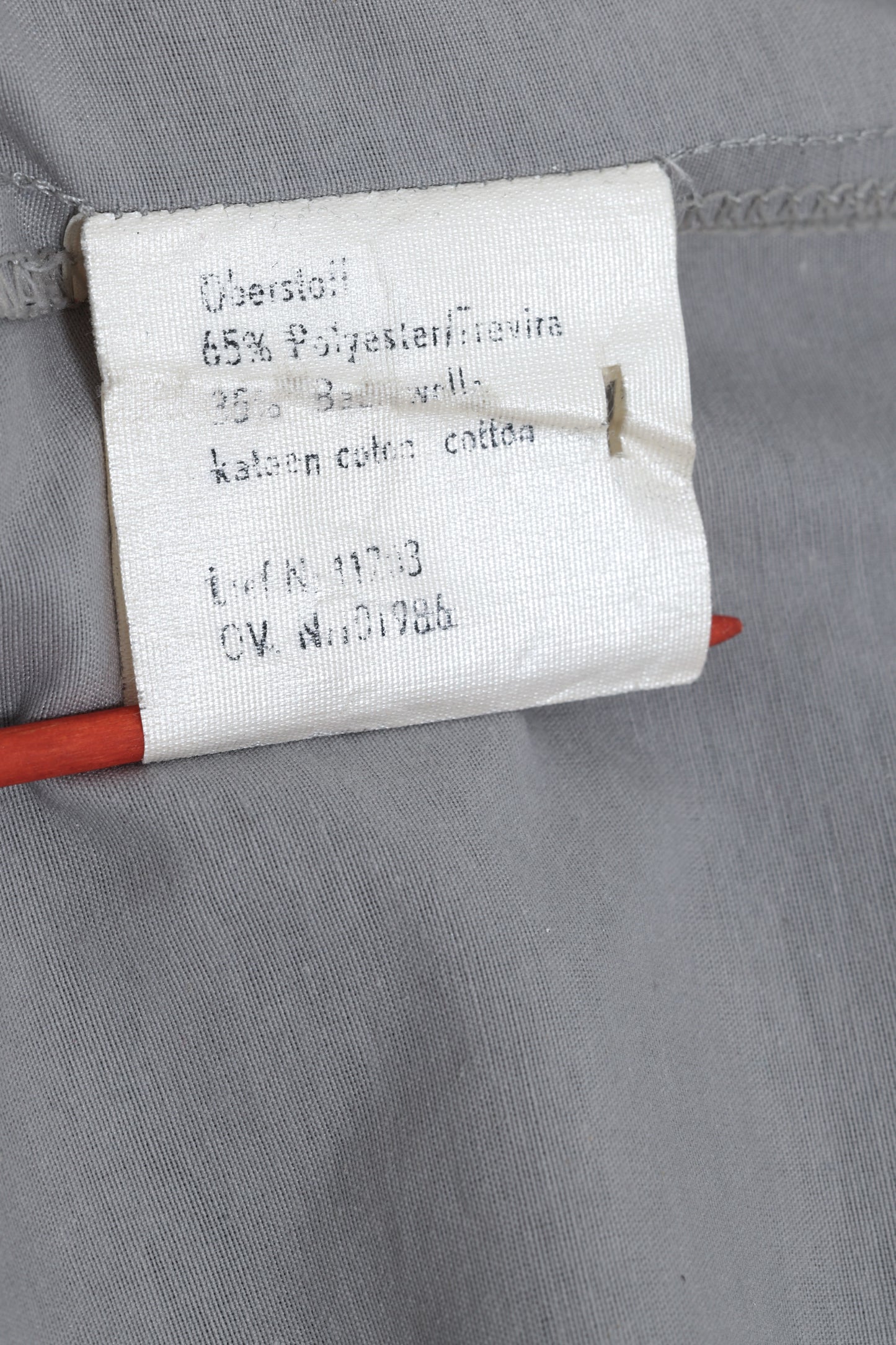
This double-breasted utility weather coat appears to originate from a late-1980s to early-1990s West German or broader Central European manufacturing context, identifiable through its labeling system, construction economy, textile blend notation, and softened military-administrative styling language. The garment is constructed from a lightweight matte twill identified on the interior label as 65% polyester and 35% cotton, producing a fabric with moderate tensile stability, low surface luster, compact weave density, and a dry mechanical drape that resists collapse while avoiding the stiffness associated with earlier coated rainwear systems. The silhouette merges trench-derived iconography with industrial simplification: epaulettes, cuff tabs, and a convertible storm collar remain present, while extensive internal tailoring infrastructure has been removed in favor of production efficiency and broad fit adaptability. Construction methodology indicates medium-scale industrial manufacturing with overlocked seam allowances, machine-set buttonholes, minimal interfacing, and low-labor finishing protocols. The coat occupies the territory between civilian rainwear, municipal uniform issue, and administrative outerwear.
Designer Origin & Brand Profile
No overt branding survives beyond a utilitarian size marker and textile-content label bearing German-language notation. The absence of marketing identifiers, decorative woven branding, or aspirational labeling strongly suggests either contract manufacturing, department-store private labeling, or municipal procurement production. This anonymity is itself diagnostically useful. The garment belongs to a strain of Central European outerwear manufacturing in which functionality, laundering durability, and sizing tolerance outweighed symbolic authorship.
The design language reflects a transitional period during which military and trench-derived garments were increasingly abstracted into civilian administrative dress. The coat borrows enough trench architecture to imply authority while avoiding the expense associated with true tailored trench production. Its broad dropped shoulder, simplified sleeve insertion, and hidden front closure indicate a manufacturer attentive to production throughput and broad consumer fit compatibility. There is no evidence of couture methodology, artisanal tailoring, or high-fashion experimentation. The coat instead demonstrates the industrial confidence of late Cold War outerwear manufacturing: a garment designed by committees familiar with inventories, not manifestos.
Brand Heritage & Industry Influence
Although attribution remains indeterminate, the garment aligns strongly with late-1980s German and Austrian utility outerwear systems that occupied the middle territory between formal raincoats and occupational wear. During this period, manufacturers increasingly adopted blended twills capable of repeated laundering, dimensional retention, and lower pressing requirements. The textile blend listed on the label corresponds directly with this industrial trajectory.
The coat reflects a historical moment in which trench-coat iconography migrated downward into broader civilian markets. Earlier trench systems relied upon substantial tailoring structures, wool interlinings, storm shields, sleeve heads, and carefully balanced chest architecture. By the late twentieth century, many of these features had been selectively retained as visual shorthand while internal engineering was aggressively simplified. Here, epaulettes survive despite the absence of military function. Double-breasting survives despite the garment’s comparatively soft front structure. The coat gestures toward command while quietly admitting it would prefer not to work weekends.
Garment Classification & Design Intent
This garment is best classified as a lightweight double-breasted utility weather coat with convertible trench-derived collar architecture and dolman-raglan hybrid sleeve drafting. It is intended for transitional climate use rather than severe weather protection. The textile lacks the density, coating, or laminated backing associated with technical rainwear, yet the broad overlap and concealed closure provide moderate wind protection.
Its intended environment appears administrative, urban, and semi-professional. The oversized body permits layering over tailoring or knitwear without excessive strain at the armhole or chest. The coat’s visual system attempts institutional authority through proportion and familiar trench references while maintaining ease of movement and laundering practicality. It is not military issue, though it borrows military grammar fluently enough to suggest someone in procurement admired uniforms from a comfortable distance.
Construction Methodology & Engineering
Assembly is fully industrial and highly rationalized. Interior seams are overlocked using multi-thread serger finishing, visible along center-back and interior vertical seams. Construction sequencing indicates large-scale factory workflow prioritizing speed and repeatability. Seam allowances appear narrow and standardized, likely between 1 cm and 1.2 cm, minimizing textile waste and facilitating rapid assembly alignment.
Buttonholes are machine-worked with moderate stitch density and slight fraying at entry points, suggesting either wear or economical thread tension calibration during production. Buttons are molded plastic with a matte grey finish coordinated tonally to the shell fabric, an efficient and visually disciplined choice typical of institutional outerwear.
The front closure system combines concealed fly-front architecture with double-breasted internal anchoring. This arrangement reduces visual interruption across the torso while preserving weather overlap. The front facings appear lightly fused rather than canvas-supported. There is no indication of pad stitching, chest floating, or hand-shaped roll memory. Lapel behavior is therefore dependent primarily on pressing and textile response rather than tailored sculpting.
Technical Design Elements & Precision Detailing
The coat’s defining technical feature is its hybridized upper-body geometry. The shoulder line extends outward through a softened dropped configuration, while the sleeve insertion merges aspects of dolman and shallow raglan drafting. This reduces armhole stress concentration and permits efficient movement despite the garment’s straight body volume.
The chest yoke seam functions visually more than structurally, though it may conceal stabilization tape or serve as a distribution line for front shaping. The angled pocket flaps are notable for their asymmetrical positioning relative to the center front. Their geometry introduces directional movement otherwise absent from the garment’s restrained surface treatment.
Epaulettes and cuff tabs are minimally interfaced and attached with simple rectangular reinforcement stitching. Their retention appears iconographic rather than functional. Still, they provide visual segmentation across the large uninterrupted planes of fabric. Without them, the coat risks resembling institutional bedding.
Style Nomenclature & Historical Evolution
The garment occupies a lineage descending from trench coats, officer raincoats, and administrative field overcoats of the mid-twentieth century. Its convertible collar and double-breasted closure derive directly from military outerwear traditions established during the First and Second World Wars. By the 1980s, however, these references had become semi-detached from martial necessity and were widely incorporated into civilian weatherwear.
The silhouette reflects late-1980s volume expansion trends visible across European outerwear, particularly in garments designed to accommodate layered tailoring beneath. The broad shoulder and elongated body correspond with the era’s preference for enlarged upper-body proportions, though executed here through utility drafting rather than fashion exaggeration.
Unlike classic trench systems with set-in sleeves and tailored chest shaping, this coat simplifies the typology into a looser administrative format. It belongs less to the battlefield than to municipal corridors with fluorescent lighting and uncertain ventilation.
Fabric Composition & Textile Engineering
The label identifies a 65/35 blend combining synthetic filament-based fibers with cotton in twill construction. The textile surface exhibits low sheen, moderate compactness, and fine diagonal twill visibility under magnification. Estimated fabric weight falls between 160 and 210 GSM.
The fabric demonstrates moderate crease retention with quick recovery characteristics typical of blended utility twills. Surface behavior suggests abrasion resistance superior to pure cotton while maintaining sufficient breathability for temperate wear conditions. Drape remains controlled but not fluid; the cloth breaks in shallow folds rather than dense sculptural collapses.
The textile appears piece-dyed after weaving, producing even chromatic distribution across panels. The pale grey coloration minimizes visible fading while simultaneously revealing stress wrinkles and wear creases with remarkable honesty. Few textiles document seated administrative labor with such efficiency.
Pattern Architecture, Panel Configuration & Cut
The body appears drafted through large simplified front and back panels minimizing seam complexity. Side seams remain straight with minimal waist suppression. The absence of darts indicates reliance on volume rather than contour shaping.
The sleeve system deserves particular attention. The cut combines a dropped shoulder extension with shallow integrated sleeve shaping, reducing assembly complexity and improving fit tolerance across multiple body types. This drafting method lowers manufacturing rejection rates and reduces fitting sensitivity during grading.
Collar construction consists of a convertible turn-down collar attached to a lightly structured neckline stand. The collar points are elongated and moderately narrow, corresponding stylistically with late-1980s proportions. When closed fully, the neckline forms a high protective overlap. When worn open, the front edge rolls into broad trench-derived rever formations despite lacking traditional lapel facings.
The break line is press-established rather than structurally engineered. There is little evidence of undercollar pad stitching or hidden collar canvas. Roll behavior consequently remains soft and somewhat unstable, though appropriate to the garment’s lightweight intent.
Construction Systems, Stitch Engineering & Assembly
Primary seams are lockstitched with medium stitch density, likely between 8 and 10 SPI. Overlocked finishing is consistent internally, indicating synchronized industrial workflow rather than mixed-method production.
Hem finishing appears double-turned and machine topstitched. Collar edges are cleanly turned with edge stitching placed narrowly from the perimeter, maintaining visual sharpness without excessive rigidity. Button attachment is machine executed with thread shanks sufficient for medium-weight layering beneath the closure overlap.
Pocket flaps are topstitched and lightly reinforced at insertion points. There is no evidence of bartack reinforcement at high-strain corners, indicating moderate-duty civilian use expectations rather than occupational hard wear.
Structural Integrity & Panel Configuration
The coat derives structural coherence primarily through textile behavior and volumetric drafting instead of internal reinforcement. There is little evidence of chest canvas, shoulder padding, or substantial interfacing. The shoulder line therefore falls naturally from the body rather than projecting outward through tailored engineering.
Stress distribution is effectively managed through generous ease allocation. Armhole strain is minimized by the lowered shoulder geometry. Front overlap distributes tension evenly across the double-breasted closure system. The center front remains visually stable despite the absence of significant interfacing due to the relatively lightweight shell.
Neckline intersections are competently stabilized, though not heavily reinforced. Collar attachment seams appear clean and evenly tensioned. The garment benefits from the fact that its textile carries little weight; heavier cloth would likely expose the limitations of the internal support structure quite rapidly.
Edge Finishing, Seam Termination & Closures
Edge finishing throughout is economical but disciplined. Interior seams are overlocked with no decorative binding or concealed finishing. Facings are narrow and production-oriented, minimizing material consumption.
The concealed front placket is particularly effective visually. It reduces interruption across the torso and contributes to the garment’s subdued administrative severity. Lapel edges terminate cleanly, though the absence of substantial internal shaping produces somewhat flattened rever behavior when worn open.
Cuff tabs are functional and permit slight circumference adjustment. Their construction remains straightforward: folded self-fabric with machine-stitched perimeter finishing and button anchoring. Closure durability appears adequate for ordinary wear cycles, though repeated laundering may eventually soften edge definition around buttonholes.
Manufacturing Context, Production Scale & Industrial Feasibility
This garment was almost certainly produced in medium-to-large-scale industrial manufacturing conditions. Construction methods indicate assembly-line sequencing optimized for labor efficiency. The simplified sleeve architecture significantly reduces insertion difficulty and increases throughput consistency.
The coat avoids labor-intensive tailoring operations almost entirely. No evidence suggests hand-finishing, hand-felled lining insertion, pad stitching, or individualized pressing stages. Textile waste appears carefully controlled through broad panel utilization and limited curved seam geometry.
Production feasibility is high. This design could be manufactured rapidly with comparatively low skill dependency once pattern grading and assembly specifications were standardized. The garment sits squarely within late twentieth-century European industrial outerwear systems in which efficiency, durability, and visual acceptability achieved an uneasy but durable coalition.
Conceptual Influence & Psychological Design Intent
The coat projects institutional legitimacy through familiar trench-derived signals while carefully avoiding full military severity. Its softened geometry reduces aggression without abandoning authority altogether. The pale grey coloration contributes significantly to this effect. Black would have suggested enforcement. Beige would have suggested suburban ambition. Grey suggests administrative continuity and a filing cabinet nearby.
Psychologically, the garment communicates reliability, anonymity, and procedural competence. It belongs to environments where one signs forms, carries folded newspapers, and arrives slightly early to train platforms. The design avoids flamboyance completely, though its oversized proportions and concealed front create moments of surprising sculptural elegance in motion.
Artistic & Aesthetic Direction
Aesthetically, the coat aligns with late modernist utility design filtered through civilian outerwear traditions. The visual composition relies on planar continuity, muted tonal uniformity, and controlled geometric interruption through flaps, epaulettes, and button placements.
The collar architecture is central to this visual system. Closed, the neckline forms a disciplined vertical enclosure emphasizing the frontal plane. Open, the collar collapses into broad angular rever formations that widen the chest visually and soften the otherwise severe front geometry.
There are traces of minimalist industrial design language here, though expressed through garment manufacturing instead of conceptual fashion discourse. The coat achieves its strongest visual effect when moving; static presentation risks understating the subtle proportional intelligence embedded in the cut.
Historical Placement & Contextual Analysis
The garment most plausibly dates between 1987 and 1993. Several details support this chronology: oversized shoulder proportion, simplified trench references, concealed closure treatment, broad body ease, and the specific industrial finishing methods visible internally.
The label typography and textile blend notation correspond strongly with late Cold War and immediate post-Cold War Central European garment production. The use of lightweight blended twill instead of heavier gabardine or coated cotton reflects broader shifts in outerwear manufacturing during this period toward washable, low-maintenance utility textiles.
This coat exists within the final generation of analog administrative outerwear before technical laminates, bonded synthetics, and overt performance branding transformed weatherwear aesthetics during the 1990s.
Use Case
The garment performs best during transitional urban movement: railway platforms, municipal offices, university corridors, archive storage facilities, and overcast city centers where rain threatens intermittently but never commits fully. The oversized body accommodates tailoring beneath without distortion, though structured jackets with strong sleeveheads may compete awkwardly against the dropped shoulder geometry.
The wearer is not defined by personality so much as by accumulated procedural habits. They require a coat capable of surviving variable climates, public transportation seating, and repeated weekday wear without attracting discussion. Trousers beneath must remain relatively straight and unexaggerated to maintain proportional equilibrium. Footwear should possess enough mass to stabilize the elongated silhouette; delicate shoes would appear abandoned beneath it.
The coat begins functioning the moment weather becomes inconvenient but not catastrophic. It is not storm equipment. It is infrastructure.
Share