(Netherlands)
1986, Quilted Thermal Collarless Combat Liner Jacket for Dutch Service Use
1986, Quilted Thermal Collarless Combat Liner Jacket for Dutch Service Use
Couldn't load pickup availability
~ EU 50, US L
Measurements (cm):
shoulder to shoulder: 46
sleeve (shoulder to cuff): 62
chest (pit to pit): 60
length (collar to hem): 70
SKU: 900943
This is a military-issued insulated liner jacket manufactured in 1986 by Gebr. v.d. Kloot-Meijburg for Dutch service use. Designed as an intermediate thermal layer rather than a standalone outer garment, it utilizes a diamond-quilted shell enclosing lightweight insulating fill distributed through a regular stitch matrix. The label designation, production year, and military-style stock coding strongly indicate quartermaster procurement rather than civilian retail manufacture. Construction prioritizes thermal retention, low production cost, repairability, and compatibility with a larger field garment system. Although such liners have become popular in contemporary fashion circles, their original purpose was entirely functional: preserving body heat while generating minimal administrative excitement, a quality military procurement offices have historically regarded as a virtue.
I. Designer Origin & Brand Profile
The manufacturer identified on the label, Gebr. v.d. Kloot-Meijburg, appears associated with contract garment production rather than fashion authorship. This distinction is significant. The garment emerges from a procurement environment where success is measured by specification compliance, durability, thermal performance, and manufacturing consistency. Design decisions therefore originate from military requirements, technical standards, and logistical considerations rather than seasonal aesthetic agendas.
The visual character of the jacket derives almost entirely from engineering necessity. The diamond quilting stabilizes insulation. The collarless neckline reduces bulk beneath a field jacket. The hook-and-loop closure enables rapid dressing. The knitted cuffs reduce heat loss. Every visible feature serves a defined operational purpose.
II. Brand Heritage & Industry Influence
Military liner jackets occupy an important position within twentieth-century garment manufacturing because they represent modular clothing systems at industrial scale. Throughout the Cold War period, European armed forces increasingly adopted layered clothing strategies allowing thermal regulation across varied climates.
Manufacturers such as Gebr. v.d. Kloot-Meijburg participated in a production ecosystem emphasizing interchangeability, standardization, and predictable performance. The influence of these garments on civilian fashion became particularly visible from the 1990s onward, when surplus markets exposed designers to utilitarian construction methods. Contemporary fashion’s enthusiasm for quilted liners often treats them as novel design objects. Military quartermasters arrived at the same solutions decades earlier while attempting to keep soldiers warm and procurement budgets tolerably stable.
III. Garment Classification & Design Intent
This garment is properly classified as a thermal liner jacket or insulated field-jacket insert. It was designed to function beneath an outer shell rather than as independent outerwear.
Several indicators support this classification. The collarless neckline eliminates bulk beneath a shell collar. The front closure is narrow and lightweight. The quilted structure prioritizes insulation over abrasion resistance. The relatively short body length facilitates layering beneath combat garments without interfering with mobility.
Its intended setting was military service during cool or cold weather conditions, likely integrated within a broader field clothing system.
IV. Construction Methodology & Engineering
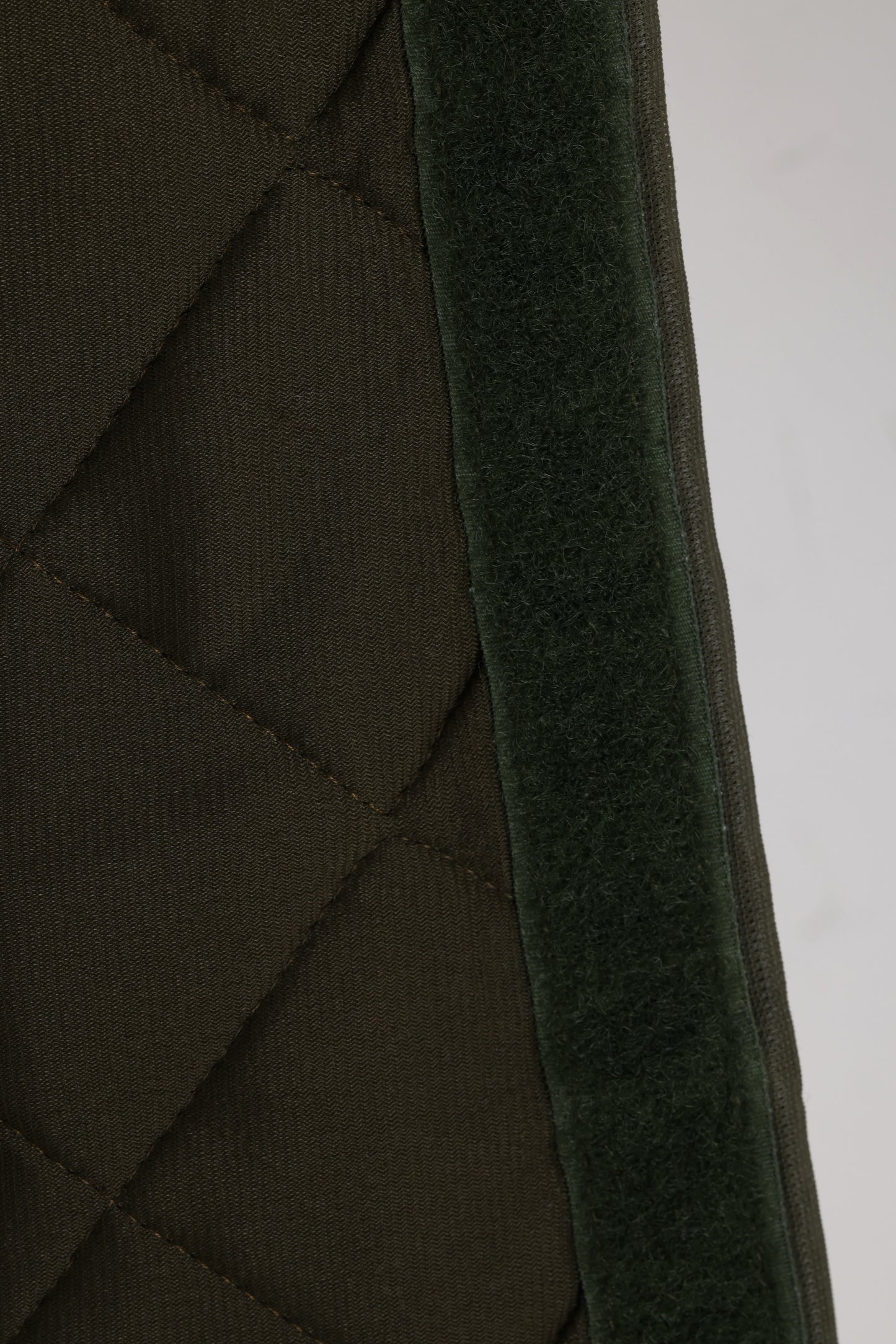
Construction follows highly efficient industrial assembly methods. The shell and lining fabrics are quilted through the insulating layer using continuous lockstitch quilting arranged in a diamond grid. This technique prevents insulation migration while maintaining uniform thermal distribution.
The perimeter is finished with woven binding tape applied around all exposed edges. This eliminates the need for turned hems and significantly reduces labor time. The front opening incorporates hook-and-loop fastening tape, allowing rapid closure without buttonholes or metal hardware.
Sleeves terminate in rib-knit storm cuffs. These cuffs are inserted into the sleeve ends during assembly and provide elastic recovery while minimizing heat escape.
The garment demonstrates production engineering optimized for speed, repeatability, and durability.
V. Technical Design Elements & Precision Detailing
The diamond quilting is the dominant technical feature. The dimensions of the quilt blocks appear consistent across the garment, indicating accurate feed control during production. Uniform spacing prevents localized insulation collapse and ensures even loft retention.
The neckline deserves particular attention. Rather than incorporating a collar, stand, or facing-heavy finishing method, the neckline is reduced to a simple bound V-opening. This minimizes thickness beneath a parent garment while maintaining structural stability.
Hook-and-loop tape placement is integrated directly into the front edge assembly. This solution permits operation while wearing gloves and avoids failure points associated with button loss.
VI. Style Nomenclature & Historical Evolution
The garment belongs to the family of military liner jackets developed extensively during the postwar period. Earlier insulated military garments often relied on heavier wool constructions or separate undergarment systems. By the latter twentieth century, lightweight quilted liners became increasingly common.
This specific example shares lineage with British, Dutch, Belgian, German, and American liner systems developed between the 1960s and 1990s. The style evolved from purely hidden functional layers into garments frequently worn independently by civilians. Modern fashion has since rediscovered the liner jacket repeatedly, often with considerable enthusiasm for features originally intended to remain unseen.
VII. Fabric Composition & Textile Engineering
The label identifies the garment as “100% Polyester,” though from a visual perspective the textile exhibits characteristics associated with lightweight utility cloth. The shell displays moderate sheen, tight weave density, low absorbency appearance, and strong dimensional stability.
The insulation layer appears lightweight and evenly distributed. Thermal efficiency derives from trapped air volume rather than material mass. Abrasion resistance is moderate. Recovery from compression appears acceptable for repeated field use.
The quilting pattern contributes significantly to performance by controlling insulation displacement during laundering and prolonged wear. Without the stitch matrix, loft concentration and thermal inconsistency would likely develop over time.
The binding tape exhibits greater density and abrasion resistance than the primary shell fabric, appropriate for edge protection.
VIII. Construction & Pattern Analysis
Pattern architecture is exceptionally economical. The body appears composed of large uninterrupted panels with minimal seam count. Material utilization efficiency is high, reflecting military manufacturing priorities.
The neckline is a collarless V-configuration. No collar stand, lapel, gorge, or facing extension is present. This absence is not a cost-cutting omission but a deliberate functional choice. The neckline must remain unobtrusive beneath an outer shell.
The sleeve appears conventionally set into the armhole rather than integrated through raglan construction. Ease distribution is minimal, consistent with layering requirements.
Assembly order likely proceeded through quilting, shoulder joining, sleeve insertion, side seam closure, cuff insertion, closure application, and perimeter binding.
IX. Structural Integrity & Panel Configuration
The diamond quilting functions simultaneously as insulation stabilization and structural reinforcement. Stress is distributed through the entire quilt matrix rather than concentrated exclusively at seam lines.
The shoulder region benefits from the continuity of the quilted pattern. This reduces deformation under repeated wear and equipment load. Armhole stress is moderated by the flexibility of the quilted structure.
Unlike tailored garments that rely upon interfacing, canvas, or padding, this jacket derives structural integrity almost entirely from stitched geometric reinforcement. The quilt grid acts as a distributed support network across the entire garment surface.
X. Edge Finishing, Seam Termination & Closures
Edge finishing is one of the strongest indicators of military production. The woven binding tape encloses raw edges continuously around the neckline, front opening, hem, and other exposed boundaries. This method is durable, efficient, and straightforward to repair.
The hook-and-loop closure is anchored through multiple rows of machine stitching. Such anchoring distributes opening stress over a broad area. Durability exceeds what would typically be required in civilian garments subjected only to occasional use.
Seam terminations appear mechanically secure and consistent. The absence of decorative finishing reflects the garment’s intended role as a hidden insulation layer.
XI. Manufacturing Context, Production Scale & Industrial Feasibility
This garment was almost certainly produced at substantial scale under military contract conditions. Every construction decision supports production efficiency.
Large quilted panels minimize cutting complexity. Bound edges reduce labor input. Hook-and-loop fasteners accelerate assembly. Collar elimination removes an entire production stage. Pattern standardization permits predictable sizing and inventory management.
From a production manager’s perspective, the garment represents disciplined industrial thinking. Nothing exists without justification. Nothing survives because it looked interesting in a design meeting.
The labor cost per unit would have been comparatively low relative to civilian insulated jackets of equivalent thermal performance.
XII. Conceptual Influence & Psychological Design Intent
The garment’s conceptual framework is institutional rather than artistic. Its visual language emerges from thermal management, logistics, and military systems engineering.
Nevertheless, contemporary observers frequently project aesthetic narratives onto such objects. The diamond quilting suggests order. The olive coloration implies field utility. The stripped neckline and exposed quilting create a visual directness often admired by designers seeking authenticity.
The garment does not communicate authority through ornament. It communicates competence through repetition and consistency.
XIII. Artistic & Aesthetic Direction
Viewed through a design lens, the jacket possesses a severe functional elegance. The diamond grid establishes rhythmic surface structure. The absence of a collar creates a clean neckline profile. The proportional relationship between body width and length produces a compact silhouette optimized for layering.
There are affinities with later minimalist design movements, though these similarities arise accidentally. The military sought thermal efficiency. Designers later observed the result and declared it aesthetically significant.
The neckline treatment is particularly successful visually. By removing conventional collar architecture, the garment achieves a reduced profile that remains remarkably contemporary.
XIV. Historical Placement & Contextual Analysis
The label date of 1986 places the garment firmly within the later Cold War period. Construction methods, materials, closure technology, and sizing systems all align with European military manufacturing practices of that era.
The jacket belongs to a transitional period in military clothing development, when lightweight insulation systems increasingly replaced heavier traditional approaches. Modular layering became central to field clothing doctrine.
The garment’s historical importance lies not in rarity but in representative value. It demonstrates how military clothing evolved toward efficient thermal systems that would later influence outdoor apparel and fashion design alike.
XV. Use Case
On the body, this garment functions as an intermediate thermal regulator. It sits beneath a field jacket, parka, or shell while preserving mobility. The wearer is not making a stylistic statement. The wearer is preparing to spend extended time outdoors in temperatures unpleasant enough to require planning.
The collarless neckline accommodates outer collars without stacking bulk beneath the throat. The rib-knit cuffs remain concealed inside outer sleeves, forming a thermal seal at the wrist. The quilted body traps air efficiently while remaining compressible beneath an outer layer.
Share