(Sweden)
1985–1995, Swedish Lambskin Trench with Deep Revers
1985–1995, Swedish Lambskin Trench with Deep Revers
Couldn't load pickup availability
… approximate size: EU 38–40, US 6–8
Measurements (cm):
shoulder to shoulder: 44
sleeve (shoulder to cuff): 58
chest (pit to pit): 48
length (collar to hem): 112
SKU: 900543
This is a long double-breasted lambskin coat drafted within the broad family of urban car coats and walking coats that gained considerable commercial traction during the late 1980s and early 1990s. The silhouette combines soft leather drape with a semi-tailored front architecture, producing a garment that borrows visual cues from trench coats while omitting many military-derived components associated with traditional trench construction. The shell appears to be composed of lightweight lambskin displaying a fine, uniform grain, moderate surface luster, and substantial pliability. Construction evidence indicates industrial production using machine-stitched leather assembly, supported by a fully lined interior and standardized buttoned closure system. As a material artifact, the coat occupies a recognizable position within the period when leather outerwear migrated from specialist utility garments into mainstream metropolitan wardrobes, often functioning as an alternative to wool overcoats during transitional weather conditions.
1. Designer Origin & Brand Profile
No label or maker identification is visible, preventing attribution to a specific manufacturer. Nevertheless, the garment exhibits characteristics associated with upper-middle commercial leather production rather than bespoke leather tailoring or couture workroom fabrication. The design vocabulary aligns with European and North American leather outerwear markets of approximately 1987–1994, when broad lapels, elongated coat lengths, and softened shoulder treatments displaced the more rigid leather tailoring of preceding decades.
The coat reflects a manufacturing philosophy centered on visual authority through material presence. The lambskin itself performs much of the aesthetic labor. The cut avoids excessive ornamentation, allowing surface continuity, panel arrangement, and lapel scale to establish identity. This approach was widespread among manufacturers producing for department store distribution, specialty leather retailers, and regional fashion chains seeking garments that conveyed status without requiring technically expensive tailoring infrastructure.
2. Brand Heritage & Industry Influence
Without maker identification, discussion must shift toward the industrial category represented by the garment. Leather outerwear experienced substantial commercial expansion during the late twentieth century. Improvements in hide processing, finishing technology, and globalized manufacturing enabled softer skins to be used in longer silhouettes that previously would have been prohibitively heavy.
This coat belongs to that evolution. It demonstrates the period’s movement away from motorcycle-specific leather garments and toward leather as an everyday metropolitan material. The design participates in the same commercial current that produced leather blazers, leather shirt-jackets, and leather trench-inspired coats throughout Europe and North America. The result is less concerned with occupational utility than with the projection of urban sophistication through material selection.
3. Garment Classification & Design Intent
The garment is best classified as a double-breasted lambskin walking coat or car coat with trench-derived styling references.
Its intended use appears to be general city wear during cool transitional seasons. The length provides protection extending below the knee, while the relatively soft shoulder treatment and absence of storm flaps, epaulettes, gun flaps, belts, or throat latches indicate that weather resistance was secondary to appearance.
The double-breasted closure introduces visual mass at the center front and allows the lapels to frame the torso with considerable breadth. The design intent appears focused on elongation of the body, visual narrowing through vertical seam placement, and exploitation of leather drape. The wearer receives the authority of a trench silhouette without inheriting the complexity—or inconvenience—of military baggage.
4. Construction Methodology & Engineering
Assembly appears predominantly machine executed using leather-specific lockstitch construction. Stitch lengths are moderately extended, consistent with leatherwork practices intended to minimize perforation-induced weakening.
The front body is assembled from multiple vertical panels joined through topstitched seam constructions. These seams simultaneously perform structural and decorative functions. Because leather lacks woven yarn recovery, seam placement becomes a primary shaping mechanism.
Buttonholes appear machine bound and reinforced. Covered buttons distribute closure pressure more evenly than harder materials while maintaining visual continuity with the shell.
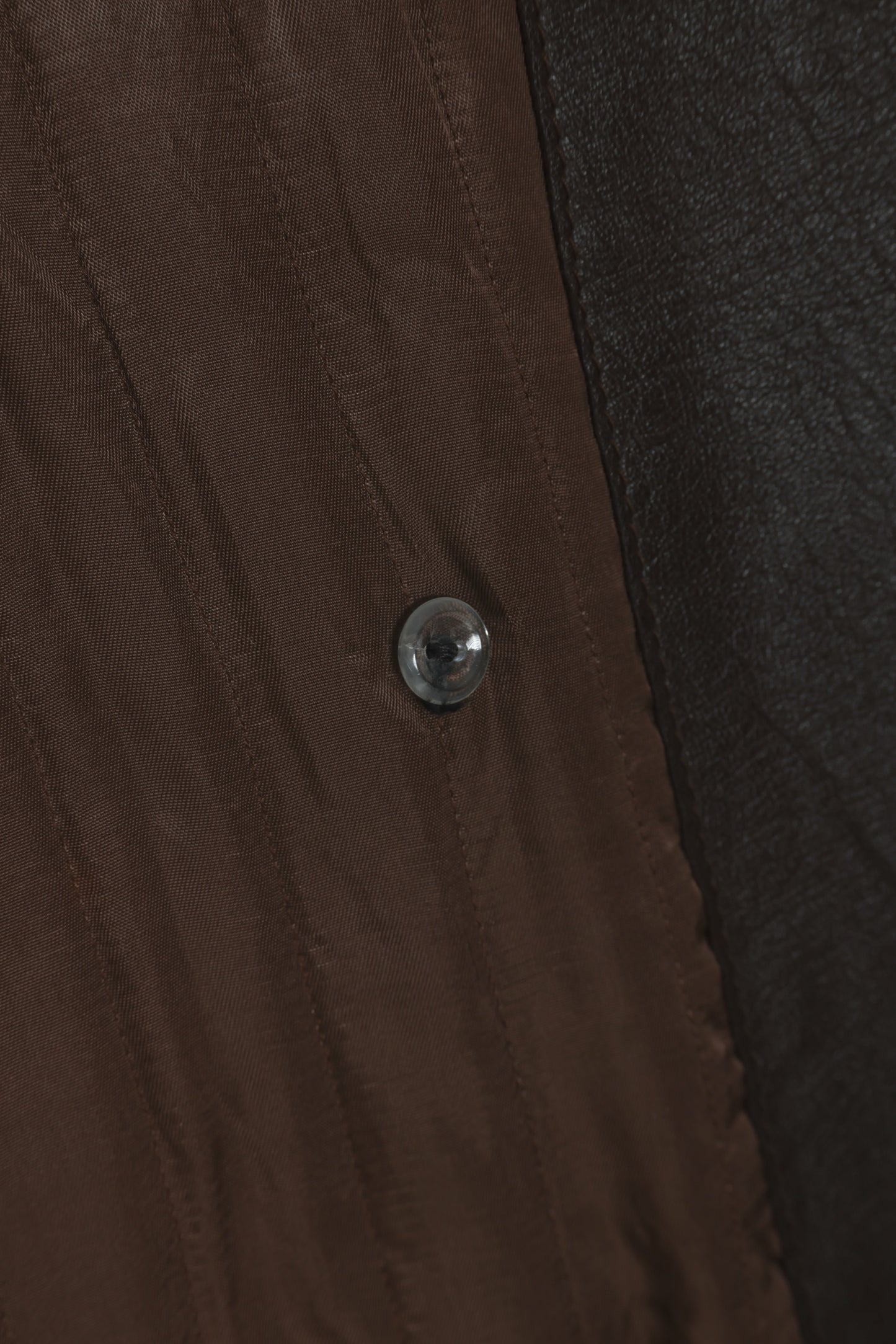
The lining is attached through a conventional bagged assembly process. Interior inspection reveals a vertically quilted or channel-stitched lining configuration which likely serves stabilization and insulation functions.
5. Technical Design Elements & Precision Detailing
The most significant design element is the enlarged lapel architecture. The lapels are drafted substantially wider than required for closure functionality. Their scale shifts visual weight upward, balancing the garment’s long length.
Diagonal pocket welts integrated into lower front seam intersections demonstrate careful visual coordination. The pockets mirror lapel angles, creating a geometric relationship across the front body.
Cuff tabs provide a secondary horizontal motif. Their purpose is largely visual. They introduce structure near the sleeve hem without requiring the more labor-intensive cuff vent systems associated with tailored overcoats.
The waist seam functions as both pattern engineering and visual interruption. It reduces material waste, simplifies hide utilization, and controls vertical stretch across the garment length.
6. Style Nomenclature & Historical Evolution
This garment occupies an interesting position between trench coat, leather overcoat, and car coat traditions.
Historically, the car coat emerged during the early automobile era as a shorter protective outer garment. By the late twentieth century, the term had broadened considerably. Simultaneously, trench coat features migrated into civilian fashion detached from military function.
The broad lapels, double-breasted front, and extended length derive from trench traditions. The simplified body construction, absence of belt systems, and softer shoulder line derive from commercial leather coat development.
Its closest historical relatives appear in late-1980s and early-1990s urban outerwear collections where leather was expected to perform socially before it performed meteorologically.
7. Fabric Composition & Textile Engineering
The shell is identified as lambskin.
Visible evidence suggests a relatively lightweight hide exhibiting fine grain uniformity, moderate suppleness, limited stiffness, and fluid drape characteristics. Surface reflection is soft and diffuse rather than highly polished.
Lambskin provides favorable flexibility and comfort but generally possesses lower abrasion resistance than heavier bovine leathers. The hide’s softness facilitates larger lapel formations and smoother body movement without excessive structural resistance.
The lining displays a tightly woven filament-based construction with moderate sheen and low bulk. Vertical stitched channels indicate either quilting stabilization or lining management intended to prevent migration and distortion.
The material selection aligns appropriately with intended use. A heavier hide would have compromised drape and increased fatigue during wear. This garment prioritizes movement and visual continuity.
8. Construction & Pattern Analysis
The pattern system appears based upon vertically segmented front panels combined with waist-level horizontal interruption.
The front body likely consists of center-front panels, intermediate shaping panels, and side sections working together to control volume. The vertical seam arrangement produces silhouette definition without relying heavily upon darts.
The collar and lapel system deserve particular attention. The collar is a broad fall collar drafted with substantial width and moderate stand. It transitions into oversized lapels through a low gorge placement. The gorge line sits noticeably lower than traditional tailoring standards, a characteristic frequently encountered in late twentieth-century outerwear.
The lapels exhibit hybrid notch-to-peak behavior. Their outer geometry projects upward with a pointed extension, although the overall drafting remains closer to a notched configuration than a classical peaked lapel. The result is a generous revers shape that spreads broadly across the chest.
The front edge appears supported through internal reinforcement, likely a fused or sewn-in stabilizing component suitable for leather production. No evidence suggests hand pad-stitching.
9. Structural Integrity & Panel Configuration
Structurally, the coat relies on seam architecture more than internal tailoring.
Vertical front seams direct stress downward toward the hem while helping distribute tension generated by closure strain. The waist seam acts as a stabilizing cross-member, interrupting longitudinal distortion and reducing hide creep over time.
Shoulder shaping appears relatively soft. There is little indication of substantial shoulder padding. The shoulder line therefore follows the wearer’s anatomy instead of imposing an independent geometry.
Stress concentrations occur at button positions, pocket entries, cuff tab attachments, and lapel fold points. Visible construction suggests these zones received additional reinforcement through seam layering and localized interfacing.
The collar-neck junction appears competently balanced. No obvious collapse or twisting is visible despite the weight of the oversized lapels.
10. Edge Finishing, Seam Termination & Closures
Leather edge finishing appears executed through turned and stitched construction rather than raw-edge treatment.
Lapel edges are folded and topstitched with consistent spacing. This approach stabilizes the perimeter while preserving a clean visual line. The collar edges receive identical treatment, producing continuity across the revers system.
The double-breasted closure consists of covered buttons anchored through conventional shank attachment. Covered buttons are often less durable than hard molded alternatives but produce superior visual integration.
Buttonholes appear machine worked and adequately reinforced. The front overlap width provides sufficient wind protection while maintaining balanced lapel roll.
The lapels display a soft roll behavior. They are not engineered to produce the sculpted chest architecture associated with tailored wool overcoats. Instead, they fold according to hide memory and gravity, which is entirely appropriate for this category.
11. Manufacturing Context, Production Scale & Industrial Feasibility
Production characteristics indicate medium-scale industrial manufacture.
The pattern minimizes hide wastage through strategic panel division. The waist seam is particularly revealing. While visually integrated, it also allows manufacturers to utilize shorter hide sections and improve cutting efficiency.
Assembly complexity remains moderate. No feature requires extensive hand labor. Collar setting, lining insertion, button application, and seam topstitching are all compatible with factory workflow.
Labor expenditure would have concentrated primarily on hide inspection, cutting accuracy, matching grain appearance across panels, and maintaining stitch consistency through variable material thickness.
This is the sort of garment factories prefer: substantial enough to justify its price, yet cooperative enough not to provoke mutiny on the production floor.
12. Conceptual Influence & Psychological Design Intent
The coat reflects late twentieth-century interest in authority communicated through surface and proportion.
Its conceptual framework is rooted in adaptation. Military and tailoring references are retained in outline while occupational requirements are discarded. The garment borrows institutional visual language without asking the wearer to supervise a trench network or command a cavalry regiment.
The lambskin introduces an element of softness that moderates the severity often associated with double-breasted silhouettes. The wearer is presented as deliberate, organized, and materially aware, though not necessarily interested in explaining any of those traits.
13. Artistic & Aesthetic Direction
Aesthetically, the coat belongs to the broad territory of late-modern urban dressing. The visual system depends upon scale relationships between lapels, collar, closure arrangement, and elongated body.
The large collar establishes the primary focal point. The lapels direct attention inward toward the center front. Vertical seam lines elongate the silhouette while diagonal pocket entries disrupt excessive rigidity.
There are faint echoes of power dressing, post-modern tailoring, and late-century minimalism, though filtered through commercial leather manufacturing. The garment avoids overt experimentation. Its confidence derives from proportion and material behavior.
14. Historical Placement & Contextual Analysis
The strongest dating evidence lies in the collar and lapel dimensions, silhouette length, closure arrangement, shoulder treatment, and leather finishing characteristics.
The broad collar points, deep revers, lowered gorge, and elongated coat length collectively support a production date most plausibly between approximately 1988 and 1994.
The garment diverges from 1970s leather coats, which often featured sharper collars and more exaggerated flare, and from late-1990s examples that increasingly favored cleaner fronts and narrower lapels. It also predates the highly fitted leather outerwear that emerged during the early twenty-first century.
The lining construction and industrial assembly techniques further support a late twentieth-century manufacturing context.
Use Case
This coat is intended for movement through an urban environment between destinations rather than prolonged outdoor exposure. It performs effectively during commutes, office travel, evening engagements, and transitional weather conditions where a wool overcoat would feel excessive and a lighter jacket insufficient.
The wearer is identifiable less by occupation than by a sequence of decisions. They have chosen length over brevity, leather over cloth, double-breasted structure over simplicity, and broad lapels over invisibility. Adjacent garments must cooperate accordingly. Knitwear must remain relatively low in bulk to prevent congestion beneath the armholes. Trousers or skirts must accept visual subordination to the coat’s length. Footwear requires enough visual weight to balance the descending vertical line established by the hem.
Share