(Unattributed)
1985–1995, Staple-Yarn Raglan Utility Jumper
1985–1995, Staple-Yarn Raglan Utility Jumper
Couldn't load pickup availability
~ EU 42–44, US L
Measurements (cm):
shoulder to shoulder: 42
sleeve (shoulder to cuff): 58
chest (pit to pit): 54
length (collar to hem): 70
SKU: 909956
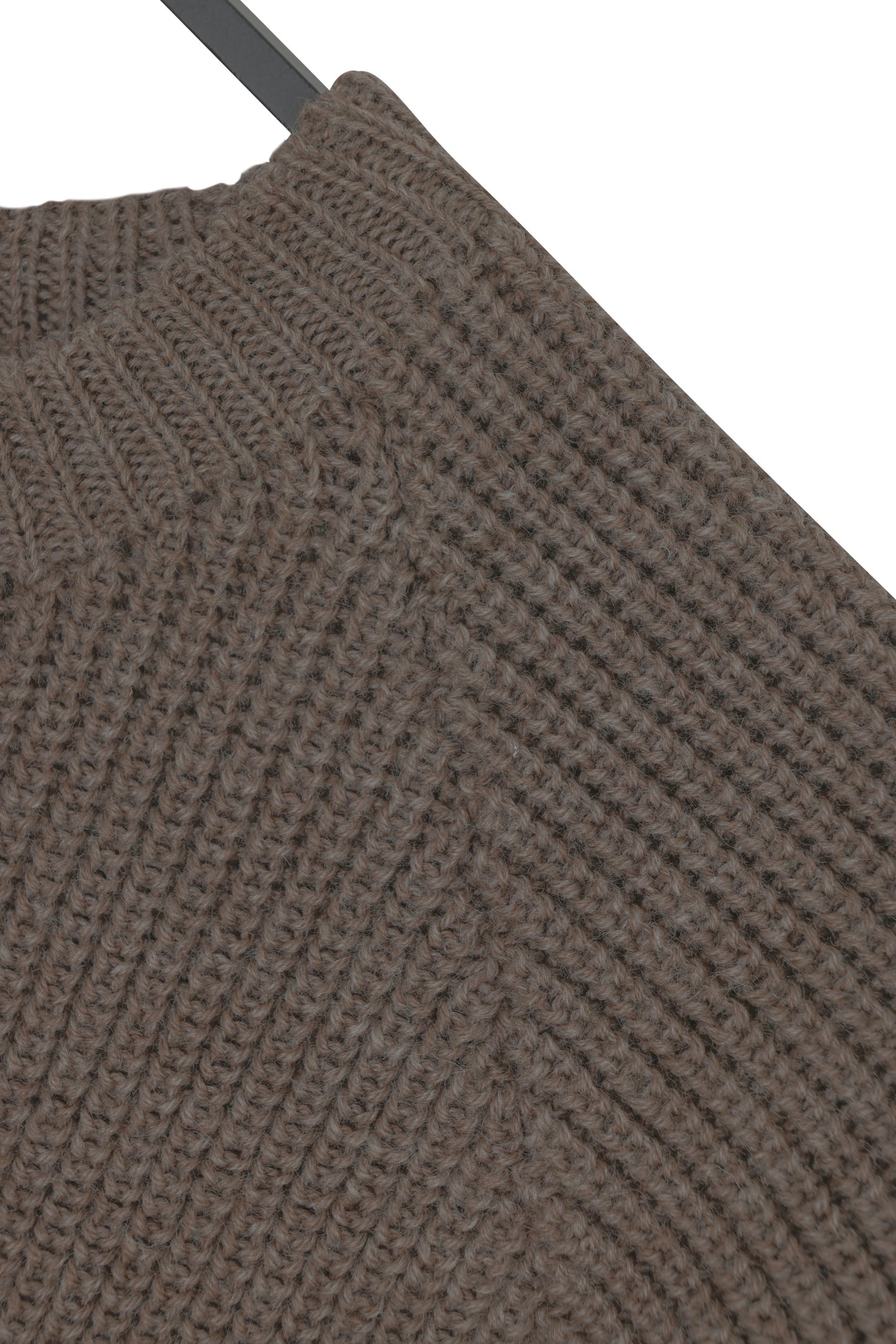
This is a crewneck raglan pullover executed in a medium-to-heavy gauge textured knit structure. Based upon silhouette, stitch engineering, neckline treatment, and yarn characteristics, production most plausibly falls between the late 1980s and mid-1990s. The sweater is constructed from a heathered staple-fiber acrylic yarn exhibiting moderate loft, visible haloing, low surface luster, and stable dimensional recovery. The garment appears to be fully fashioned on industrial flatbed knitting equipment, with shaping achieved through stitch increases and reductions rather than cut-and-sew panel fabrication. Its significance lies in the increasingly uncommon quality of execution found in commercial acrylic knitwear of the period, demonstrating manufacturing standards that exceeded the disposable knitwear segment while remaining firmly within industrial production frameworks.
I. Designer Origin & Brand Profile
No maker identification is visible; consequently, attribution must proceed from construction evidence. The garment belongs to a category of late twentieth-century commercial knitwear frequently produced by European, British, Japanese, and North American manufacturers operating in the mid-market sector. The design philosophy evident here privileges durability, thermal retention, straightforward maintenance, and visual texture over seasonal novelty.
From a designer’s perspective, the object demonstrates confidence in proportion and stitch architecture. The absence of decorative motifs shifts attention toward surface engineering and silhouette. The raglan system softens shoulder definition while preserving mobility, producing a relaxed but controlled profile. This approach was particularly common among manufacturers seeking garments capable of functioning across multiple age groups and retail demographics.
The knitting quality suggests a producer familiar with fully-fashioned construction techniques. Unlike lower-cost tubular sweaters assembled from cut knitted yardage, this example reveals evidence of deliberate shaping integrated into production. Such decisions require greater programming, machine time, and quality control.
II. Brand Heritage & Industry Influence
Although anonymous, the garment participates in a broader lineage of industrial knitwear development that emerged after flatbed machine technology reached substantial sophistication during the second half of the twentieth century. Manufacturers increasingly reproduced qualities once associated with hand-knit outerwear while maintaining commercial production volumes.
The sweater reflects a period when acrylic-based yarn systems occupied a substantial share of winter knitwear markets. Manufacturers sought to replicate the warmth, visual depth, and tactile familiarity of traditional wool garments while reducing cost volatility and simplifying consumer care requirements.
Its industrial significance resides in the translation of heritage hand-knit visual language into repeatable factory processes. The diagonal shoulder textures, dense body stitch, and substantial rib structures all reference earlier hand-knitting traditions while remaining entirely compatible with mechanized production.
III. Garment Classification & Design Intent
This garment is best classified as a women’s fully-fashioned raglan crewneck sweater intended for cool-weather casual wear. It belongs to the category of utility knitwear positioned between lightweight layering garments and heavy outdoor sporting sweaters.
The design objective centers upon thermal efficiency, comfort, and durability. The elongated body length provides coverage below the natural waistline. The moderate chest ease permits layering over shirts and lightweight undergarments without excessive bulk.
Its intended setting encompasses everyday urban and suburban use, educational environments, travel, domestic wear, and informal occupational contexts. It is not athletic knitwear, nor is it formal knitwear. Its purpose is continuity of wear across a broad range of routine activities.
IV. Construction Methodology & Engineering
The garment appears fully fashioned. Evidence is visible in the raglan shaping lines extending from neckline to underarm. These lines are formed through systematic stitch transfers and reductions rather than through sewn panel joins.
The neckline consists of a separately engineered rib structure integrated into the body during assembly. The rib appears approximately 2x2 in configuration, though image resolution limits definitive gauge determination. The neckband demonstrates sufficient depth to stabilize the opening while maintaining elastic recovery.
The raglan seams likely utilize linked assembly. Linking remains one of the most effective methods for joining knitted components because it preserves flexibility while minimizing bulk accumulation.
The cuff and hem ribs appear knitted as integral structural components rather than attached after completion. This method improves efficiency while creating superior recovery characteristics.
V. Technical Design Elements & Precision Detailing
The dominant technical feature is the contrast between stitch orientations. The torso utilizes a compact textured structure resembling a seed or modified moss arrangement, generating a dense, granular surface. The sleeves and raglan zones introduce directional rib formations that create visual movement toward the neckline.
The raglan shaping is particularly successful. Fashion decreases appear evenly distributed, producing clean shoulder transitions without distortion. The neckline insertion maintains symmetry on both sides, indicating careful machine programming and quality control.
No superfluous ornamentation interrupts the visual field. The decorative content emerges entirely from stitch manipulation, a characteristic often associated with knitwear producers confident in their technical capabilities.
VI. Style Nomenclature & Historical Evolution
The garment belongs to the broad family of raglan pullovers. The raglan sleeve derives from nineteenth-century military tailoring traditions associated with mobility and weather protection. During the twentieth century, the construction migrated into sportswear, outdoor garments, and knitwear.
By the 1980s and 1990s, raglan sweaters had become particularly common within casual winter wardrobes. Manufacturers appreciated the adaptability of raglan shaping to knitted production because stitch reductions could be executed efficiently during machine knitting.
The dense textured body recalls traditions found in British utility knitwear, Scandinavian work sweaters, and postwar outdoor clothing. Here, however, those historical references have been translated into a commercial women’s garment intended for everyday use.
VII. Fabric Composition & Textile Engineering
The user identifies the yarn as acrylic, and the visual evidence supports that assessment. The yarn displays a diffuse halo, moderate bulk, muted reflectivity, and relatively uniform diameter. The surface lacks the pronounced scale definition associated with untreated wool fibers.
Estimated fabric mass falls within approximately 450–650 GSM depending upon local stitch density. The knit exhibits substantial loft and insulation capacity relative to weight.
The yarn structure appears engineered for volumetric retention. Abrasion resistance would likely exceed many natural-fiber counterparts. Moisture management remains less effective than traditional wool systems, though dimensional stability during laundering would generally be superior.
The fabric demonstrates moderate elasticity generated through knit architecture rather than fiber extension. Recovery appears aided by rib structures concentrated at neckline, cuffs, and hem.
VIII. Construction & Pattern Analysis
This garment appears produced on industrial flatbed knitting machinery at a medium gauge, likely between 5 and 7 gauge. The stitch density balances insulation and flexibility effectively.
Pattern architecture consists of a front body panel, back body panel, and two raglan sleeves. Fashion shaping occurs through systematic reductions at raglan lines. The sleeve cap is therefore integrated into the garment geometry rather than drafted as a separate set-in structure.
The neckline is circular and closely controlled. The neck rib is attached to a carefully balanced opening whose circumference appears calibrated to maintain recovery without excessive compression.
The raglan lines function as both structural and visual devices. Their diagonal trajectory distributes stress from arm movement across a greater area than a conventional shoulder seam.
Assembly appears consistent with linked knitwear production. Stitch alignment along joining points appears precise, minimizing distortion under tension.
IX. Structural Integrity & Panel Configuration
Structurally, the garment benefits from favorable load distribution. Raglan construction transfers strain away from a concentrated shoulder point and disperses it along the diagonal seam pathway.
The neckline functions as a critical stabilization zone. The rib collar anchors the entire upper structure while controlling stretch accumulation generated by repeated dressing and undressing cycles.
The hem rib acts as a counterweight to the body panel. Its increased contraction ratio gathers the lower circumference and helps maintain silhouette definition.
The sleeves are proportioned generously enough to permit unrestricted movement while avoiding excessive fabric accumulation at the underarm. This indicates careful balancing between body ease and sleeve volume.
X. Edge Finishing, Seam Termination & Closures
As a pullover, the garment lacks independent closure systems. Structural performance therefore depends heavily upon neckline engineering and seam integrity.
The collar edge appears cleanly cast off with controlled tension. Excessively tight bind-offs often create distortion at the neckline; no such issue is evident here.
Cuff finishing demonstrates notable competence. The rib sections are sufficiently long to maintain position on the wrist without requiring aggressive compression. This balance contributes significantly to long-term wear comfort.
The hem edge appears similarly well controlled. Rolling and torque effects common in inferior knitwear are absent.
The raglan seams likely terminate into reinforced linkage points at neckline and underarm intersections. These locations represent the highest strain concentrations in this construction type.
XI. Manufacturing Context, Production Scale & Industrial Feasibility
This garment reflects medium-scale industrial production executed with above-average technical standards. It does not exhibit couture labor investment, nor does it display the shortcuts typical of low-cost volume manufacturing.
Fully-fashioned production increases machine programming requirements and reduces throughput compared with simplified cut-and-sew knitwear. Manufacturers accepted these costs because material utilization improved and finished garments achieved superior fit characteristics.
The stitch pattern itself adds production complexity. Multiple texture zones require additional machine operations and more rigorous monitoring of tension consistency.
Viewed through a production manager’s lens, the garment occupies an efficient middle ground: sophisticated enough to distinguish itself in retail environments, simple enough to remain commercially viable.
XII. Conceptual Influence & Psychological Design Intent
The design language draws from traditions of utility clothing, outdoor knitwear, and domestic hand-knitting without directly reproducing any single historical source.
The visual emphasis on texture communicates durability and seasonal appropriateness. Consumers often interpret dense knit surfaces as indicators of warmth and longevity regardless of actual thermal performance.
The absence of decorative motifs shifts attention toward construction itself. The garment’s argument is straightforward: stitch density, surface depth, and proportion are expected to justify ownership.
There is a faintly humorous aspect to this category of knitwear. It often appears determined to avoid attracting attention, yet considerable technical effort has been invested to ensure that it does precisely that among those who examine construction.
XIII. Artistic & Aesthetic Direction
The aesthetic direction aligns with late twentieth-century interpretations of heritage knitwear. Visual interest emerges through structural variation rather than graphic intervention.
The neckline serves as the central framing device. The crewneck opening establishes a stable circular boundary from which the raglan lines radiate outward. This geometry creates a subtle visual hierarchy directing attention toward the face.
The silhouette avoids exaggerated width, cropped proportions, or overt body-conscious shaping. Instead, the garment relies upon measured volume and textural consistency.
Its artistic success derives from proportional discipline and stitch organization. Every visible decision appears tied to structure.
XIV. Historical Placement & Contextual Analysis
The most defensible production period is approximately 1985–1998. Several factors support this chronology: the relaxed fit, substantial body length, textured utility-knit aesthetic, fully-fashioned raglan construction, and widespread commercial adoption of high-bulk acrylic yarn systems.
The garment diverges from the oversized fashion extremes associated with certain late-1980s knitwear while remaining fuller than many early-2000s silhouettes. The result is a balanced profile characteristic of transitional casual knitwear markets during the period.
Its technical features belong to an era when manufacturers still invested meaningful resources in knitting quality before the widespread dominance of ultra-low-cost globalized sweater production.
XV. Use Case
Placed on a moving body, this sweater performs most effectively during transitional autumn conditions, winter indoor environments, and outdoor activity requiring moderate insulation without specialized weather protection.
The wearer is identifiable not through biography but through decisions. She chooses a garment expected to survive frequent use, repeated laundering, and changing wardrobes without demanding attention. Shirts worn beneath must tolerate a relatively high crew neckline. Outerwear worn above it requires sufficient sleeve ease to accommodate the textured knit volume concentrated along the raglan shoulders.
Share