Sarah (Italy)
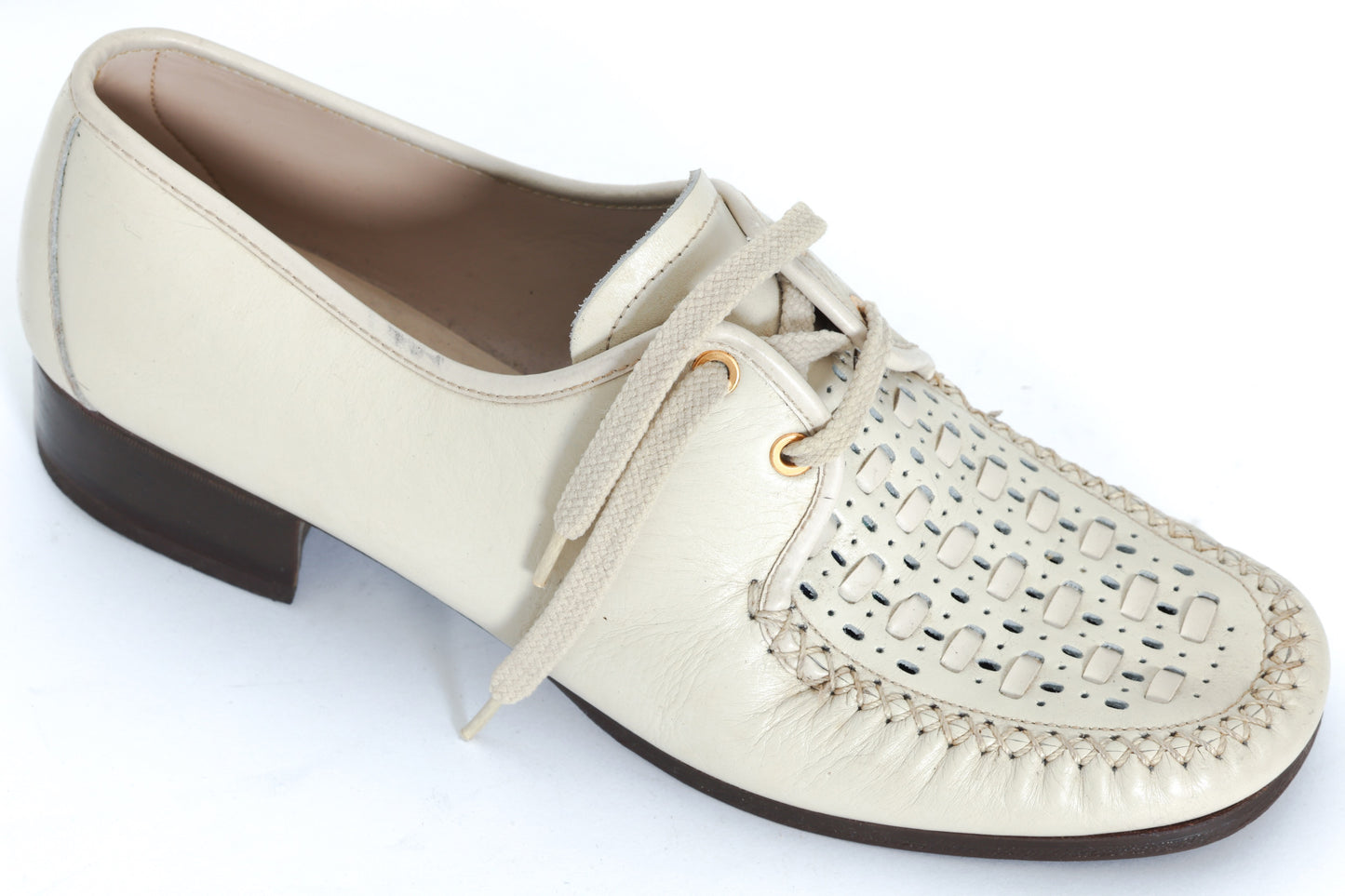
1985–1995, Italian Hand-Laced Calfskin Moccasin-Derived Resort Derby
1985–1995, Italian Hand-Laced Calfskin Moccasin-Derived Resort Derby
Couldn't load pickup availability
~ EU 41, US 10–10.5
Measurements (cm):
insole (heel to toe): 26.5 cm
SKU: 900953
The identification materially alters the assessment of the shoe’s provenance, manufacturing context, and intended market position. The “Sarah – Made in Italy” marking places the model firmly within the Italian women’s footwear sector rather than the German or Austrian comfort-footwear tradition that might initially be inferred from constructional cues alone. While Sarah does not appear to occupy the documented upper echelon of Italian luxury shoemaking alongside brands such as Santoni, Fratelli Rossetti, Silvano Sassetti, or Officine Creative, the construction, pattern engineering, material selection, and overall design language align convincingly with the artisanal comfort-fashion footwear segment that flourished across Italy during the late 1980s through the mid-1990s. The shoe reflects the output of the small- to medium-scale family-owned manufacturers concentrated in regions such as Marche and Tuscany, where women’s leather footwear was produced with a level of craftsmanship that frequently exceeded what would be expected from its market positioning. The underlying philosophy evident throughout the design emphasizes soft leather engineering, lightweight wearability, summer-season functionality, handcrafted visual detailing, and comfort-oriented ergonomics. Unlike luxury dress shoemakers whose priorities center on sculpted silhouettes, aggressive waist shaping, formal elegance, and architectural refinement, Sarah’s apparent focus is practical luxury expressed through artisanal comfort. The shoe embodies a distinctly Italian tradition in which handcraft techniques are integrated into everyday footwear rather than reserved exclusively for formal categories.
Although Sarah itself does not appear to hold a major position within the broader history of luxury footwear, the model serves as a compelling representative of a significant manufacturing tradition. During the 1980s and 1990s, numerous Italian producers occupied the space between orthopedic comfort footwear, resort footwear, and casual luxury footwear, creating products that balanced ergonomic functionality with elevated material quality and hand-finished detailing. This particular model belongs squarely within that lineage. Its importance lies less in brand prestige than in its embodiment of an era when Italian factories routinely incorporated labor-intensive leatherworking and finishing techniques into mid-market footwear, creating products that offered genuine craftsmanship without aspiring to the complexity or formality of high-end welted dress shoes.
From a classification standpoint, the design can be understood simultaneously as a moccasin-inspired Derby, an apron-front lace-up, a perforated summer Oxford hybrid, and a women’s leisure shoe. It occupies an intermediate position between traditional moccasins, casual derbies, and resort footwear, making its intended use immediately apparent. The shoe was designed for warm-weather city wear, resort environments, casual tailoring, and pairing with summer dresses or separates. Despite its lace-up architecture, it should not be viewed as a formal shoe. The extensive perforation system unequivocally places it within the category of seasonal leisure footwear, where breathability and comfort take precedence over conventional notions of dress formality.
The upper leather appears notably soft and supple, with the material characteristics most consistent with either full-grain lambskin, soft nappa calf, or another high-quality chrome-tanned Italian leather. Several indicators support this conclusion, including the fine nature of the crease formation, the leather’s soft collapse characteristics, the smooth and relatively uniform grain structure, and the evident flexibility of the upper. Even after visible wear, the leather has aged with considerable grace. Unlike heavily corrected-grain materials, the surface exhibits natural fiber movement, organic wrinkle development, and minimal evidence of coating failure. The cream finish appears pigmented but relatively thin, allowing the inherent character of the leather substrate to remain visible rather than being obscured beneath an excessively opaque surface treatment. As a result, the leather quality exceeds what is typically encountered in mass-market women’s footwear and contributes significantly to the shoe’s overall impression of refinement.
The last employed is unmistakably comfort-oriented and reveals a deliberate commitment to ergonomic design principles. Its defining characteristics include a rounded almond toe, a wide forefoot platform, a generous toe box, moderate instep volume, and low toe spring. From an orthopedic perspective, these features offer meaningful advantages, including minimal forefoot compression, more natural metatarsal alignment, reduced digital crowding, and a stable walking platform. Compared with many contemporary fashion-oriented women’s shoes, the last is substantially more anatomical and demonstrates a conscious prioritization of long-term comfort over visual sharpness. Rather than pursuing aggressive tapering or exaggerated elegance, the design allows the foot to occupy the interior volume with comparatively little restriction.
The most technically significant element of the shoe is its moccasin-derived upper assembly. Visible constructional evidence indicates a hand-laced apron construction in which the apron perimeter is joined to the sidewall structure through externally visible lacing stitches. This method requires substantially greater labor input than conventional machine-sewn vamp assembly and contributes significantly to the artisanal character of the design. The hand-laced perimeter functions not merely as decoration but also as a structural component of the upper architecture. Definitive identification of the sole attachment method remains impossible without outsole imagery, yet the available evidence suggests either Blake-stitched construction or cemented construction. Given the slim sole profile and Italian manufacturing context, Blake construction remains entirely plausible. Goodyear welt construction, by contrast, appears highly unlikely due to the shoe’s profile, intended market segment, and overall design philosophy.
The sole unit itself exhibits characteristics consistent with lightweight leisure footwear. Visible elements suggest a thin-profile sole, a stained leather sole edge, and a layered heel structure. The heel appears to consist of a leatherboard stack faced with a leather veneer and finished with a rubber toplift. With an estimated height of approximately 30 to 35 millimeters, the heel introduces a mild forward pitch while preserving walking comfort and maintaining the shoe’s ergonomic orientation. The overall sole architecture favors flexibility over structural rigidity, reinforcing the model’s emphasis on ease of movement and prolonged wearability rather than formal support structures.
Interior observations suggest a construction specification centered on natural materials. The shoe appears to feature a full leather lining, a leather-covered footbed, and minimal synthetic content. The most probable configuration includes a leather sock liner, a flexible insole board, and lightweight shank reinforcement. This arrangement works in conjunction with the extensive perforation system to improve ventilation, moisture regulation, and thermal comfort. Such integration of breathable upper architecture with leather-lined interiors reflects a thoughtful approach to warm-weather footwear design and enhances the shoe’s suitability for prolonged summer wear.
Among the most impressive aspects of the craftsmanship is the execution of the apron stitching. The visible work demonstrates consistent stitch tension, uniform spacing, and commendable symmetry throughout the perimeter. The hand-laced apron requires considerably more labor than standard machine-sewn apron construction and serves as the shoe’s primary expression of artisanal workmanship. Additional details, including the clean finishing of the topline, neatly executed Derby facings, and well-resolved seam transitions, further support the conclusion that craftsmanship quality sits comfortably above average for its category.
The pattern engineering is more sophisticated than the shoe’s understated appearance initially suggests. The upper incorporates a single-piece quarter assembly, Derby facings, an apron insert, and a perforated vamp panel configured to minimize unnecessary seams. This approach yields several functional advantages, including reduced pressure points, enhanced flexibility, and improved overall comfort. The pattern layout demonstrates that ergonomic considerations played a meaningful role in the design process and that construction decisions were not driven solely by visual concerns.
The toe structure follows the same philosophy of controlled softness evident throughout the rest of the shoe. Reinforcement likely consists of either a light leather toe puff or a minimal thermoplastic stiffener. Despite visible wear, the toe shape has retained a reasonable degree of stability, indicating the presence of some internal reinforcement. Nevertheless, the broader design philosophy clearly prioritizes flexibility and comfort over rigid shape retention, distinguishing the shoe from more formally structured footwear categories.
The closure system is deliberately simple and functional. A two-eyelet Derby configuration is paired with gold-tone metal eyelets and flat woven cotton laces. The oversized eyelets and broader lace format reinforce the casual summer aesthetic while providing practical benefits. Functionally, the arrangement allows easy adjustment, rapid entry, and improved accommodation of minor fit variations, all of which align with the comfort-oriented purpose of the shoe.
Finishing techniques are intentionally restrained and consistent with the model’s broader aesthetic objectives. The leather exhibits uniform cream pigmentation, a soft semi-matte finish, and minimal burnishing. There is no evidence of hand-applied patina work, antiquing treatments, or high-gloss finishing. Rather than pursuing dramatic luxury presentation, the finishing strategy seeks to emphasize softness, lightness, and material authenticity. This restraint contributes to the shoe’s understated appeal and aligns closely with contemporary notions of quiet luxury.
Decorative elements are integrated with functional requirements rather than applied superficially. The geometric perforation matrix serves multiple purposes simultaneously, enhancing ventilation, reducing weight, and creating visual texture across the upper. The hand-laced apron contributes structural reinforcement while simultaneously reinforcing the artisanal identity of the design. The brass eyelets introduce a subtle degree of visual refinement without disturbing the shoe’s overall restraint. The result is a design in which ornamentation and utility remain closely intertwined.
The heel architecture continues the theme of relaxed comfort. The shoe features a soft topline, a relatively low collar height, and moderate heel cup depth. This configuration is likely to produce a comfortable fit, an easy break-in period, and a forgiving yet reasonably secure heel hold. Such characteristics are entirely consistent with the leisure-focused role for which the shoe was designed.
Support characteristics suggest a preference for natural foot movement rather than corrective intervention. The shoe appears to provide moderate arch shaping, a flexible midfoot, and lightweight shank reinforcement. These features support a natural gait cycle and comfortable prolonged wear while stopping short of offering significant pronation control or orthopedic correction. As such, the support profile reflects comfort-oriented engineering rather than medicalized footwear design.
Stylistically and historically, the evidence points strongly toward production during the late 1980s through the mid-1990s. The cream monochromatic palette, perforated summer-oriented construction, low-volume Derby shape, moderate block heel, and moccasin-inspired assembly all align closely with Italian resort and leisure footwear trends of that period. The shoe captures a specific moment in Italian footwear design when comfort, craftsmanship, and relaxed sophistication were increasingly integrated into women’s casual footwear categories.
At a conceptual level, the model successfully combines Italian summer footwear traditions, moccasin-derived construction influences, and women’s comfort engineering into a coherent whole. The guiding philosophy may be summarized as soft luxury through craftsmanship. Rather than emphasizing status, formality, or conspicuous design, the shoe focuses on tactile comfort, artisanal detailing, and seasonal practicality. This philosophy remains surprisingly relevant within the contemporary market, where quiet luxury, slow fashion, heritage craft, relaxed tailoring, and resort dressing continue to shape consumer preferences. The perforated leather upper feels particularly current in an environment where breathable natural materials are increasingly valued and where authenticity often carries greater appeal than overt displays of luxury.
From a technical standpoint, the shoe merits strong evaluations across several categories. Leather quality earns an estimated 8.4 out of 10, reflecting the supple nappa-grade material and its favorable aging characteristics. Comfort engineering scores approximately 8.8 out of 10 due to the anatomical last, generous fit profile, and flexible construction. Pattern engineering reaches roughly 8.3 out of 10, supported by efficient seam placement and ergonomic upper design. Construction quality stands near 8.0 out of 10, while artisanal character rises to approximately 8.7 out of 10 thanks largely to the labor-intensive hand-laced apron assembly. Seasonal functionality is perhaps the strongest attribute at approximately 9.1 out of 10, owing to the highly breathable perforated architecture and warm-weather suitability.
The shoe’s principal strengths include its soft, high-quality Italian leather, labor-intensive hand-laced moccasin-style apron construction, excellent breathability, anatomically friendly last design, strong comfort credentials, and distinctive vintage Italian character. Its limitations are equally clear. Structural support remains relatively modest, the light-colored leather is susceptible to visible wear and staining, wet-weather suitability is limited, and shape retention falls below that of more heavily structured dress footwear. Nevertheless, these limitations are largely consequences of deliberate design choices rather than shortcomings in execution.
Share