Oratop (Finland)
1985–1995, Dutch Golf Jacket in Dense Plain-Weave Shell
1985–1995, Dutch Golf Jacket in Dense Plain-Weave Shell
Couldn't load pickup availability
~ EU 48–50, US M–L
Measurements (cm):
shoulder to shoulder: 46
sleeve (shoulder to cuff): 65
chest (pit to pit): 61
length (collar to hem): 66
SKU: 900958
This is a zip-front leisure blouson produced under the Oratop De Luxe label, a Dutch-market manufacturer or distributor operating within the commercial outerwear sector during the late twentieth century. The jacket combines elements of the Harrington, golf jacket, and continental leisure blouson traditions through a restrained shirt collar, ribbed waistband, angled zip pockets, and clean front closure system. The shell fabric presents as a tightly woven, medium-weight cloth exhibiting low reflectivity, moderate firmness, and sufficient density for wind resistance without substantial insulation. Construction quality exceeds the minimum standards associated with budget outerwear, particularly in the execution of pocket installation, collar assembly, and front zipper integration. The garment occupies a category of transitional-weather outerwear intended for daily urban use, travel, driving, and informal social settings.
I. Designer Origin & Brand Profile
The surviving label identifies the garment as Oratop De Luxe, a Dutch-market brand whose surviving commercial footprint appears modest. The nomenclature suggests a regional manufacturer or distributor participating in the broad European outerwear market during the late twentieth century. Such firms frequently occupied the space between department-store private labels and internationally recognized fashion houses.
The design language is characteristic of manufacturers focused on longevity of sale rather than seasonal disruption. Every visible decision indicates concern with broad market acceptance. The silhouette avoids extreme volume, exaggerated shoulder treatments, decorative trims, or overt fashion signaling.
From the designer’s perspective, the jacket’s success derives from proportion management. The relationship between collar size, body width, waistband depth, and pocket placement creates visual equilibrium. Nothing competes for dominance. Even the hardware appears selected to integrate into the tonal scheme rather than announce itself.
II. Brand Heritage & Industry Influence
While Oratop itself does not appear among major fashion innovators, garments of this category represent an important chapter within postwar European outerwear production. By the 1980s and 1990s, regional manufacturers across the Netherlands, Germany, Belgium, and Scandinavia had refined a commercial formula combining tailoring principles with sportswear utility.
This jacket reflects that lineage. The garment adopts industrial production efficiencies while preserving details inherited from tailoring traditions, particularly in the collar drafting and front closure arrangement.
Its historical significance lies less in innovation than in competence. Entire sectors of the European apparel industry were built upon garments exactly like this: technically sound, commercially durable, and sufficiently adaptable to survive multiple fashion cycles with minimal alteration.
III. Garment Classification & Design Intent
This garment is most accurately classified as a women’s leisure blouson incorporating Harrington-derived and golf-jacket influences.
The intended purpose is protection against mild weather conditions while preserving mobility and presentability. The jacket was designed for everyday wear, transportation, walking, light travel, and semi-casual social environments.
The shirt-style collar introduces a degree of formality absent from athletic bomber jackets. Simultaneously, the ribbed waistband provides waist retention associated with sportswear traditions. The result occupies an intermediate position between tailored outerwear and casual utility clothing.
Its intended wearer required a garment capable of functioning across multiple environments without demanding wardrobe changes. Such garments often become long-term residents of closets because they solve more problems than they create.
IV. Construction Methodology & Engineering
The jacket appears assembled using industrial lockstitch construction throughout primary seams. Visible topstitching suggests a production environment emphasizing repeatability and structural stabilization.
The front closure utilizes a centered zipper extending into the collar base. The zipper is integrated into reinforced front facings that appear supported by internal stabilizing layers. The front opening remains notably flat, indicating effective control of seam tension during installation.
The pocket assemblies represent one of the more technically demanding components. Each pocket combines an angled opening with zipper insertion, requiring careful sequencing during production. Pocket bags appear mounted behind shaped pocket panels that simultaneously contribute to the jacket’s visual structure.
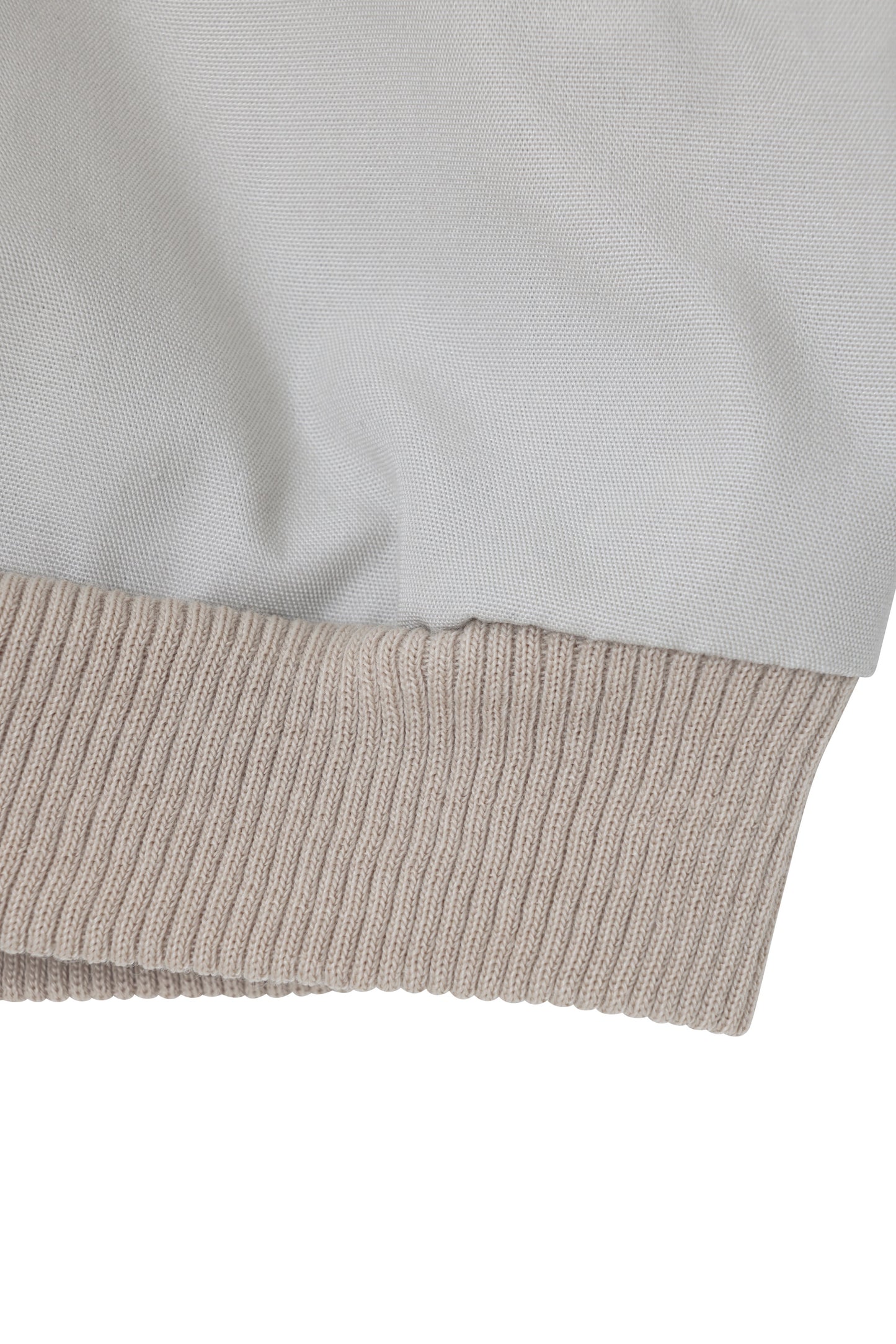
The waistband consists of a separately attached rib-knit component. This construction creates controlled blousing above the waist while preserving flexibility and wearer comfort.
V. Technical Design Elements & Precision Detailing
The most successful design element is the pocket architecture. The angled zipper entries align with the body’s natural hand position while generating visual movement across the otherwise restrained front panel.
The front body incorporates vertical shaping seams adjacent to the zipper. These seams create subtle visual elongation and may conceal structural reinforcement associated with the closure system.
Hardware selection remains deliberately understated. The zipper teeth and sliders are visible but not oversized. Such proportional moderation often indicates experienced product development personnel who understood that hardware can easily overwhelm lightweight garments.
The waistband and collar establish the primary visual framework. Together they contain the volume of the body panel and create balance between upper and lower sections.
VI. Style Nomenclature & Historical Evolution
This garment belongs to the broad family of blouson jackets. The term derives from the characteristic bloused effect generated when excess body volume is controlled at the waist.
Its ancestry includes golfing jackets of the 1930s, postwar leisure jackets, British Harrington jackets, and continental driving jackets. By the late twentieth century, these influences had largely merged into a generalized category of casual outerwear.
The collar warrants particular attention. It is a traditional shirt-style fall collar mounted onto a stand. Unlike the funnel collars of bomber jackets or the button-tab collars of certain Harrington models, this collar maintains a closer relationship to tailoring traditions.
The result is a hybrid form: neither purely sportswear nor conventionally tailored outerwear.
VII. Fabric Composition & Textile Engineering
The shell fabric exhibits characteristics associated with a tightly woven filament-based cloth. The surface displays low nap, minimal texture, subdued luster, and relatively compact yarn spacing.
Estimated fabric weight falls within approximately 180–260 GSM. The material appears engineered for moderate wind resistance, dimensional stability, and resistance to wrinkling.
The cloth demonstrates sufficient body to maintain panel definition while remaining flexible enough for bloused shaping above the waistband. Recovery characteristics appear favorable, particularly around high-movement zones such as elbows and side seams.
The rib-knit waistband introduces a distinct performance component. Its elasticity provides tension-based silhouette control without requiring darts or tailored waist suppression.
VIII. Construction & Pattern Analysis
Pattern architecture is notably efficient. The body appears derived from relatively large front and back panels with limited seam interruption.
Shoulder construction appears conventional, utilizing set-in sleeves rather than raglan geometry. The shoulder line remains soft and slightly extended, reflecting late twentieth-century proportion preferences.
The collar consists of a separate stand and fall assembly. The collar stand establishes elevation around the neckline, while the collar leaf folds outward to create the visible profile.
Drafting indicates industrial standardization rather than individualized pattern development. Nevertheless, the proportions are carefully calibrated. The chest circumference, shoulder width, sleeve dimensions, and waistband compression exist in productive relationship to one another.
Pocket placement appears determined through both ergonomic and aesthetic considerations. The angle facilitates hand entry while visually narrowing the front torso.
IX. Structural Integrity & Panel Configuration
The garment’s primary structural load paths originate at the shoulder seams and transfer downward through side seams and front closure supports.
Stress concentration around pocket entries has been addressed through reinforced zipper installation and shaped pocket panels. Pocket openings are among the first areas to fail in outerwear of this type; the construction visible here appears designed to resist such deterioration.
The collar base receives additional stabilization through internal interfacing. Without such support, the collar would collapse and distort under repeated wear.
The waistband functions as a structural anchor. By concentrating tension at the hem, it assists in maintaining silhouette integrity while reducing distortion elsewhere in the garment.
X. Edge Finishing, Seam Termination & Closures
The collar edges appear turned, enclosed, and topstitched. Edge definition remains crisp, suggesting stable interfacing and accurate sewing control.
The zipper insertion demonstrates competent alignment. Misalignment at the collar junction is common in lower-grade production; here the closure appears centered and balanced.
Pocket zipper installations are especially noteworthy. The zipper tape has been integrated with minimal puckering, indicating careful control of feed rates and stabilization during assembly.
Sleeve cuffs appear cleanly finished with turned hems rather than knit cuffs. This decision maintains visual consistency with the tailored collar.
The collar roll line remains controlled and symmetrical. The collar neither collapses into the neckline nor stands excessively away from the body.
XI. Manufacturing Context, Production Scale & Industrial Feasibility
This garment was almost certainly produced within a medium-scale industrial manufacturing environment. Construction complexity exceeds what would be desirable for ultra-low-cost production, yet remains entirely feasible for established commercial outerwear factories.
The greatest labor inputs occur during pocket construction, collar assembly, zipper installation, and waistband attachment. Each process requires dedicated operations and quality-control checkpoints.
From a production management perspective, the design demonstrates sensible allocation of labor. Complexity is concentrated where consumers perceive value. Large uninterrupted body panels simplify cutting and assembly, offsetting costs introduced elsewhere.
Material utilization appears efficient. Pattern pieces are relatively rectangular, minimizing cutting waste.
XII. Conceptual Influence & Psychological Design Intent
The garment’s conceptual foundation rests upon ideas of competence, cleanliness, and adaptability. It references traditional leisurewear without reproducing historical garments directly.
The pale coloration amplifies these themes. Light-colored outerwear has historically signaled controlled environments and predictable routines. It is seldom chosen by individuals anticipating mechanical repair work or encounters with wet livestock.
The jacket communicates accessibility. It neither advertises technical performance nor fashion radicalism. Its confidence derives from its refusal to participate in either category.
XIII. Artistic & Aesthetic Direction
The visual system is fundamentally modernist in character. Ornament is absent. Structure becomes decoration.
The collar establishes the primary frame for the upper body. Its measured proportions create a horizontal visual anchor. The zipper introduces a strong vertical axis. The angled pockets generate opposing diagonal forces.
These three geometries—horizontal collar, vertical closure, diagonal pockets—create the entire composition.
The aesthetic achievement lies in how little material is required to produce visual order.
XIV. Historical Placement & Contextual Analysis
A production date between approximately 1988 and 1998 appears most plausible.
Several factors support this assessment: the generous shoulder width, relaxed chest volume, ribbed blouson waistband, hardware proportions, pocket geometry, and overall silhouette. Earlier decades frequently produced shorter and more fitted variants. Later examples often incorporated more overt technical detailing or minimalist luxury branding.
The garment belongs to a period when European casual outerwear occupied a middle ground between tailoring and sportswear. Manufacturers had not yet surrendered entirely to either extreme.
The collar is particularly useful chronologically. Its moderate point length and balanced spread are characteristic of late-century casual outerwear and diverge from the exaggerated collar treatments of many 1970s garments.
XV. Use Case
Placed on a moving body, the jacket performs best during spring mornings, autumn afternoons, coastal weather, and travel conditions involving repeated transitions between indoors and outdoors.
The wearer is identifiable through accumulated decisions. She values adaptability over novelty and expects a single garment to function across several environments in one day. The jacket may accompany errands, train journeys, lunch appointments, museum visits, and prolonged walking without appearing misplaced in any setting.
Adjacent garments must accommodate the waistband’s compression effect. High-rise trousers and straight skirts integrate particularly well because the bloused volume terminates cleanly at the waist. Bulky knitwear beneath the jacket would begin to challenge the available ease, though lightweight sweaters remain entirely plausible.
The jacket performs most effectively when allowed to do exactly what it was designed to do: remain useful for years while attracting very little commentary.
Share