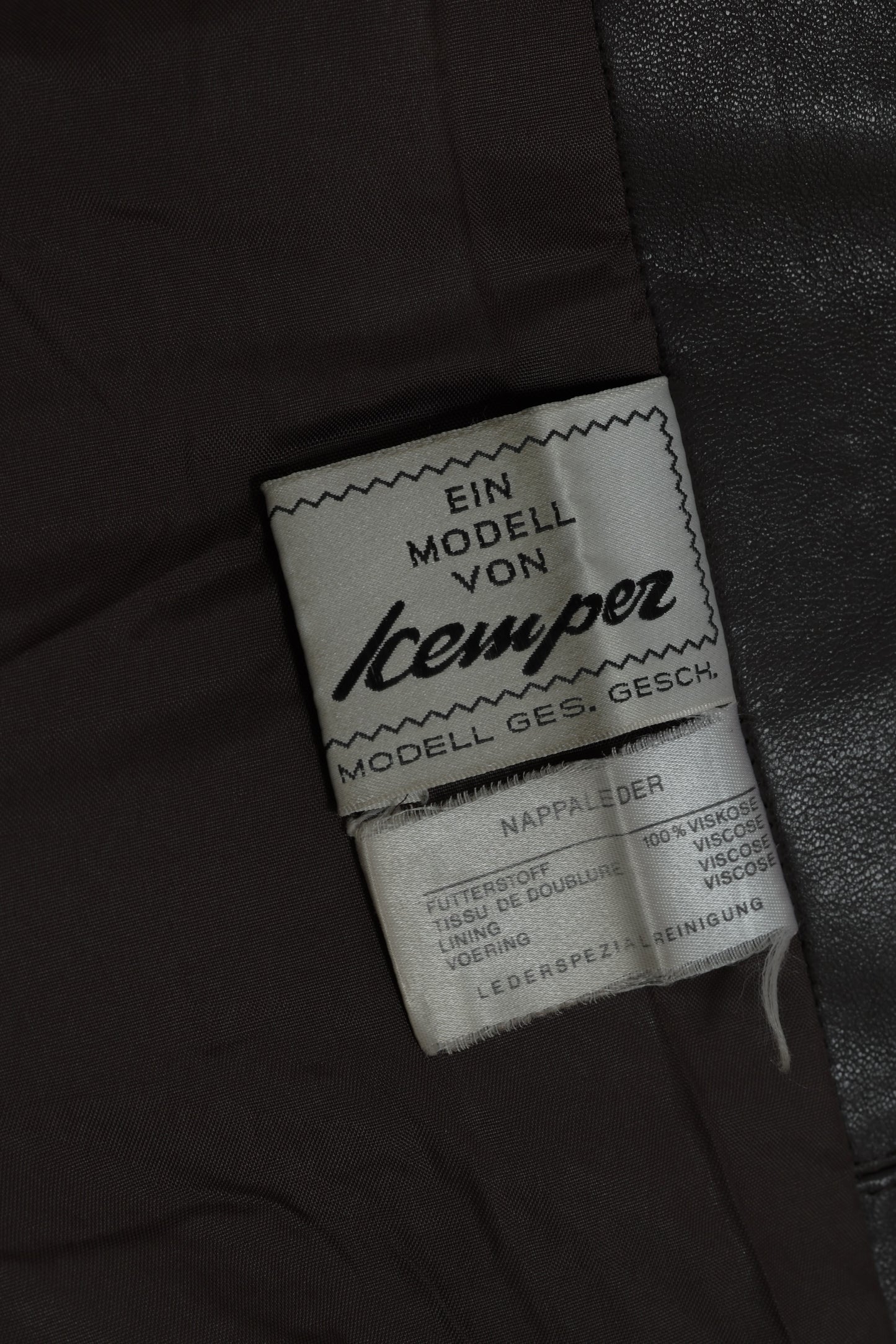
Kemper (West Germany)
1985–1992, West German Lambskin Duster
1985–1992, West German Lambskin Duster
Couldn't load pickup availability
… approximate size: EU 40–42, US L
Measurements (cm):
shoulder to shoulder: 46
sleeve (shoulder to cuff): 56
chest (pit to pit): 60
length (collar to hem): 102
SKU: 900562
This is a mid-length lambskin walking coat produced in Germany during the late 1980s to early 1990s. The coat combines a relaxed oversized silhouette with a concealed front closure system, large utility patch pockets, and a convertible storm-collar arrangement that reflects broader European outerwear developments of the period. The shell leather exhibits a soft hand, fine pebble grain, and moderate drape characteristic of garment-grade lambskin intended for metropolitan wear rather than heavy-duty field use. Construction methods indicate industrial production executed at an upper-middle market level, prioritizing comfort, material quality, and ease of wear over tailored body sculpting. The garment occupies an interesting historical moment when leather outerwear increasingly borrowed proportions and drafting principles from oversized woven coats, producing silhouettes that emphasized volume, movement, and material presence.
1. Designer Origin & Brand Profile
The label identifies the garment as “Ein Modell von Bexper” with the designation “Modell Ges. Gesch.,” indicating a registered model or protected design under German commercial practice. The terminology is consistent with German apparel labeling conventions of the late twentieth century and suggests a manufacturer operating within the established leather garment sector rather than a couture or designer-led enterprise.
Bexper appears representative of the many German leather specialists that supplied domestic and regional European markets during the 1980s and early 1990s. Such firms frequently concentrated on technical material handling, efficient production, and durable construction while adapting prevailing fashion trends into commercially viable products.
The coat demonstrates a manufacturer comfortable working with soft lambskin at scale. The pattern and assembly indicate confidence in material behavior. There is little evidence of stylistic anxiety. The garment assumes the leather itself is persuasive enough and declines to hold a committee meeting about the matter.
2. Brand Heritage & Industry Influence
German leather manufacturing maintained substantial technical expertise throughout the postwar decades. By the late 1980s, many firms had shifted from heavily structured leather garments toward softer constructions reflecting changing consumer expectations.
This coat reflects that transition. The silhouette rejects the fitted leather jacket traditions associated with earlier decades and instead adopts the volume and ease emerging throughout European outerwear. Manufacturers increasingly integrated garment-washed appearances, softer hides, and simplified construction systems into their offerings.
The significance of firms such as Bexper lies not in dramatic innovation but in their role as translators of broader fashion developments into accessible products supported by reliable manufacturing systems. Such companies formed the industrial backbone through which trends entered everyday wardrobes.
3. Garment Classification & Design Intent
The garment is best classified as a women’s leather walking coat or city coat. Its length, oversized body dimensions, concealed closure, and large patch pockets position it within the category of urban utility outerwear.
The design intent emphasizes ease, coverage, and comfort. Unlike tailored leather coats that seek visual definition through panel shaping, this garment derives its character from controlled volume. The wearer is not required to conform to the garment; the garment accommodates the wearer.
Its intended setting includes commuting, shopping districts, travel, office environments, and general urban use. The oversized proportions allow layering beneath, expanding seasonal functionality.
4. Construction Methodology & Engineering
Construction appears entirely machine assembled using industrial lockstitch operations. The leather panels are joined through standard seam constructions with visible topstitch reinforcement along major structural lines.
The concealed front closure is one of the coat’s defining engineering decisions. The fly-front arrangement hides the principal fastening system beneath an overlapping front panel, preserving a clean visual surface. Visible collar buttons function independently from the concealed front closure and appear intended to secure the collar under adverse weather conditions.
The coat is fully lined in a woven viscose lining, as indicated by the care label. This lining improves movement over underlying garments while protecting seam allowances and structural interiors.
Assembly sequencing likely followed conventional leather outerwear production: body construction, pocket application, sleeve assembly, collar preparation, lining insertion, front closure installation, and final edge finishing.
5. Technical Design Elements & Precision Detailing
The large patch pockets dominate the lower visual field. Unlike inset pockets, these pockets remain fully visible and contribute significantly to the garment’s architectural composition. Their dimensions suggest genuine utility rather than decorative symbolism.
The concealed placket introduces an unusual degree of visual discipline. Large expanses of uninterrupted leather become possible because the fastening system withdraws from view.
The collar incorporates a storm-fastening arrangement featuring button-and-loop closure at the throat. This feature reflects practical outerwear traditions and suggests adaptation from military and rainwear precedents.
The shoulder area incorporates shaped upper panels that create subtle articulation without resorting to traditional tailoring devices.
6. Style Nomenclature & Historical Evolution
The coat belongs to a lineage descending from car coats, raincoats, utility overcoats, and walking coats. During the 1980s, these categories increasingly merged as designers and manufacturers explored oversized silhouettes and relaxed proportions.
The concealed front closure has roots in military and weatherproof outerwear, where protection from wind and precipitation justified covered fastening systems. By the late twentieth century, these details frequently migrated into civilian fashion.
The garment also participates in the broader movement toward volume-driven dressing that characterized much European outerwear during the late 1980s and early 1990s. The oversized silhouette reflects contemporary preferences for layered dressing and softened body definition.
7. Fabric Composition & Textile Engineering
The label identifies the shell as lambskin. Visually, the leather exhibits a fine pebble grain with moderate natural variation across the surface. Reflectivity remains subdued, avoiding the high gloss associated with corrected or heavily coated finishes.
The material displays substantial drape for a leather garment. Sleeve folds collapse naturally and form rounded creases rather than rigid angular breaks. This behavior indicates a relatively soft temper and lower structural resistance.
Estimated material weight falls within a medium garment-leather range suitable for extended wear. Abrasion resistance is adequate for urban use but secondary to comfort and drape.
The lining consists of 100% viscose according to the label. Viscose was frequently selected for leather garments because of its smooth surface, breathability, and favorable movement characteristics.
8. Construction & Pattern Analysis
Pattern engineering reveals one of the garment’s most interesting attributes. The shoulder structure appears to occupy territory between a conventional set-in sleeve and a dolman-influenced configuration. The upper sleeve integrates into a broad shoulder panel that reduces visual seam concentration around the armscye.
This approach permits additional mobility while supporting the oversized silhouette. The chest width of 60 cm relative to the shoulder measurement confirms substantial ease throughout the body.
The front pattern is comparatively simple. Vertical shaping is minimized, allowing the leather to fall from the shoulder with minimal interruption. The coat relies on mass and drape instead of sculpted waist suppression.
Collar drafting follows a convertible format. When worn open, the collar functions similarly to a broad notch-collar arrangement. When fastened, the throat closure converts the neckline into a more protective configuration.
The gorge line is low and understated. Lapel formation is soft and collapsible, reflecting the absence of heavy tailoring support.
9. Structural Integrity & Panel Configuration
Structural support derives primarily from material strength and seam placement. The shoulder panels distribute stress effectively across the upper torso while reducing localized strain at the armscye.
Large patch pockets create significant weight concentration in the lower front body. Their attachment appears reinforced through perimeter topstitching and integration into the horizontal waist seam.
The concealed placket serves as both closure mechanism and structural spine. It stabilizes the center front and limits distortion across the opening.
The neckline exhibits competent balance. The collar sits close to the body without excessive collapse despite the softness of the leather. This suggests appropriate interfacing or reinforcement within the collar assembly.
10. Edge Finishing, Seam Termination & Closures
Visible edge finishing relies on turned leather edges secured by machine topstitching. The collar perimeter, cuff edges, pocket tops, front opening, and hem all exhibit consistent finishing methodology.
The concealed closure system deserves particular attention. Fly-front constructions require accurate alignment and repeated reinforcement because closure stress becomes concentrated beneath the visible surface. Successful execution depends on careful sequencing during assembly.
The collar closure combines buttons and stitched loops integrated directly into the collar stand area. This arrangement permits weather protection without disrupting the clean appearance of the coat when worn open.
Seam terminations appear neat and consistent, indicative of experienced leather production rather than improvised workshop methods.
11. Manufacturing Context, Production Scale & Industrial Feasibility
This garment was clearly designed for industrial production. Panel count remains moderate, shaping is simplified, and assembly methods support efficient workflow.
The largest manufacturing challenges would have involved hide selection, pocket placement accuracy, placket construction, and collar assembly. The oversized silhouette actually reduces several production difficulties because close body fitting becomes less critical.
Labor expenditure exceeds that of a basic textile coat due to leather handling requirements, but remains far below bespoke leather tailoring. The garment represents a highly rational balance between quality and manufacturability.
The pattern demonstrates an understanding that production managers occasionally prefer garments that can be assembled without requiring existential negotiations at every workstation.
12. Conceptual Influence & Psychological Design Intent
The coat reflects late twentieth-century interest in ease, protection, and material authenticity. Its oversized volume communicates confidence through occupation of space rather than through aggressive body shaping.
The concealed closure removes visual clutter and places emphasis on surface continuity. This encourages attention toward the material itself and the garment’s scale.
Psychologically, the coat offers shelter. Its dimensions create a physical buffer between wearer and environment. Unlike fitted leather garments that often project energy outward, this coat draws space inward around the wearer.
13. Artistic & Aesthetic Direction
The garment aligns with late-modern European outerwear aesthetics. Large uninterrupted surfaces, simplified detailing, and substantial volume dominate the visual composition.
The collar functions as the principal framing element. Broad collar points establish horizontal width at the neckline while the concealed front directs attention downward through a clean central axis.
The oversized sleeves reinforce the silhouette’s architectural quality. Their fullness contrasts with the relatively controlled collar and front opening, creating balance between structure and movement.
The visual language recalls aspects of late-1980s minimalist outerwear, where proportion became more important than decoration.
14. Historical Placement & Contextual Analysis
Several indicators support dating between approximately 1987 and 1993. These include the oversized silhouette, dropped shoulder treatment, concealed placket, large patch pockets, broad collar geometry, and relaxed sleeve volume.
The garment belongs to a period when European outerwear increasingly emphasized comfort and ease while maintaining a degree of urban sophistication. Leather coats expanded beyond traditional fitted formats and adopted proportions borrowed from contemporary woven outerwear.
The label construction, care tag typography, and manufacturing approach align closely with German apparel production during the final years of West Germany and the immediate reunification period.
Use Case
This coat is designed for movement through a city during cold but not severe weather. It performs best over lightweight tailoring, knitwear, soft jackets, and layered separates. The generous body volume permits adaptation throughout the day as temperatures shift between street, train, office, and restaurant environments.
Share