(Unattributed)
1985–1992, Crinkle Crepe Chemisier with Full Sleeve Volume
1985–1992, Crinkle Crepe Chemisier with Full Sleeve Volume
Couldn't load pickup availability
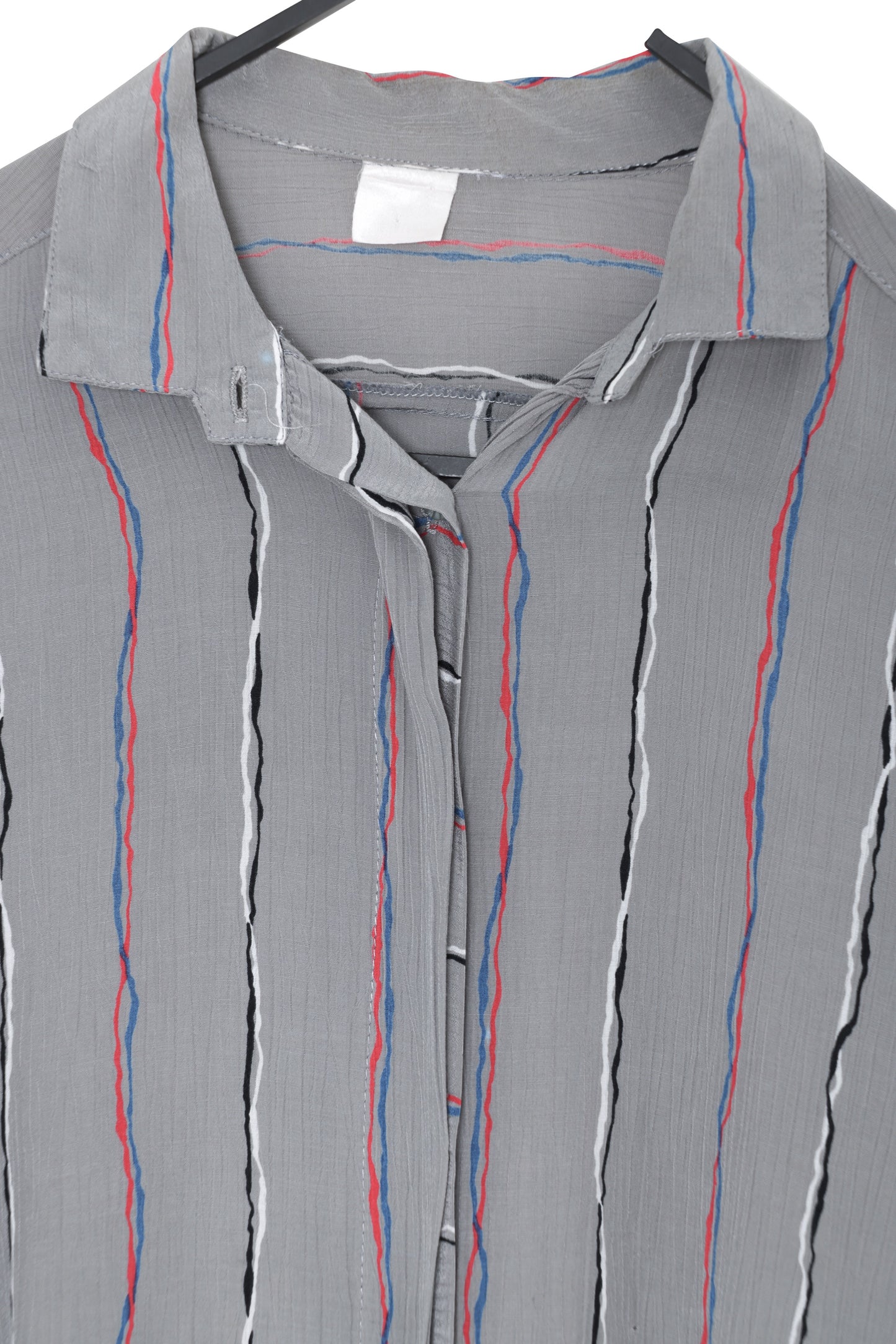
This garment is a long-sleeved shirt-blouse with a soft convertible collar, concealed button placket, gathered sleeve head, and buttoned cuff. The production period is most defensibly placed circa 1983–1990, with possible extension into the very early 1990s, supported by the lightweight crinkle crepe, dropped shoulder balance, sleeve fullness, grey ground, and narrow multicolor vertical stripe. No maker label is present beyond a blank white tab, so attribution remains limited to commercial blouse production without a confirmed brand, designer, or manufacturing region. The textile is a lightweight woven crinkle crepe or crepe-effect dress cloth with fine vertical surface ridging and printed red, blue, black, and white lines over a grey ground. The construction system is machine-sewn, economical, and blouse-specific, with emphasis on soft drape, low-bulk edges, concealed closure, and sleeve volume managed through gathering at the shoulder and cuff.
I. Designer Origin & Brand Profile
No maker label, brand name, size tab, fiber label, or country-of-origin marking is established in the object record. The blank white neck tab indicates that a label was either never printed, removed, washed out, or replaced during the garment’s life, but it does not support a named attribution. Authorship is therefore best assessed through production category, material handling, silhouette, and assembly method. The garment belongs to commercial blouse manufacture, likely produced for a fashion retail environment in which soft drape, print movement, and easy-care finishing carried more design value than tailored internal structure. The design decisions indicate a standardized blouse block adapted through textile selection, sleeve fullness, concealed placket treatment, and a collar scaled for open-neck wear.
II. Brand Heritage & Industry Influence
Brand heritage cannot be assigned without documentary label evidence. The garment nevertheless belongs to a well-established late twentieth-century industry category: the printed synthetic or regenerated-cellulosic blouse designed for office-adjacent, day, and semi-dressed use. During the 1980s, blouse manufacturers frequently used crepe and crepe-effect cloths to produce drape, surface texture, and print movement while keeping sewing operations compatible with commercial machinery. This garment reflects that sector through its concealed placket, soft collar, dropped shoulder, and full sleeve head, all of which align with period blouse production. The object’s industrial significance sits in its conversion of a shirt format into a softer chemisier form: not tailored shirting, but a draped blouse assembled with shirt-derived components.
III. Garment Classification & Design Intent
The garment is properly classified as a long-sleeved shirt-blouse or chemisier. Its functional category is daywear, with a plausible setting in office, retail, travel, informal professional, or semi-dressed casual wardrobes. The concealed front closure refines the center line, while the vertical printed stripe lengthens the torso and gives the light cloth a stronger graphic order. The collar is a soft convertible shirt collar, intended to frame the neckline without requiring a rigid stand, tie, scarf, or jacket. The gathered sleeve head and cuffed wrist introduce blouse volume into a shirt-derived body, producing a silhouette consistent with mid-to-late 1980s commercial fashion.
IV. Construction Methodology & Engineering
The garment is assembled by machine using lightweight woven-blouse methods. The main body panels are joined at shoulder and side seams, the front opening is built as a folded or applied concealed placket, and the collar is set into a lightly stabilized neckline. The shoulder seam is extended, shifting the armhole outward and allowing gathered sleeve volume to fall from a lowered junction. Sleeve heads are drawn into the armscye with gathering, producing vertical folds that continue into the sleeve length. The cuffs are machine-formed barrel cuffs with button closure, controlling the sleeve fullness at the wrist. The fabric’s crinkle crepe structure requires careful seam tension; excessive feed pressure would distort the stripe and flatten the surface, while insufficient stabilization would leave the placket and collar prone to waviness.
V. Technical Design Elements & Detailing
The principal design elements are the concealed placket, soft collar, gathered sleeve head, cuffed sleeve termination, and vertical printed stripe. The placket has a front fold that covers the buttons, producing a cleaner central axis while preserving a conventional button-front system beneath. The collar is broad enough to read as a shirt collar but soft enough to collapse into the neckline without a heavily built stand. The sleeve construction is technically important: the upper sleeve is gathered into the dropped shoulder line, creating controlled fullness that travels down the length of the sleeve and is then collected into the cuff. The printed stripe is irregular in line quality, with red, blue, black, and white bands that follow the garment vertically but respond to the fabric’s crinkled surface. Manufacturing feasibility is moderate; the garment is not structurally complex, but the cloth requires controlled feeding, fine needles, and precise placket handling.
VI. Style Nomenclature & Historical Evolution
The appropriate style terms are shirt-blouse, chemisier, long-sleeved blouse-shirt, and concealed-placket blouse. Historically, this type descends from the shirtwaist and tailored blouse but belongs more directly to late twentieth-century soft blouse production. By the 1970s and 1980s, the shirt-derived blouse had expanded into synthetic crepes, rayon crepes, georgette-like cloths, and printed textured fabrics, allowing manufacturers to preserve collar and placket references while abandoning the crispness of cotton shirting. The concealed placket became common in commercial blouse design because it softened the front while giving a more finished presentation under jackets or knit layers. The gathered sleeve head and extended shoulder are strongly associated with 1980s proportion, when upper-body volume and softened tailoring entered ordinary blouse construction.
VII. Fabric Composition & Textile Engineering
Fiber content is unverified. The textile structure is most defensibly described as a lightweight woven crinkle crepe or crepe-effect dress cloth, not generic woven cloth. The surface has fine longitudinal ridging, a dry hand, slight spring, and a pebbled or compressed texture consistent with crepe-twist yarns, crepe finishing, or a crinkle-set woven construction. The grey ground carries printed vertical lines in red, blue, black, and white; the line edges modulate with the surface relief, indicating that print behavior is affected by the crepe texture. A regenerated cellulosic such as viscose or rayon, a polyester crepe, or a blended construction would all be plausible from performance evidence, but no specific fiber can be assigned without label or testing. Estimated weight likely sits in a light blouse range, approximately 70–120 GSM. The cloth offers fluid drape, low bulk, moderate opacity, and limited inherent recovery. Crepe surfaces of this type can be prone to snagging, seam slippage, edge fray, surface abrasion, and distortion under steam or aggressive laundering. The fabric’s value for this garment lies in its ability to hold sleeve volume without stiffness while giving the plain shirt body a textured, moving surface.
VIII. Construction & Pattern Analysis
The pattern uses a shirt-derived body with reduced tailoring and increased textile dependence. The front panels are cut to carry the stripe vertically, with the center-front concealed placket forming a narrow structural zone. The back panel appears simple and unshaped, likely using ease rather than darts for fit. The shoulder is dropped or extended, placing the sleeve insertion beyond the natural shoulder point and allowing a fuller sleeve head to be gathered into the seam. This pattern choice reduces the need for precise shoulder shaping while supporting a softer 1980s blouse silhouette. The collar is drafted as a soft convertible collar, probably with a minimal stand or integrated neckline roll rather than a firm tailored stand. Stitching is machine-executed with relatively fine thread; seam allowances are narrow and suited to a lightweight crepe. Assembly depends on stabilizing the neckline and placket before attaching the collar and setting the gathered sleeves.
IX. Structural Integrity & Panel Configuration
The garment’s structure is light and textile-led. The body panels supply vertical fall, while the sleeve construction supplies the strongest three-dimensional shaping. No evidence supports boning, canvas, padding, waist stays, or heavy interfacing. Stability is concentrated at the collar, neckline, placket, cuffs, shoulder seams, and sleeve insertions. The collar points and placket need light support to resist curling, but the garment would be damaged aesthetically by excessive stiffness. The gathered sleeve head introduces stress at the armscye seam because fullness is compressed into a relatively narrow seam line; even stitch tension and secure seam finishing are therefore important. The cuff manages the sleeve’s lower fullness and prevents the crepe from collapsing entirely around the wrist. The most vulnerable areas are the collar edge, top of placket, buttonholes, shoulder seam, cuff button point, and gathered sleeve seam where fabric movement and thread strain converge.
X. Edge Finishing, Seam Termination & Closures
Edges are resolved through machine turning, narrow seam allowances, topstitching, and enclosed placket construction. The collar edges are turned and topstitched close to the perimeter, giving the soft crepe enough definition to form a recognizable collar point. The neckline seam is machine-finished, with the back neck edge showing a utilitarian finish typical of commercial blouse work. The concealed placket covers the button closure, reducing visual interruption along the front while adding extra fabric layers that must be kept flat. Buttonholes are machine-worked and placed within the closure system; their anchoring depends on placket stabilization because lightweight crepe alone would stretch and distort under repeated fastening. Cuff edges are turned and stitched, with the cuff acting as both closure element and sleeve-volume control. Durability is adequate for a light blouse, though repairability is highest at buttons and cuffs and lower at seam-slippage zones in the crepe.
XI. Edge Treatment, Wearability & Manufacturing Context
The garment was designed for commercial production with manageable labor and a moderate decorative return from the textile. The expensive operations are not tailoring operations; they are fabric-control operations: aligning the stripe, forming the concealed placket, setting the collar without distortion, gathering the sleeve head evenly, and attaching cuffs cleanly to a mobile cloth. The sleeve gathering adds sewing time but allows a standard body block to receive a more fashionable sleeve proportion. The concealed placket adds folding, pressing, and buttonhole control, but it raises perceived finish without requiring lining or internal tailoring. Manufacturing quality control would focus on placket straightness, collar symmetry, sleeve-gather distribution, cuff closure alignment, stripe skew, seam puckering, and fray management. Wearability is favorable for layered day use because the fabric is light, breathable enough by structure, and visually forgiving, though it would require careful laundering and pressing to preserve surface texture and placket shape.
XII. Conceptual Influence & Psychological Design Intent
The garment’s concept is rooted in late twentieth-century soft tailoring and printed blouse dressing. It borrows the shirt’s collar, placket, cuff, and vertical front organization, then translates those components into a draped crepe format. The grey ground moderates the bright red and blue lines, while the black and white stripe elements sharpen the surface without producing heavy contrast blocks. The concealed placket supports a cleaner torso presentation, and the gathered sleeves create period-specific volume without shoulder pads or jacket structure. The garment’s cultural position aligns with 1980s blouse dressing, when office-adjacent clothing often balanced professional shirt references with softer textiles and fuller silhouettes. The design communicates polish through closure treatment and collar architecture, while the fabric supplies movement and surface complexity.
XIII. Artistic & Aesthetic Direction
The aesthetic direction is graphic, vertical, and textile-driven. The grey ground places emphasis on the line system and the crepe surface, making the fabric both pattern and texture. The collar forms the main upper-frame element, with its points extending over the front body and tying the neckline to the stripe direction. The concealed placket reduces button interruption, allowing the printed verticals to remain dominant across the torso. Sleeve volume shifts the garment away from strict shirting and toward a blouse silhouette associated with 1980s proportion. The composition does not require ornate trim; its visual system is built from line, surface relief, soft collar geometry, and controlled fullness at the sleeve head and cuff.
XIV. Historical Placement & Contextual Analysis
The most defensible production range is circa 1983–1990, with a possible early 1990s continuation. The date is supported by the soft grey palette with bright linear accents, lightweight crinkle crepe, concealed placket, extended shoulder line, gathered sleeve volume, and broad but softened collar. Earlier 1970s blouse collars tend to appear larger, more pointed, and often paired with different earth-toned textile systems; this garment’s cooler grey ground and graphic red-blue-black-white striping align more closely with mid-to-late 1980s commercial fashion. The construction method also fits that period, especially the combination of soft synthetic or regenerated-cellulosic crepe with blouse volume and machine-efficient finishing. Probable origin cannot be assigned from the object record. The garment sits within an international commercial blouse typology, with stylistic affinity to European and broader Western retail markets of the 1980s.
XV. Use Case
The garment is suited to daywear requiring a soft but dressed appearance: office-adjacent work, travel, retail settings, meals, or layered seasonal dressing. It would function well under a jacket, cardigan, or sleeveless vest, provided the outer layer has enough armhole and shoulder allowance to accommodate the gathered sleeve head. The collar can be worn open at the throat, with the concealed placket keeping the front surface controlled. The sleeve fullness requires the cuff to remain fastened or partially fastened to manage the fabric at the wrist. The hem can be worn untucked or lightly tucked, though the lightweight crepe may shift under a waistband. Care demands would include gentle washing or dry cleaning depending on fiber content, low mechanical agitation, careful pressing from the reverse or with a cloth, and protection from snagging at seams, cuffs, collar points, and placket folds. Its technical use-context is a soft 1980s shirt-blouse for warm indoor environments, transitional layering, and movement-compatible day dressing.
Share