1
/
of
4
(West Germany)
1980–1995 Leather Biker Pants, Reinforced Knee Panels, Waist Strap
1980–1995 Leather Biker Pants, Reinforced Knee Panels, Waist Strap
Regular price
$88.00
Regular price
Sale price
$88.00
Unit price
/
per
Shipping calculated at checkout.
Couldn't load pickup availability
This is a pair of black leather biker trousers dated 1980–1995, cut with straight fitted legs, reinforced knees, oblique zipper pockets, a long lower-leg opening, and an integrated waist-retention strap. The medium is probable sheepskin garment leather with a pigmented, low-relief grain, selected for enough suppleness to bend at hip and knee while maintaining a close lower-body profile. The diagonal waist strap and paired pocket openings concentrate metal hardware above the hip, while the rounded knee overlays divide the legs into repeated zones of mobility and abrasion control. True riding suits of the period used thicker hide, substantial impact pads, stretch inserts, and jacket-connection zippers; this independent trouser retains the rider vocabulary in a form equally compatible with late-twentieth-century club and street dress (Cycle World, “Fieldsheer Mistral Two-Piece Suit,” May 1990; Victoria and Albert Museum, Club to Catwalk: London Fashion in the 1980s, 2013). Its research value lies in the specific reduction of motorcycling equipment into a serially assembled leather fashion garment whose movement aids remain functional even though certified protective performance is unresolved.
I. Designer, House, Maker Origin & Historical Profile
The designer and manufacturer are unknown. No maker or country-of-origin mark accompanies the catalog record, and no model code or component trademark provides a traceable commercial identity. The black zipper chains, domed snap, broad metal clasp, and separate multi-slot catch are component evidence only; none identifies a garment maker or sewing location. Attribution therefore stops at an unmarked, serially made leather trouser with a documented 1980–1995 date range.
Country of manufacture cannot be separated from intended market with confidence. Western European manufacture and East Asian export manufacture for Western European or North American sale are both plausible: the trouser block, black molded zipper chains, pigmented garment leather, and integrated adjustment hardware circulated across all three production spheres during the period. A contemporary example demonstrates the danger of assigning manufacture from styling: the Fieldsheer Mistral riding suit was designed in England, made in Korea, and sold through American dealers (Cycle World, “Fieldsheer Mistral Two-Piece Suit,” May 1990). The narrowest supportable conclusion is that these trousers were probably made for the transatlantic Western European or North American leather-rider market; the design source, factory country, and later distribution route remain unresolved.
II. Brand Heritage, Fashion-Historical Position & Industry Influence
The relevant history is a product system, not a missing company biography. By 1990, high-specification street-riding suits could use 1.3–1.4 mm cowhide, double and triple leather at impact zones, closed-cell foam at knees and hips, expandable sections for flexion, and a zipper joining jacket to trousers. Cycle World described precisely that construction in its May 1990 evaluation of the Fieldsheer Mistral. The present object selects only part of the system: a close leather shell, layered knees, controlled lower-leg access, secure pockets, and additional waist retention. It omits any documented jacket connector, track-position patterning, substantial removable armor, or specialized ventilation. Its industry position is consequently best stated as civilian motorcycle-derived leatherwear, not professional racing equipment (Cycle World, “Fieldsheer Mistral Two-Piece Suit,” May 1990).
European regulation does not supply a hidden maker or a narrower date. Council Directive 89/686/EEC established the European personal-protective-equipment framework in 1989, with national measures applied from 1 July 1992 and a transition for earlier national arrangements through 30 June 1995; a later European Commission answer stated that motorcyclists’ garments fell within that framework only when special protection was claimed, while separate knee or elbow protectors were always PPE. EN 1621-1 for impact protectors was adopted in 1997, after the recorded upper date, and the general EN 13595 clothing standard followed in 2002 (Council Directive 93/95/EEC, 29 October 1993; Official Journal of the European Communities, answer E-1396/00, 8 June 2000; NEN-EN 13595-1:2002). The absence of conformity information therefore does not prove a pre-regulatory date; it only prevents cataloguing the trousers as certified protection.
III. Garment Classification & Design Intent
The stable classification is a pair of full-length, motorcycle-derived leather biker trousers. A conventional center-front zipper fly and snap-fastened waistband establish the basic trouser type. The legs remain close through thigh, knee, and calf without the expanding hem of a flare, the extreme seat and thigh volume of a jodhpur, or the external chaps construction of open-backed riding protection. Shaped overlays occupy the knees; paired zippered pocket openings sit diagonally across the upper fronts; a broad leather strap crosses the waist; and a long zipper opens the outer lower leg. These features distinguish the object from ordinary leather jeans while stopping short of a racing-suit classification.
The design resolves four linked problems created by close leather trousers. The waist requires a secondary means of holding a heavy, low-stretch shell against the body; the articulated joint requires a sacrificial or cushioned layer; the narrow lower leg requires an opening large enough to admit the foot and negotiate a boot; and small possessions require closed pockets that will not gape in movement. The strap, knee overlays, long leg zipper, and pocket zippers answer those needs. Their joint effect is mobility under containment, with localized release points inserted into a material that otherwise resists extension.
Protective intent remains graduated. The knee construction can spread abrasion and may contain low-bulk padding, yet no documented impact rating, removable protector, dense racing-grade hide, or suit-connection system establishes professional protection. The trousers could serve road riding at modest intensity, fashion wear derived from rider equipment, or both. The object’s most defensible design intent is therefore independent civilian wear that preserves functional elements of motorcycle trousers without proving a complete safety system.
IV. Construction Methodology & Engineering
The trousers are cut and sewn from multiple garment-leather components. The probable sequence began with hide sorting and nesting, followed by cutting of paired fronts and backs, waistband sections, pocket frames, fly pieces, knee overlays, lower-leg opening facings, belt loops, and the broad retention strap. The pocket zippers were set into reinforced diagonal slashes before the major leg seams closed. The knee components were probably prepared as subassemblies, their rounded edges turned or skived, then topstitched to the fronts; any thin interlayer would have been trapped at this stage. Fly, front rise, back rise, inseams, and side seams followed, with the lower-leg zipper inserted before the hem was closed.
The separate waistband was stabilized with a black woven facing and then attached around the top edge. Belt loops, the snap, the slotted metal catch, and the strap anchorage concentrate several perforating operations in a narrow band, so the leather is folded, doubled, or backed at these points. The strap itself is built from folded or faced leather around a stable core and finishes in a broad rectangular metal clasp. Its diagonal crossing path distributes waist tension beyond the center-front snap and fly.
Machine assembly is construction-confirmed by even lockstitch rows, consistent stitch length, repeated topstitch margins, mechanically set hardware, and zipper installation. A compound-feed or roller-foot leather machine is the probable principal equipment because it can advance a high-friction skin without marking or shifting the grain face. The sequence required skiving at turned edges and intersecting seams to prevent hard ridges, but the available evidence does not establish hand skiving, die cutting, or a named factory process. Pressing would have relied chiefly on rolling, hammering through protection, and controlled heat, since direct hot ironing risks glazing or distorting pigmented leather.
V. Technical Design Elements & Detailing
The waistband system combines a conventional fly closure with an external secondary retention assembly. A domed metal snap secures the waistband above the zipper fly. Separate from that closure, a wide leather strap crosses the front and terminates in a substantial rectangular metal clasp; a multi-slot metal catch is fixed into the opposite waistband area. The visible topology is external and load-bearing. It is not a French bearer, French fly, waist stay, or internal bearer, all of which require a concealed secondary fastening behind or beside the fly. “External waist-retention strap with multi-slot catch” is the exact available term.
The upper fronts carry paired oblique zipper pockets. Each opening is framed by narrow turned leather lips that stabilize the cut edge and keep the zipper chain below the surrounding grain plane. The diagonal orientation follows the hand’s entry path while contributing two dark, reflective lines across the hips. Their closed construction offers limited secure storage and reduces the chance of a pocket mouth catching during movement.
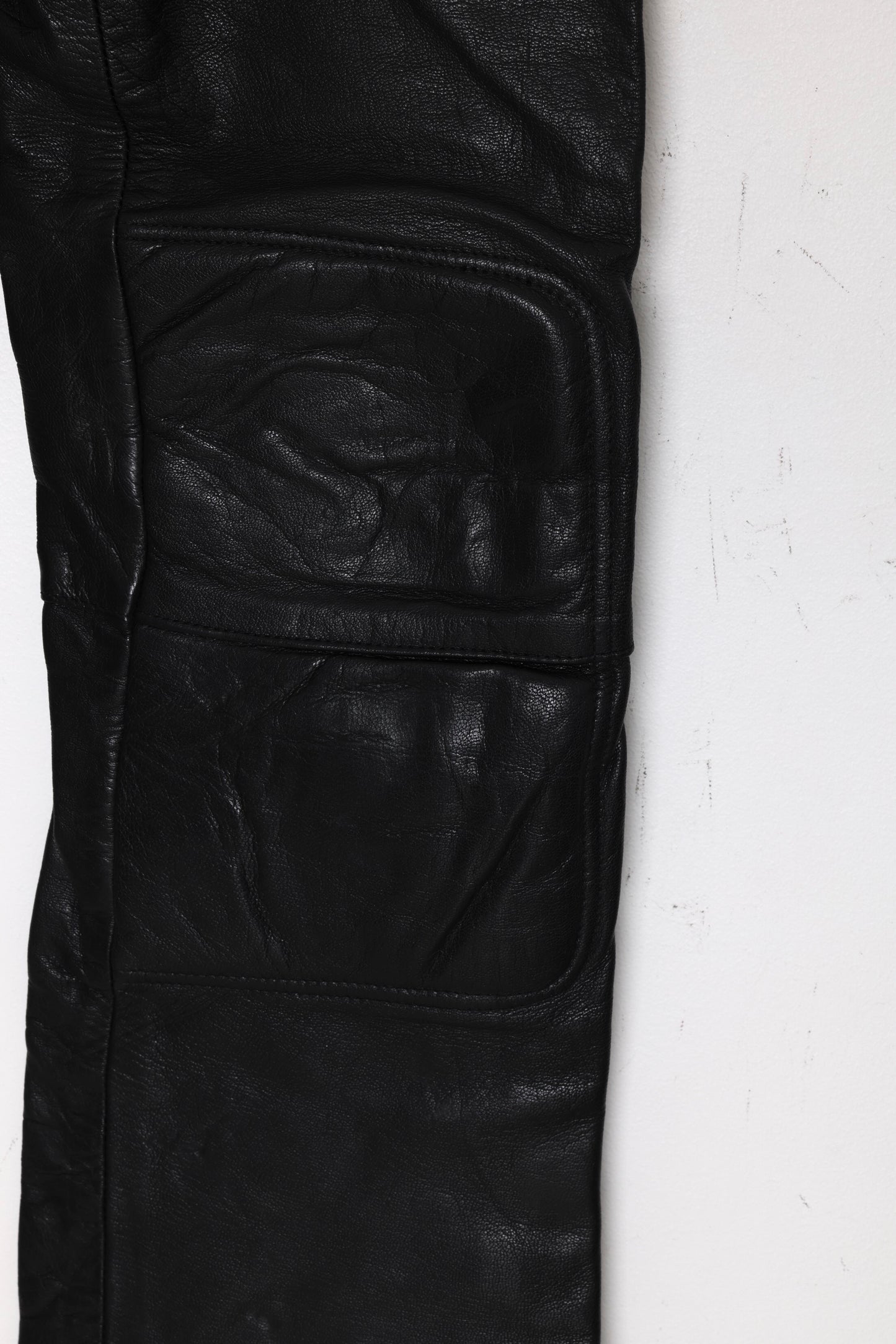
At each knee, a large rounded rectangular overlay is set within a wider segmented zone. The upper seam follows the flexion area and the broad lower component continues below the patella. Surface fullness and compression wrinkles indicate more than a printed or merely decorative outline; the assembly provides a second leather layer and probably encloses thin cushioning, though the interlayer is unverified. It is neither a replaceable knee slider nor a rigid impact protector. The long lower-leg zipper supplies circumference at dressing and then returns the calf and ankle to a close line compatible with boots.
Hardware is both operational and compositional. Black zipper chains recede into the leather field, while the silver waist fittings create the principal contrast. The enlarged buckle and slotted catch are deliberately over-scaled relative to the snap and zipper pulls. Their mass visually announces the waist as a fastening zone before the eye reaches the knees, where repetition replaces contrast as the organizing device.
VI. Nomenclature and Historical Drift
“Motorcycle trousers” originally identifies equipment patterned around a seated rider and built to manage abrasion, impact, wind, and joint movement. A University of Westminster Menswear Archive Dainese example, object 2020.2.3 and dated 1972–1990, has a snap and zipper fly, oval padded leather knees, long calf zippers, reinforced seat, pleated mobility panels, and a zipper for attachment to a matching jacket. The present trousers share the knee reinforcement, close leg, snap-and-fly opening, and long lower-leg access, but the independent waistband, street pockets, softer hide, and lack of a documented jacket connector shift them away from a divided racing suit. “Motorcycle-derived biker trousers” preserves both ancestry and difference (University of Westminster Menswear Archive, Dainese Leather Motorcycle Trousers, object 2020.2.3).
The term “biker trousers” had already moved beyond literal road equipment by the turn of the 1980s. The Design Museum’s BLITZ: The Club That Shaped the 80s catalogue places late-1970s La Rocka leather biker trousers in a display on gender experimentation and fetishwear at the Blitz club. The item’s presence in that documented wardrobe system does not make every later black leather trouser a club garment, but it establishes that the archetype was available for recombination before the proposed date begins (Design Museum, BLITZ: The Club That Shaped the 80s, 2024, exhibition catalogue, pp. 52–53).
The drift continued through the 1980s as leather, workwear abrasion, fetish references, and rider hardware circulated across London club and fashion settings. The Victoria and Albert Museum’s Club to Catwalk research cites The Face in September 1982 on leather’s dominance in the “Hard Times” look, then identifies fetishwear at Taboo and silver leather “armoured” jackets in the tighter clubwear that followed the summer of 1987. The trousers sit plausibly within that motorcycle-to-clubwear continuum because their hardware, close leg, and segmented knees carry equipment references without the full protective construction of a track suit (Victoria and Albert Museum, Club to Catwalk: London Fashion in the 1980s, press material, 2013).
VII. Fabric Composition & Textile Engineering
The principal material is probable sheepskin garment leather; goatskin is the nearest alternative. The grain is fine to moderately pebbled, irregular at small scale, and accompanied by rounded compression wrinkles, low apparent mass, and substantial suppleness. Those traits favor sheep over adult bovine hide, which commonly has greater thickness, panel body, and broader grain, while the absence of a pronounced ridged grain lowers the probability of goat. Lamb cannot be separated securely from adult sheep because the pigmented surface mutes follicle evidence and the section thickness is not recorded. The responsible material name is therefore “probable sheepskin,” with goatskin retained as an unresolved secondary candidate.
Species diagnosis from surface morphology has an exact limit. The Smithsonian Museum Conservation Institute’s record of Erling Hansen’s leather-identification study notes that hair-follicle patterns are characteristic but that sheep and goat can be difficult to distinguish, different skin areas vary, and later treatment may alter the grain. Here the coating and embossing or plating obscure the pore field enough to prevent an unqualified species claim (Smithsonian Museum Conservation Institute, accession 10053, Erling Hansen, “Identification of Leather,” 1978).
The black face is pigment-finished or otherwise heavily coated. Color is even across natural variation, pore detail is subdued, and highlights sit on the surface instead of rising from a transparent dye field. The finish improves color consistency and offers some resistance to soiling, but it can crack independently of the collagen layer as the knees flex. No evidence establishes aniline, semi-aniline, corrected-grain, split, bonded, patent, or nappa leather, and none of those names is used as a substitute for species or finish.
The leather has medium-light garment weight and a soft but not fluid handle. It folds into broad creases at the thigh, compresses densely inside the knee overlays, and keeps enough body to support zipper frames and the large waist hardware. Extension probably comes from the skin’s directional fiber structure and panel geometry, not elastomeric content. The black waistband facing is a closely woven textile, probably selected to reduce friction and stabilize the top edge, but its fiber content and weave repeat are unresolved.
VIII. Construction & Pattern Analysis
The base is consistent with a conventional four-panel trouser block modified by applied knee assemblies and at least one long lower-leg opening. The front waist is divided by a center fly; the upper fronts sweep cleanly to the hip without pleats; and shaping is carried by seam trajectory, probable back darts or yoke suppression, and the shaped waistband. No direct rise measurement survives, so “high-rise” or “low-rise” would create an unsupported proportion. The waist-to-hip transition is close, while the legs remain comparatively straight below the upper thigh.
The knee line is treated as a separate pattern event. A broad overlay is centered on each leg, its rounded corners avoiding abrupt stress points, and horizontal divisions bracket the joint. This adds thickness at the point of flexion without changing the underlying leg block. Fullness inside the overlay forms soft radiating folds when the leg is straight; in wear, those folds can open as the knee bends. The result is articulated by component layering, not by a knitted expansion panel or an aggressively pre-curved racing leg.
Below the knee, the side seam and inseam remain nearly parallel, producing a narrow straight lower leg. The long zipper releases circumference for dressing and boot passage, then closes the leg back to its intended profile. Leather grain direction was probably selected with the firmer line running vertically through the legs and the more yielding direction across hip and knee. Exact grain placement cannot be reconstructed without marked pattern pieces, but the stable vertical fall and localized transverse creasing support that arrangement.
The broad waist strap crosses the frontal axis independently of the trouser block. Its diagonal path adds a second adjustable layer over the applied waistband and can compensate for minor variation in waist fit without recutting the hip. This is a functional overlay on the pattern, not a grown-on waistband extension. It also introduces controlled asymmetry into an otherwise bilateral front.
IX. Structural Integrity & Panel Configuration
Primary vertical load travels from the legs through the side seams, rises, and waistband. The external strap supplements that path by taking circumferential tension across a wide band and transferring it through hardware mountings into reinforced waistband sections. The snap locates the waistband ends while the zipper closes the fly; neither is asked to carry the entire waist load alone. Pocket openings interrupt the upper fronts, so their turned frames and zipper tapes act as local stays against extension.
The crotch junction, pocket ends, zipper bases, strap roots, catch mounting, and knee-overlay corners are the principal stress concentrations. Rounded overlay corners reduce the tearing tendency of a sharp internal angle. Repeated topstitching around the knees spreads shear across a larger perimeter, while the second leather layer accepts surface abrasion before the base leg panel. These features improve local resistance but do not establish racing-grade protection, which depends on hide thickness, seam strength, impact absorption, and coverage as a system.
Compression wrinkling at the knees and upper thighs is consistent with normal flexion in a close leather shell. Edge wear at the waistband and minor surface change around hardware show where stiff components have worked against the skin. The leather remains coherent enough to preserve panel geometry, yet every existing needle hole is permanent; any seam opening or hardware replacement must reuse the established perforation path where possible. New parallel stitching could create a tear line.
X. Edge Finishing, Seam Termination & Closures
External applied components use turned or skived-and-turned edges secured by narrow lockstitch topstitching. Pocket openings are clean-finished with leather frames over zipper tapes. The waistband top is faced with black woven textile; the facing encloses the raw edge and reduces skin-on-skin bulk. Major leg seams are probably plain seams with allowances opened, flattened, or selectively topstitched, though their complete internal finish is unresolved. The leather does not fray like a woven cloth, so bulk reduction and resistance to tearing at stitch holes matter more than overlocking.
The center-front closure is a conventional zipper fly topped by a metal snap. The external strap and multi-slot catch form an additional waist-retention system, not part of the fly topology. The two oblique pocket zippers are non-separating closed-end units. The long lower-leg zipper is also non-separating and opens the leg circumference for entry; its termination requires reinforcement because repeated pulling concentrates force at the zipper stop and adjacent leather.
Zipper replacement would require careful removal without enlarging the existing stitch perforations, matching chain width and tape flexibility, and preserving the leg circumference. The knee overlays should not be detached merely to flatten creases; their fullness participates in flexion. Loose turned edges may be secured through existing holes with compatible thread, while adhesive use near the pigmented grain risks tidelines, darkening, and future stiffness. Hardware corrosion products should be isolated from the leather without abrasive polishing that would alter the period surface.
XI. Edge Treatment, Wearability & Manufacturing Context
The finish system balances body comfort with production economy. Textile facing keeps the waistband interior smoother than a doubled raw leather edge, and zipper pockets reduce bulk compared with projecting flaps. Turned overlay edges avoid exposed flesh surfaces at the knees. The lower-leg opening prevents the narrow calf from becoming a dressing obstacle, and the wide strap allows adjustment without elasticizing the entire waistband. Each solution adds operations, but each is localized where the base material’s low stretch creates a specific need.
Serial manufacture required skilled skin selection, mirrored cutting, edge skiving, zipper setting, curved topstitching, and hardware installation. The most exacting controls were bilateral knee placement, flat pocket zippers, an undistorted fly, and alignment of the strap with its catch. Leather yield would have been managed by placing smaller pocket frames, loops, and facings around the irregular margins left by the large leg panels. Component count is higher than ordinary leather jeans because reinforcement, access, and adjustment are built as separate subassemblies.
Comparison with period riding equipment identifies the industrial translation. The 1990 Fieldsheer Mistral used 1.3–1.4 mm cowhide, double and triple impact layers, two-stage closed-cell foam, stretch at the knees, and a jacket-to-trouser zipper; a 1990 Kawasaki Chicane suit used double leather at knees, hips, and seat, elastic-backed mobility panels, calf zippers, and a waist connector. This object retains the visual and functional shorthand of layered knees, close calves, zippers, and secure waist fit, while reducing material thickness, articulated inserts, body coverage, and suit integration. The rider archetype therefore survives through selected operations that were feasible in a fashion-leather factory, not through a complete performance specification (Cycle World, “Fieldsheer Mistral Two-Piece Suit,” May 1990; Cycle World, “Kawasaki Chicane Riding Suit,” February 1990).
XII. Cultural Framing
The trousers organize the lower body through containment, localized reinforcement, and controlled access. In a riding context, the close leg reduces loose material, the waist strap limits downward shift, the knee overlays accommodate flexion, the lower-leg zipper negotiates boots, and the closed pockets secure small objects. In a street or club context, the same devices keep their mechanical credibility while producing a highly coded black-leather appearance. The object can occupy both systems because its equipment-derived parts continue to work even after the full racing suit has been abandoned.
This dual use was historically available during the recorded period. The Design Museum’s BLITZ catalogue places leather biker trousers within the late-1970s wardrobe of the Blitz circle, where biker dress, fetishwear, and experiments with gender presentation overlapped. The V&A’s Club to Catwalk research traces leather-heavy “Hard Times” style in 1982 and later leather armor imagery within the club fashions that followed 1987. These records support a cultural frame of post-punk and club-fashion circulation, but they do not establish the trousers’ original wearer, venue, sexuality, or subcultural membership (Design Museum, BLITZ: The Club That Shaped the 80s, 2024; Victoria and Albert Museum, Club to Catwalk: London Fashion in the 1980s, 2013).
The original gendered market is unverified. Fastening direction, black color, close fit, and body proportions are not sufficient evidence. The object’s meaningful wardrobe category is instead a unisex-capable rider-derived separate: equipment vocabulary is concentrated at waist and knee, while the independent trouser format permits combination with a leather jacket, short fashion jacket, knit layer, or other civilian upper garment. That modularity separates it from an issued uniform and from a matched racing suit.
XIII. Artistic & Aesthetic Direction
The whole-object composition is axial but not static. Two straight dark legs descend from a dense waist zone; the center fly sets the vertical axis, paired pocket zippers open away from it on shallow diagonals, and the crossing strap interrupts it with a heavier oblique. Rounded rectangular knee fields repeat at a lower scale and reset the rhythm before the legs continue to the hem. The long lower-leg zipper introduces a single extended vertical accent at the outer edge. Bilateral mass and asymmetrical hardware are held in productive imbalance.
Black pigment compresses the panels into one field until light strikes the grain. Highlights then separate the smooth upper fronts from the more deeply folded knees, and the topstitched overlay edges become low sculptural ridges. Metal at the waist carries the brightest value and makes fastening the focal event; black zipper chains register through intermittent reflections, closer to incised lines than applied ornament. In motion, knee folds expand and collapse inside their stitched boundaries, so the lower composition changes through flexion while the waistband remains visually dense and fixed.
The historically bounded visual field is late-1970s and 1980s club fashion’s use of industrial, rider, and fetish materials. The Design Museum’s BLITZ catalogue joins biker trousers and leather headwear to the Blitz circle’s experimentation, while the V&A’s Club to Catwalk exhibition connects 1982 leather-heavy “Hard Times” dress, Taboo fetishwear, and later silver leather armor imagery. The correspondence here is not a documented designer influence. It is a period adjacency in material, hardware scale, bodily containment, and the conversion of protective segmentation into graphic surface (Design Museum, BLITZ: The Club That Shaped the 80s, 2024, pp. 52–53; Victoria and Albert Museum, Club to Catwalk: London Fashion in the 1980s, 2013).
The resulting cultural register is harder and more equipment-literate than ordinary leather tailoring, but less specialized than track apparel. It makes the dressed body read as mechanically zoned: waist secured, possessions sealed, knees defended, calves opened and closed by zip. Period club culture supplied a public setting in which such functional signs could be intensified without requiring their original use, while motorcycling preserved the signs’ practical credibility. The object’s aesthetic thesis is therefore a machine-body silhouette built from genuine mobility devices: rider engineering reduced to black planes, silver catches, and repeated joint armor, then made available as independent urban dress.
XIV. Historical Placement & Contextual Analysis
The documentary date recorded with the object is 1980–1995. Construction supports that interval without narrowing it securely: black molded zipper chains, a large geometric waist buckle, straight fitted leather legs, applied knee reinforcement, and an independent trouser format all fit the period. Earlier rider precedents were fully established by the 1970s. The Westminster Menswear Archive dates its Dainese motorcycle trousers to 1972–1990, while the Design Museum records La Rocka leather biker trousers in a late-1970s club wardrobe. These comparisons set the lower boundary as plausible, not exact (University of Westminster Menswear Archive, object 2020.2.3; Design Museum, BLITZ: The Club That Shaped the 80s, 2024).
Evidence around 1990 provides the strongest chronological anchor. Cycle World’s 1990 evaluations describe black two-piece leather riding suits with padded or doubled knees, close legs, calf zippers, mobility inserts, secure pockets, and waist connectors. The present trousers share several of those features but simplify the system into an independent garment. At the same time, V&A research locates leather-heavy and armored club-fashion vocabularies from 1982 through the later 1980s. The conjunction of motorcycle construction and fashion circulation is therefore strongest within the recorded interval, but no dated label, proprietary hardware, or securely identified model supports an exact year (Cycle World, May and February 1990; Victoria and Albert Museum, Club to Catwalk: London Fashion in the 1980s, 2013).
Regulatory history supplies an upper-context marker but not a terminus. The European PPE framework began with Directive 89/686/EEC, national application from July 1992, and a transition ending June 1995; impact-protector standard EN 1621-1 was adopted in 1997, and the general professional-rider clothing standard EN 13595 followed in 2002. The European Commission also distinguished ordinary motorcycle clothing from PPE unless special protection was claimed. A missing conformity label on an unmarked trouser can therefore result from product category, market, or documentation loss and cannot date the object by itself (Council Directive 93/95/EEC, 1993; Official Journal of the European Communities, answer E-1396/00, 2000; NEN-EN 13595-1:2002).
Origin remains less exact than date. A Western European design-and-market hypothesis is supported by close comparison to European rider trousers and by the multi-component waist hardware, while North American sale of imported Asian manufacture is equally compatible with period distribution. Fieldsheer’s English-designed, Korean-made, American-dealer model shows how easily those roles separated by 1990. The strongest conclusion is probable Western European or North American market circulation with country of manufacture unresolved; no single component justifies a national attribution (Cycle World, “Fieldsheer Mistral Two-Piece Suit,” May 1990).
Archival significance lies in the surviving relationship among soft leather, segmented joints, serial hardware, and independent trouser form. The object does not demonstrate a market-wide change on its own. It does preserve a specific point on a documented continuum: protective rider components reduced enough for club or street circulation while retaining practical waist, pocket, knee, and boot-access functions. The central numeric date estimate is 1980–1995, with the recorded range carrying greatest weight and the 1972–1990 Dainese comparator, 1990 riding-suit evaluations, and 1982–late-1980s club-fashion evidence providing the chronological fit (University of Westminster Menswear Archive, object 2020.2.3; Cycle World, May and February 1990; Victoria and Albert Museum, Club to Catwalk: London Fashion in the 1980s, 2013).
XV. Use Case
The wearer would enter through the opened fly and lower-leg zipper, draw the close leather legs into position, close the fly and waistband snap, then set the external strap into its multi-slot catch. The wide strap could refine waist tension after the hips were seated without loading the snap alone. Zipper pockets would be closed before travel or active movement. The lower-leg opening is compatible with boots because it adds circumference during dressing and then reduces loose material around the calf.
Hip flexion is accommodated by the supple base leather and the crotch extension; knee flexion opens the stored wrinkles within the shaped overlays. Sitting transfers load toward the back rise and waistband, making the secondary strap useful against downward displacement. Deep squatting would concentrate compression at the backs of the knees and tension at overlay seams, while a long walking stride would be limited by the close thigh and non-stretch leather. The garment permits ordinary walking, sitting, mounting, and riding posture, but no evidence supports competition-level articulation or impact management.
The most supportable dress system pairs the trousers with boots and an independent upper garment, including a motorcycle jacket or short civilian leather layer. They are not dependent on a matching jacket, and no connector requires one. Pocket capacity is modest and suited to flat, small objects; heavier contents would pull against the diagonal openings and mark the soft fronts. Thermal performance is moderate: leather blocks wind, while the close fit and limited ventilation can accumulate heat and moisture.
Preservation follows the material diagnosis. Probable sheepskin can lose oils, stiffen, and tear at perforated seams; a pigmented finish can craze over flexion zones; black dye or surface coating can transfer; metal can corrode and stain adjacent collagen; and unsupported hanging can distort the waistband around the heavy fittings. Storage should support the trousers horizontally with broad padding beneath knees and waist, retain natural folds without sharp creases, and isolate metal from prolonged contact with damp leather. Unrecorded dressings or aggressive cleaning would risk darkening, tackiness, finish loss, and uneven flex.
The intended use was close-fitting civilian rider or rider-derived street wear: the material blocks wind and supplies abrasion resistance, the waist assembly stabilizes the garment, the knee overlays manage repeated flexion and surface wear, and the long lower-leg opening accommodates boots, while the absence of documented armor or certification prevents assigning professional protective performance.
Share