(Unattributed)
1978–1988, Soft Collar Day Shirt
1978–1988, Soft Collar Day Shirt
Couldn't load pickup availability
This is a women’s long-sleeved button-front shirt-blouse from the DACH region, most plausibly dating from the late 1970s through the 1980s based on its collar geometry, narrow body, vertical stripe textile, lightweight woven handle, and industrial shirtmaking details. The garment is made from a dark green woven cloth with grouped white vertical stripes, a surface that appears matte, moderately light in density, pliable, and prone to wrinkling, indicating a breathable daywear textile with limited internal structuring. Construction is standardized and machine-driven: a soft pointed convertible collar, front button closure, single patch chest pocket, set-in sleeves, barrel cuffs, and topstitched edge control. Its significance lies less in rarity than in its ordinary technical literacy: a regional commercial shirt made with efficient methods, visually disciplined stripe placement in some areas, and a few frank manufacturing shortcuts where the factory clearly had lunch plans.
I. Designer Origin & Brand Profile
No visible label, maker mark, size tab, laundry coding, or brand identifier appears in the supplied images, so authorship must remain unattributed. Within a DACH context, the garment aligns with late twentieth-century commercial women’s blouse-shirt production: practical domestic wardrobe clothing made for daily wear, office-casual settings, light travel, and informal professional environments. The design is not atelier-led in any visible sense; it belongs to industrial shirtmaking adapted for a women’s torso through a slimmer body line and slightly shaped side profile. The designer’s hand, if one may call it that, is present in proportion and textile selection rather than individual flourish: pointed collar, narrow placket, white buttons, chest pocket, cuffed sleeves, and stripe-driven surface rhythm. From the historian’s view, this is the sort of garment that survives because it was useful, not because it demanded reverence, which is often the more honest archive.
II. Brand Heritage & Industry Influence
Because no brand evidence is present, heritage cannot be assigned to a named house or manufacturer. The garment should instead be situated within the broad DACH commercial clothing sector, where postwar and late Cold War apparel production often balanced regional retail distribution, domestic manufacturing, and outsourced industrial assembly. Its shirtmaking system reflects a mature European mass-production vocabulary: economical cut, repeatable seams, applied pocket, topstitched collar and cuffs, and a button-front format with low fitting risk. The influence here is typological rather than branded: the women’s shirt-blouse absorbs elements from men’s shirting, workwear pockets, office dressing, and casual weekend dress. Its industrial value rests in easy grading, efficient marker planning, and tolerable sewing complexity across multiple sizes.
III. Garment Classification & Design Intent
The object is best classified as a women’s casual shirt-blouse, specifically a button-front woven day shirt with convertible pointed collar, set-in sleeves, patch pocket, and barrel cuffs. It is not a tailored blouse in the formal dressmaker sense, since there is no visible darting, shaped yoke architecture, lining, interfacing complexity, or couture-level internal support. Its intended setting is everyday wear across domestic, educational, informal office, retail, or travel contexts. The design purpose is bodily neatness without strict tailoring: the vertical stripe lengthens the torso, the dark green ground limits visual soil visibility, and the white buttons and stripes sharpen the front opening. The garment’s market position would have been accessible commercial fashion, relying on a familiar shirt form made slightly feminine through scale, color, and fit.
IV. Construction Methodology & Engineering
Construction appears machine-assembled throughout, with lockstitch topstitching visible at collar edges, placket, pocket, cuff edges, and hem. The collar is a soft convertible type with a separate fall and likely a light internal support layer, though it lacks the firmness of a fused formal shirt collar. The points are triangular, relatively long, and topstitched close to the edge; slight unevenness at the point turnings suggests speed sewing or later laundering distortion. The front closure uses a narrow applied or folded placket with vertically aligned small white buttons, likely two-hole or four-hole plastic buttons secured by machine or hand reattachment where wear has intervened. The seams appear industrially joined and finished with economy methods, likely overlocked or clean-turned in key areas, although interior seam images are not supplied. Durability is adequate for light use, but the cloth’s wrinkling and soft structure show that resilience depends more on laundering discipline than internal engineering.
V. Technical Design Elements & Detailing
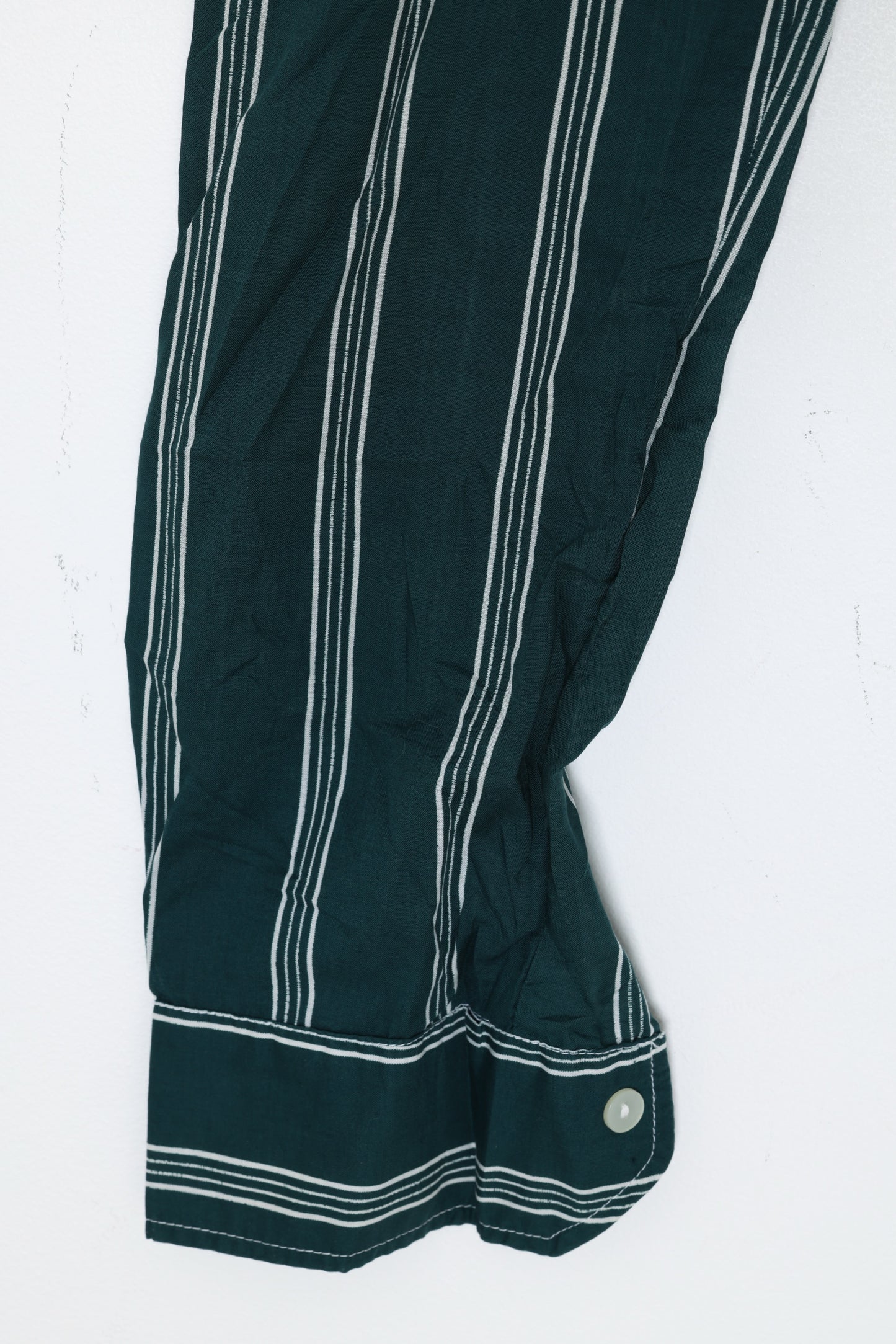
The defining technical detail is the grouped vertical stripe, arranged in white linear bands against the dark green ground. Stripe alignment is acceptable but not obsessive: the pocket flap or upper pocket band uses horizontal stripe orientation, creating contrast against the vertical body stripes, while the pocket body continues vertical striping. This is a simple but effective shirtmaker’s device, giving the pocket definition without embroidery, appliqué, or expensive trim. The collar points show diagonal and vertical stripe interaction, with topstitching tracing the triangular point; this produces a graphic edge but also exposes any minor asymmetry. The cuffs use horizontal striping at the cuff band, another common production decision that helps visually separate sleeve from cuff while allowing efficient cutting from striped yardage. These details increase perceived finish at minimal cost, a very old commercial trick and still a respectable one.
VI. Style Nomenclature & Historical Evolution
The garment’s correct style nomenclature is a women’s woven shirt-blouse with convertible pointed collar and barrel cuffs. Historically, this form descends from men’s tailored shirts, early twentieth-century shirtwaists, utility blouses, and mid-century women’s casual shirting. By the 1970s and 1980s, the shirt-blouse had become a durable category in European wardrobes, bridging office dress, informal labor, travel clothing, and leisure. The pointed collar and patch pocket retain work-shirt associations, while the narrow body and light cloth shift the object into women’s casual fashion. The DACH regional context supports a reading tied to sober commercial dressing: useful, washable, moderately smart, and spared from the indignity of pretending to be eveningwear.
VII. Fabric Composition & Textile Engineering
Fiber content is not provided and no label is visible, so the textile must be described by observable behavior. The fabric appears to be a lightweight to mid-light plain-woven cloth, likely in the approximate 90–140 GSM range, with a matte surface, low luster, moderate opacity, visible wrinkling, and a soft hand. The white striping appears integrated into the textile structure or printed with enough regularity to mimic woven striping; close inspection from images alone cannot conclusively distinguish yarn-dyed stripe from surface print. The cloth has moderate drape with low body, limited elasticity, and visible crease retention after storage or handling. Abrasion resistance would be moderate in daily wear, with stress most likely at cuff edges, buttonholes, side seams, and pocket corners. Breathability appears good, making the garment suitable for indoor and temperate outdoor use, though the fabric’s crush tendency would punish anyone expecting a permanently pressed appearance.
VIII. Construction & Pattern Analysis
The pattern is based on a standard shirt block with front panels, back panel, set-in sleeves, collar, cuffs, front placket, and patch pocket. The body is relatively narrow through the waist and hip, indicating either a women’s shaped block or a straight block scaled small enough to read as fitted on a female torso. No bust darts are visible, so shaping is likely achieved through side seam contour, cloth drape, and ease distribution rather than explicit three-dimensional dart control. The collar is drafted as a soft convertible collar with a low stand effect integrated into the neckline rather than a high separate stand typical of formal shirting. The neckline is shallow and open at the top button, with the collar roll collapsing softly around the neck due to minimal internal support. Sleeve construction appears standard set-in, with cuffs attached to gathered or eased sleeve openings, and the cuff button closure indicates basic wrist adjustability.
IX. Structural Integrity & Panel Configuration
Structurally, the garment is light and flexible, with little evidence of interfacing beyond possible collar, cuff, and placket stabilization. Stress is distributed through ordinary shirtmaking zones: shoulder seams, armholes, sleeve plackets or cuff openings, pocket corners, buttonholes, and hem turnings. The patch pocket is vulnerable at its upper corners; visible topstitching provides some anchoring, but no bar tacks are clearly visible from the images. The collar-neckline intersection is soft, which improves comfort but reduces long-term shape retention. The front placket appears stable enough for repeated buttoning, though the small buttons and light cloth require careful laundering to avoid distortion. The garment’s integrity is suitable for daywear, not heavy labor, unless one has unusually romantic ideas about what a lightweight striped blouse owes society.
X. Edge Finishing, Seam Termination & Closures
Edges are resolved through machine topstitching and folded turnings at collar, cuffs, placket, pocket, and hem. The collar edges are topstitched close to the perimeter, with the points turned and pressed; the roll behavior is soft and somewhat collapsed, consistent with a lightly supported collar. The lapel category is not applicable in the tailored-jacket sense, but the open upper front creates a small revere-like break when the top button is left undone. This break is governed by the placket, collar fall, and neckline curve, not by pad stitching, canvas, or a drafted lapel facing system. Button closures use small white plastic buttons, visually compatible with the stripe and likely chosen for cost, availability, and washability. The hem is shirt-style and slightly curved, with a narrow machine-stitched turning that supports wear tucked or untucked.
XI. Manufacturing Context, Production Scale & Industrial Feasibility
The garment is highly feasible within late twentieth-century commercial production. Its components are few, its operations are familiar, and its pattern pieces allow efficient cutting from striped cloth if stripe direction is managed with reasonable care. Labor concentrates in collar setting, cuff attachment, placket formation, buttonhole placement, button attachment, and pocket positioning. The pocket’s horizontal stripe band adds a small cutting and sewing consideration, but it remains well within standard factory capacity. The soft collar avoids the labor and material cost of formal collar structuring, while the absence of darts reduces sewing time and grading complexity. Production scale was likely small-to-medium regional commercial or larger industrial batch production, not bespoke, not couture, and not materially pretending otherwise.
XII. Conceptual Influence & Psychological Design Intent
The garment communicates competence through familiar codes: vertical stripe, dark ground, buttoned front, collar, cuff, and pocket. Its psychological effect lies in making casual dress appear organized without imposing full tailoring on the body. The green ground suggests utility and modest visual authority, while the white stripe gives the surface a measured cadence associated with shirting, work cloth, and office-adjacent dress. The chest pocket introduces practical association even if it may have carried little more than a note, a transit ticket, or the small moral burden of convenience. Conceptually, the shirt sits between domestic practicality and public presentation, a category of clothing designed for women who needed to look assembled while still moving through ordinary work and errands.
XIII. Artistic & Aesthetic Direction
The aesthetic system is linear, vertical, and shirt-derived. Proportion is governed by the long sleeves, elongated front opening, pointed collar, and vertical stripe pattern, all of which draw the eye downward through the torso. The collar frames the face with angular points and a low open neckline, producing a sharper upper-body outline than a rounded blouse collar would offer. The pocket interrupts the stripe field at the left chest, adding asymmetry and a small plane of constructional emphasis. There is no avant-garde program here, no radical pattern intervention, no conceptual garment-as-thesis; the artifact’s value lies in ordinary design intelligence under commercial constraints. That can be more revealing than grander garments, because the factory had fewer places to hide.
XIV. Historical Placement & Contextual Analysis
The most defensible date range is late 1970s to 1980s, with some possibility extending into the early 1990s depending on regional retail lag and wardrobe retention. Evidence for this placement includes the pointed soft collar, dark green stripe palette, narrow button-front shirt-blouse form, light woven cloth, white plastic buttons, and casual office/work-leisure styling. The garment participates in the long evolution of the shirtwaist and women’s blouse into everyday European separates, especially as women’s wardrobes increasingly incorporated shirt forms previously coded through menswear and workwear. Collar style is important here: the pointed convertible collar is less formal than a structured shirt collar on a stand and less decorative than earlier blouse collars, positioning the garment within casualized late twentieth-century dress. Its historical value is strongest as a study object for regional commercial dressing, textile economy, and everyday garment survival.
XV. Use Case
On a moving body, this shirt performs best in a day organized around transit, indoor work, errands, and mild social exposure: a tram ride, a shop counter, a university office, a small studio, a household task that spills into public space. The wearer is not an invented personality but a pattern of decisions: washable cloth, covered arms, collar for social adequacy, pocket for minor utility, dark color for repeated use, stripe for visual order. Adjacent garments must cooperate with its narrow body and long vertical line: high-waisted trousers, a simple skirt, a cardigan, or a plain jacket would need to avoid fighting the stripe field. Underlayers should be fine and smooth because the cloth has limited body and will reveal bulk.
Share