(France)
1975-1985, French Shirt-Blouse with Stripe-Reversed Collar Points
1975-1985, French Shirt-Blouse with Stripe-Reversed Collar Points
Couldn't load pickup availability
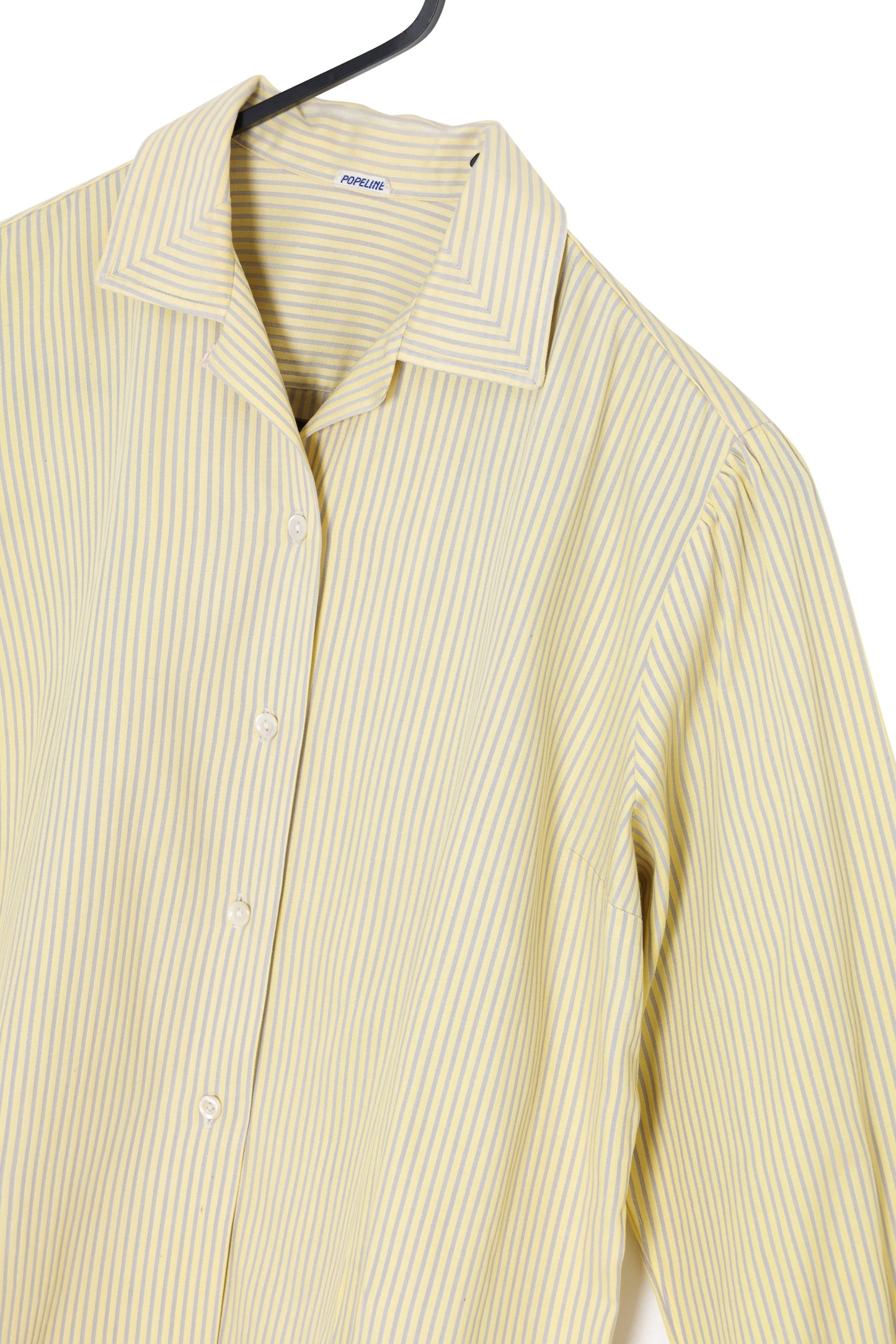
This is a French women’s button-front shirt-blouse with a broad convertible collar, long set-in sleeves, extended button cuffs, and a straight, lightly shaped body. The probable production range is late 1970s to early 1980s, supported by the collar scale, cuff length, relaxed shoulder balance, and domestic-commercial daywear format. The neck label reading POPELINE should be treated as French textile nomenclature, not as secure brand authorship; it identifies the garment through the language of poplin shirting cloth. The textile presents as a lightweight pale yellow ground with narrow grey striping, a soft regular hand, moderate opacity, and sufficient body to hold the collar edges without heavy internal structure. Construction is industrial machine work, with visible topstitching, applied collar pieces, set-in sleeves, buttoned placket, and cuff finishing consistent with French commercial blouse manufacture.
I. Designer Origin & Brand Profile
The visible authorship evidence is limited to the small woven interior neck label reading POPELINE. This is not sufficient evidence for a named designer or house attribution. In French, popeline denotes poplin, so the label should be read first as a textile or product-category descriptor within a French-language manufacturing or retail context. The object is therefore best cataloged as French-origin or French-market commercial blouse production, with manufacturer unknown. Design authorship is embedded in industrial pattern work: collar scale, stripe direction, cuff length, button placement, and seam economy carry the design identity more than any documented maker name.
II. Brand Heritage & Industry Influence
No independent brand history can be established from the visible label alone. The garment’s heritage belongs to the French and broader European blouse trade, where women’s shirting absorbed menswear components while softening fit, color, and neckline behavior for daily wear. The POPELINE label participates in a French textile-language convention, foregrounding cloth identity and wash-and-wear utility over named fashion authorship. Its importance is not house mythology; it is evidence of how French commercial daywear translated shirting structure into a feminine blouse format. That layer of production rarely flatters archivists, but it often tells the truth.
III. Garment Classification & Design Intent
The garment is best classified as a French women’s striped shirt-blouse with a convertible collar and extended button cuffs. It has a full button-front closure, long set-in sleeves, a broad open collar, and a straight body with light shaping through ease and side balance. The intended purpose is daytime wear: domestic, casual office, travel, retail, or informal professional use. The pale yellow and grey stripe creates a clean daywear surface without the severity of formal menswear shirting. The design intent is legible through proportion: it borrows shirt authority through collar, placket, and cuffs, then softens that authority through color, hand, and an open neckline.
IV. Construction Methodology & Engineering
The blouse appears machine assembled throughout, with lockstitch topstitching along the collar perimeter, front opening, shoulder area, cuffs, and sleeve seams. The collar is a two-piece convertible assembly with an applied fall and likely a simple integrated stand or partial stand at the neckline. The broad fall has enough support to maintain its rectangular spread, but not enough internal stiffness to create a hard tailored roll. The front opening is finished through a stitched placket or turned self-facing, with small pale buttons anchored through reinforced cloth. Sleeve heads are set into softened armholes, with visible fullness near the cap, especially in the full-length view. The construction favors repeatable industrial assembly and serviceable finish, with the collar serving as the main engineered visual feature.
V. Technical Design Elements & Detailing
The strongest technical feature is the stripe handling at the collar. The collar fall is cut so the stripes turn directionally around the collar points, creating a nested angular effect across the front edges. This is deliberate cutting, not incidental cloth use. The vertical body stripes lengthen the torso, while the collar’s changed stripe direction frames the neckline and gives the garment its principal graphic event. The cuffs continue the striped system in a deep rectangular format, adding weight at the wrist. The detailing is simple, but it is not empty: the garment depends on proportion, stripe control, and edge accuracy instead of applied ornament.
VI. Style Nomenclature & Historical Evolution
The correct style nomenclature is French women’s striped shirt-blouse with convertible collar and extended button cuffs. Its lineage derives from the shirtwaist, postwar women’s tailored blouse, and the late twentieth-century adaptation of menswear shirting into women’s daily wardrobes. During the 1970s and early 1980s, such blouses often carried larger collars, softer bodies, longer cuffs, and decorative stripe placement. The open neckline recalls camp-collar and convertible-collar shirt forms, though this blouse retains more formal shirt structure than leisurewear. It is a commercial descendant of the shirtwaist, translated through French daywear habits and late twentieth-century casualization.
VII. Fabric Composition & Textile Engineering
Fiber content is not visible. The term POPELINE indicates a poplin association in French nomenclature, though the exact fiber cannot be confirmed from the images. The textile presents as lightweight, regular, and softly surfaced, with subdued reflectivity, moderate density, and a pliant drape. The pale yellow ground and grey stripe appear integrated into the cloth, though physical inspection of the reverse and yarn crossings would be needed to confirm whether the stripe is woven or printed. The fabric has enough dimensional stability to support the collar, placket, and cuffs, while the sleeve and body retain a soft vertical fall. A plausible blouse-weight range would be approximately 90–150 GSM. Abrasion resistance appears suitable for ordinary daywear; recovery seems moderate, with slight seam-area undulation suggesting sensitivity to laundering and stitching tension.
VIII. Construction & Pattern Analysis
The pattern is based on a conventional shirt block adapted for women’s blouse proportions. The front panels are cut with vertical stripe orientation and a straight or lightly shaped side line. No obvious bust darts are visible, so shaping appears to be handled through ease, side contour, and fabric behavior. The back appears similarly simple, with horizontal stripe orientation at the interior neckline suggesting a facing, yoke, or inner collar treatment. The sleeve is long and set in, with added fullness at the sleeve head and wrist, controlled into the cuff through gathering or small tucks. The collar is drafted as a broad convertible form with a generous fall, moderate point length, and shallow open neckline. Its attachment is clean but commercially simple, with topstitched edges and probable lightweight internal support.
IX. Structural Integrity & Panel Configuration
The structural system is light and depends on cloth stability, topstitching, and turned edges. Stress points are concentrated at the buttonholes, button attachment points, cuff openings, sleeve-head seams, underarm junctions, and collar-neckline intersection. The broad collar fall requires accurate turn-of-cloth allowance and internal support to avoid curling or limpness at the points. Sleeve cap fullness distributes excess fabric into the armhole, improving movement but increasing strain where sleeve and shoulder meet. The long cuffs stabilize the sleeve at the wrist and give the lower sleeve a more controlled shape. The hem appears plain and narrow, with slight irregularity consistent with wear, laundering, or mild distortion over time.
X. Edge Finishing, Seam Termination & Closures
Edges appear finished through turned-and-stitched industrial methods. The collar perimeter is topstitched to stabilize the points and preserve the broad fall. The front opening is controlled by a stitched placket or self-facing. The visible buttons are small and pale, correctly scaled to the lightweight cloth, and the buttonholes appear machine worked. The cuffs are deep rectangular units with button closure, though the cuff interior is not fully visible. Tailored lapels are not present; the front neckline creates a lapel-like turnover through the open placket and convertible collar. The roll is soft and shallow, governed by cloth memory, collar draft, and pressing, not pad stitching or canvas.
IX. Structural Integrity & Panel Configuration
The structural system is light, relying on fabric stability, topstitching, and turned edges more than hidden tailoring components. Stress concentrates at the front buttonholes, button attachment points, cuff plackets, sleeve-head seams, underarm junctions, and collar-neckline intersection. The collar fall is broad, so its edge stability depends on accurate turn-of-cloth allowance and internal support; any weakening there would cause curling or limpness at the points. The sleeve cap gathering distributes excess fabric into the armhole, giving mobility but also introducing potential strain where the sleeve joins the shoulder. The long cuffs anchor the sleeves firmly at the wrist and create useful shape control. The hem appears simple and narrow, with enough irregularity at the lower edge to indicate wear, laundering, or light distortion over time.
X. Edge Finishing, Seam Termination & Closures
Edges appear resolved through turned-and-stitched industrial methods. The collar perimeter is topstitched close enough to stabilize the edge and preserve the pointed form, while the front opening is controlled by a stitched placket or facing. The visible buttons are small, pale, likely plastic or shell-like in appearance, and attached in a standard two-hole or four-hole manner; their scale is correct for the lightweight cloth and does not overload the front. Buttonholes appear machine worked. The cuffs are deep and rectangular with button closure, possibly with a small placket opening at the sleeve end, though the supplied images do not fully expose the cuff interior. Lapels are not present as tailored lapels; the front neckline instead creates a lapel-like turnover through the convertible collar and open placket. The roll behavior is soft and shallow, governed by cloth memory and collar geometry, not pad stitching or canvas.
XI. Edge Treatment, Wearability, and Manufacturing Context
The neckline depth is moderate, allowing the collar to sit open without collapsing into a low neckline. The collar edge and cuff edges are finished in a production-efficient manner, requiring accurate cutting and pressing but no hand tailoring. The hem is plain and functional, likely narrow turned machine stitching, compatible with high-throughput blouse manufacture. The sleeve fullness into the cuff improves wearability by permitting elbow movement and wrist ease, while the deep cuff gives the sleeve a finished vertical endpoint. From a production manager’s view, the most labor-sensitive operations are collar preparation, stripe placement at the collar, sleeve setting with controlled fullness, cuff attachment, and buttonhole alignment.
XII. Conceptual Influence & Psychological Design Intent
The garment’s conceptual field is not avant-garde; it belongs to the cultivated everyday. Its striped surface signals order, cleanliness, and repeatable domestic-commercial competence, while the yellow ground softens the administrative character often associated with striped shirts. The wearer is invited into a form of authority that remains approachable: collar, cuffs, and buttons say shirt; color and softness say blouse. The psychological design intent is therefore one of managed informality. It gives the body a framed neckline, lengthened torso, and articulated wrist, all without requiring the posture of a suit. This is clothing for someone who wants to look assembled before the day begins asking impertinent questions.
XIII. Artistic & Aesthetic Direction
The aesthetic direction is geometric daywear based on stripe rhythm, proportional collar scale, and low-contrast color. The collar is the compositional center: broad, angular, and made more emphatic by the stripe reversal at the points. The body remains comparatively plain, which allows the stripe field to read vertically and prevents the garment from becoming overworked. The grey stripe against pale yellow produces a washed, domestic, slightly sun-faded effect even if the color was original. The neckline treatment frames the upper chest and face through an open V formed by the placket and collar fall; the effect is less severe than a buttoned shirt collar and more structured than a scoop or jewel neckline. It is a small design event, but a real one.
XIV. Historical Placement & Contextual Analysis
The most defensible dating is circa 1975–1985. The evidence rests on the broad collar, open convertible neckline, long cuffs, relaxed sleeve volume, and commercial blouse construction. Earlier shirtwaists tend to show different collar proportions, more formal placket behavior, or period-specific waist shaping; later 1990s blouse production often shifts toward different shoulder treatments, fabric finishes, and branding systems. This garment aligns with late twentieth-century European daywear, when women’s shirts frequently negotiated between office acceptability and casual softness. The collar form belongs to a long history of convertible collars but is enlarged enough to suggest the 1970s afterlife of pronounced neckline architecture. Its historical importance is modest but specific: it records how everyday blouse manufacture absorbed menswear codes, softened them, and sold them back.
XV. Use Case
On a moving body, this blouse performs best in a narrow daywear register: under a sleeveless knit vest, tucked or half-tucked into a straight skirt, worn with high-waisted trousers, or left loose over a simple waistband. The long cuffs require adjacent garments to accommodate wrist volume; a tight jacket sleeve would compress the cuff and defeat the sleeve’s intended fall. The broad collar wants space at the neckline, so it works under a cardigan, open jacket, or V-neck layer better than under a closed crew-neck garment.
Share