Niibler (West Germany)
1975–1982, West German Leather Topcoat with Shaped Panels
1975–1982, West German Leather Topcoat with Shaped Panels
Couldn't load pickup availability
… approximate size: EU 40–42, US L
Measurements (cm):
shoulder to shoulder: 41
sleeve (shoulder to cuff): 56
chest (pit to pit): 54
length (collar to hem): 90
SKU: 900029
This is a mid-length leather car coat produced in West Germany during the late 1970s, with a probable manufacturing window between approximately 1975 and 1982. Constructed from a light cream garment leather exhibiting a fine grain structure, moderate drape, and soft surface finish, the coat reflects the widespread European transition from heavily structured leather outerwear toward lighter urban tailoring. The silhouette combines traditional tailored coat conventions with simplified industrial panel engineering intended to shape the body without excessive internal support. Visible evidence indicates machine-based commercial production executed to a relatively high standard, consistent with upper-middle market German leather manufacturing of the period. The garment remains a useful study in continental outerwear drafting, particularly for its collar architecture, curved front panel system, and adaptation of tailored jacket vocabulary into a longer leather coat format.
1. Designer Origin & Brand Profile
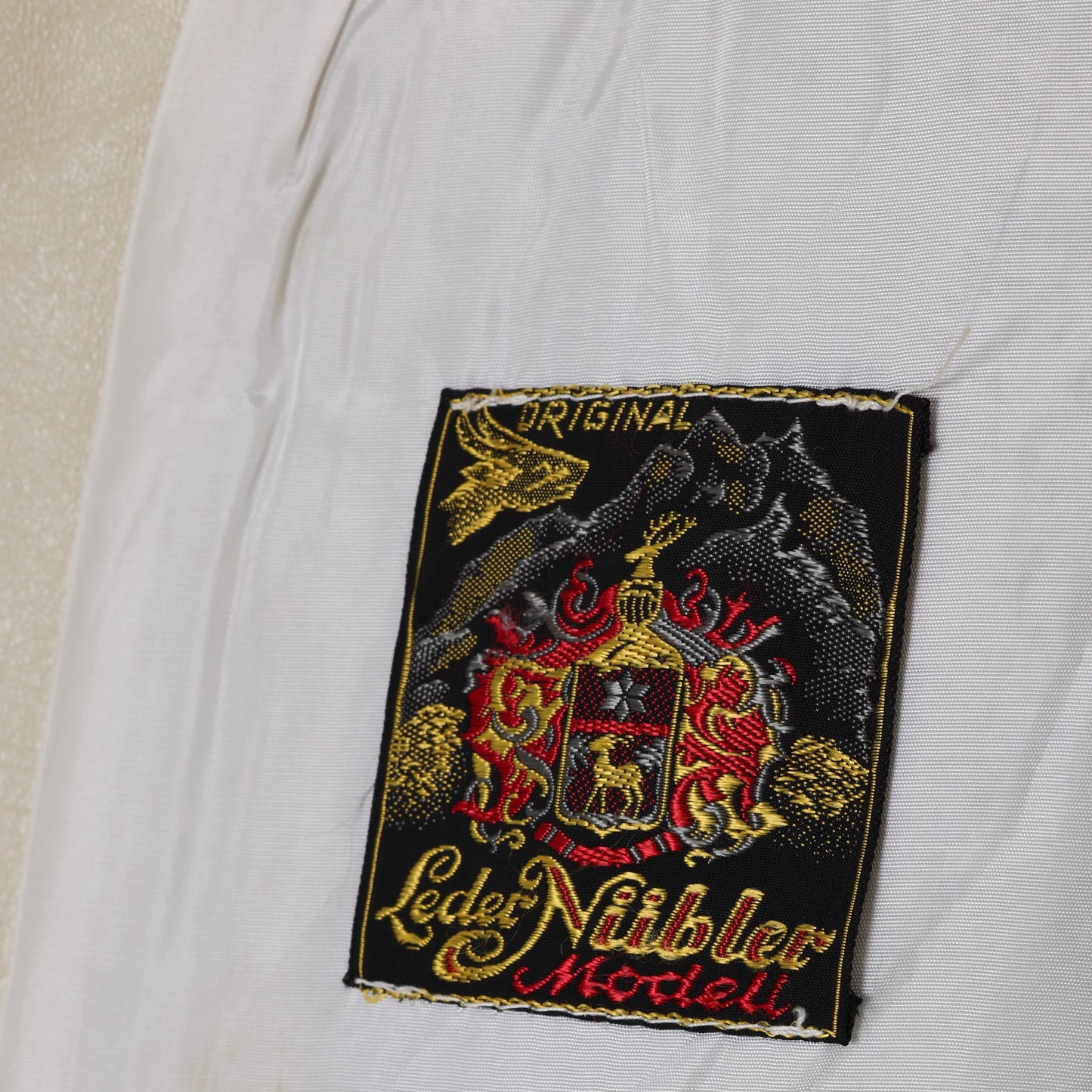
Original Leder Niibler appears to have operated within the substantial postwar German leather manufacturing sector that flourished during the economic expansion of the Federal Republic of Germany. The woven label, featuring heraldic imagery, mountain motifs, and embroidered crest symbolism, reflects a marketing language frequently adopted by German and Austrian leather firms during the 1960s through early 1980s. Such branding often emphasized regional craftsmanship, alpine associations, durability, and inherited trade expertise, whether or not the company possessed particularly ancient origins.
The coat itself suggests a manufacturer working within established commercial outerwear systems rather than couture or bespoke tailoring. Its design vocabulary prioritizes proportion, wearability, and material presentation. The leather serves as the principal visual event; pattern manipulation remains controlled and secondary. One senses a manufacturer aware that consumers purchasing pale leather outerwear required reassurance that the material itself justified the investment. The pattern therefore avoids unnecessary distractions and allows surface continuity to dominate.
2. Brand Heritage & Industry Influence
German leather production occupied an influential position within European apparel manufacturing during the postwar decades. By the 1970s, West German firms had established reputations for technical consistency, reliable finishing standards, and efficient industrial assembly. Companies operating in this sector supplied both domestic and export markets, benefiting from advanced machinery and skilled labor networks.
This garment reflects that environment. It is neither experimental nor conservative to the point of inertia. Instead, it occupies a commercially intelligent middle ground. The coat demonstrates how German manufacturers absorbed broader European fashion shifts while preserving production disciplines rooted in durability and repeatability. The influence is industrial rather than stylistic. The achievement lies less in innovation than in dependable execution, a quality that rarely receives magazine coverage but pays factory wages.
3. Garment Classification & Design Intent
The garment is most accurately classified as a women’s leather car coat or city coat. Its length, moderate volume, single-breasted closure, and tailored collar place it between a traditional tailored jacket and a full overcoat.
The intended environment appears urban and transitional. The coat would function during spring, autumn, and mild winter conditions where weather protection and visual polish were equally desirable. The design objective centers on presenting leather within a tailored framework familiar to consumers accustomed to woven coats and jackets.
The silhouette is semi-fitted, neither boxy nor body-conscious. Curved seam lines guide the eye vertically while preserving mobility. The result is a coat intended for regular use rather than ceremonial appearance. It belongs to the category of garments expected to accumulate train tickets, restaurant receipts, and evidence of actual ownership.
4. Construction Methodology & Engineering
Visible construction indicates industrial machine assembly throughout. The leather panels appear joined using lockstitch construction with relatively fine stitch spacing suitable for lightweight garment leather. Seam allowances are likely skived or reduced in thickness before assembly to minimize ridge formation.
The front closure employs three leather-covered buttons attached through reinforced support layers concealed beneath the front facings. Buttonholes appear bound or narrowly welted rather than conventionally machine-worked, a common solution in leather production due to the material’s inability to recover from needle perforation.
The shoulder assembly appears conventional, utilizing a set-in sleeve attached to a shaped armscye. No evidence suggests heavy shoulder padding. The coat relies on seam geometry rather than internal structure for silhouette formation.
5. Technical Design Elements & Precision Detailing
The most notable design element is the front panel architecture. Curvilinear seams originate near the shoulder region and travel downward into integrated hip sections. These seams perform simultaneous aesthetic and structural duties, creating visual elongation while introducing controlled shaping.
The covered buttons maintain material continuity across the front. This detail requires additional labor compared to stock hardware and suggests positioning above entry-level production.
The front hip extensions, terminating as small projecting tabs, introduce visual width at the lower torso. Their presence interrupts what might otherwise become an uninterrupted vertical column. The effect is subtle but deliberate.
Collar proportions are enlarged in accordance with late-1970s tailoring preferences. Fortunately, they stop short of requiring independent postal codes.
6. Style Nomenclature & Historical Evolution
This style descends from the car coats and town coats that emerged during the early automobile era and evolved throughout the twentieth century. By the 1960s and 1970s, leather manufacturers increasingly adapted these formats into fashion-oriented outerwear.
The notch-collar leather coat gained popularity across Germany, France, Italy, and Scandinavia during the 1970s. It represented an alternative to both motorcycle jackets and heavily structured leather overcoats. The emphasis shifted toward lighter silhouettes capable of functioning as everyday urban clothing.
The garment also reflects broader late-1970s preferences for elongated proportions, extended lapels, and softened tailoring. It occupies a point where traditional coatmaking intersects with the period’s appetite for fluidity and surface-driven design.
7. Fabric Composition & Textile Engineering
The shell appears to be a lightweight garment leather with a fine, even grain structure and moderate natural pebbled texture. Surface reflectivity is subdued rather than glossy. The material demonstrates sufficient suppleness to accommodate curved seams without significant puckering while retaining enough body to preserve coat shape.
Estimated weight likely falls between 600 and 900 gsm depending on hide thickness. The leather exhibits moderate tensile strength and favorable recovery characteristics. Small wrinkling visible at the sleeve indicates a relatively soft temper rather than board-like stiffness.
The lining appears woven and lightweight, likely selected to facilitate movement over underlying garments. The observable lining texture suggests smooth filament construction with low friction properties.
Material selection aligns well with the garment’s intended use. Heavier hides would have overwhelmed the silhouette; lighter material permits tailored shaping without excessive bulk.
8. Construction & Pattern Analysis
Pattern architecture reveals a disciplined approach to shaping. The front body appears divided into central and side panels joined through long curved seams functioning as princess-derived shaping lines. These seams reduce reliance on darts while distributing shaping across greater distances.
The shoulder line remains moderately narrow relative to chest width, preserving a feminine balance characteristic of the period. Sleeve insertion appears conventional, with limited sleeve-head buildup.
Collar drafting deserves attention. The garment employs a classic notched collar configuration consisting of upper collar, under collar, lapel extension, and facing integration. The gorge line is relatively low, a characteristic associated with 1970s tailoring. Lapel width is generous but proportionate to coat length.
The break line descends naturally toward the upper button position. Roll behavior appears soft, indicating limited internal reinforcement and reliance on material memory rather than extensive tailoring infrastructure.
9. Structural Integrity & Panel Configuration
Structural integrity derives primarily from panel arrangement and material properties rather than hidden support systems. The curved front seams direct strain away from the center front and distribute movement through the torso.
Stress concentrations occur at the button positions, armhole intersections, collar junctions, and pocket-adjacent hip regions. The seam network effectively channels these forces throughout the garment.
The neckline-to-lapel transition demonstrates competent balance. Neither side appears distorted, suggesting accurate matching of collar lengths during assembly. The collar sits cleanly against the neck region without excessive gaping.
The absence of obvious pulling across the bust and shoulder regions indicates a pattern drafted with sufficient ease for layered wear.
10. Edge Finishing, Seam Termination & Closures
Leather edge finishing appears turned and stitched throughout visible areas. Collar edges, lapels, front edges, and hem lines exhibit clean perimeter stitching executed at consistent distance from the edge.
The lapels terminate in sharp, well-controlled points. This suggests careful trimming and accurate turning during assembly. The collar points display similar precision.
Closure construction centers on three leather-covered buttons aligned along the front opening. Covered buttons require additional fabrication stages, including cutting, wrapping, securing, and attachment. Their survival in good condition suggests competent reinforcement beneath the shell.
The lapel roll remains gentle and controlled. No evidence of collapse or twisting is visible, indicating successful balancing between collar and front facings.
11. Manufacturing Context, Production Scale & Industrial Feasibility
This garment is fully compatible with medium-scale industrial production. The pattern contains more pieces than a basic coat but remains well within efficient factory capabilities.
The greatest labor demands occur in leather cutting, seam matching, collar assembly, button covering, and front edge finishing. Material yield would require careful planning due to hide irregularities and grain consistency requirements.
Production efficiency benefits from the absence of extensive tailoring internals. There is little evidence for hand pad stitching, hand shaping, or atelier-specific operations. Instead, the coat reflects the mature industrial systems that characterized West German apparel production during the late twentieth century.
It occupies the interesting territory where manufacturing competence becomes visible through what is absent: unnecessary complications.
12. Conceptual Influence & Psychological Design Intent
The coat reflects the democratization of luxury materials during the late 1970s. Leather, once strongly associated with utility, military use, or specialist outerwear, became integrated into everyday metropolitan wardrobes.
Its pale coloration softens associations with ruggedness and redirects attention toward refinement and surface quality. The design encourages the wearer to participate in a visual language of confidence and affluence without overt display.
The garment’s psychological appeal derives from material authority moderated by conventional tailoring. It signals investment while remaining legible within ordinary social environments.
13. Artistic & Aesthetic Direction
The aesthetic direction combines late-modern tailoring with the material prominence characteristic of 1970s leather fashion. Visual emphasis is placed on uninterrupted planes of pale leather punctuated by measured seam interventions.
The collar establishes the primary framing device. Its broad spread draws attention toward the face while balancing the coat’s length. The lapels create a strong vertical axis that extends through the button arrangement toward the hem.
The overall composition aligns most closely with commercial modernism. Surface, proportion, and geometry are favored over ornament. Every major visual decision serves the silhouette.
14. Historical Placement & Contextual Analysis
The garment’s dating to approximately 1975–1982 is supported by several converging indicators: enlarged collar dimensions, lowered gorge line, semi-fitted body shape, covered button treatment, elongated coat proportions, and the branding style of the woven label.
The coat belongs to a period when European manufacturers increasingly translated tailoring conventions into leather garments suitable for everyday use. Advances in leather processing enabled softer hand characteristics and more sophisticated panel engineering than had been common in earlier decades.
The West German origin is historically significant. Prior to reunification, the Federal Republic maintained a substantial apparel manufacturing sector capable of producing technically accomplished garments across both domestic and export markets.
Use Case
This coat begins its day after the temperature has become uncertain enough to require outerwear but not severe enough to justify wool. It functions most effectively during urban movement: walking several blocks, entering offices, sitting in restaurants, exiting trains, repeating the process. The wearer values material quality but declines to announce this preference through conspicuous branding. Adjacent garments must accommodate the coat’s relatively smooth interior and semi-fitted profile. Fine-gauge knitwear, lightweight tailoring, skirts, and straight-leg trousers integrate naturally beneath it. Heavy tailoring begins to compete with the coat’s internal volume, while aggressively casual garments diminish the rationale for choosing pale leather in the first place. The garment performs best when treated as a transitional outer layer within a coordinated wardrobe system, not as an isolated statement piece. Its success depends on a sequence of practical decisions accumulated over years, which is often how genuinely useful garments survive long enough to become archival objects.
Share