Rodier (France)
1973–1979, French Printed Jersey Knit Chemisier with Extended Collar Point
1973–1979, French Printed Jersey Knit Chemisier with Extended Collar Point
Couldn't load pickup availability
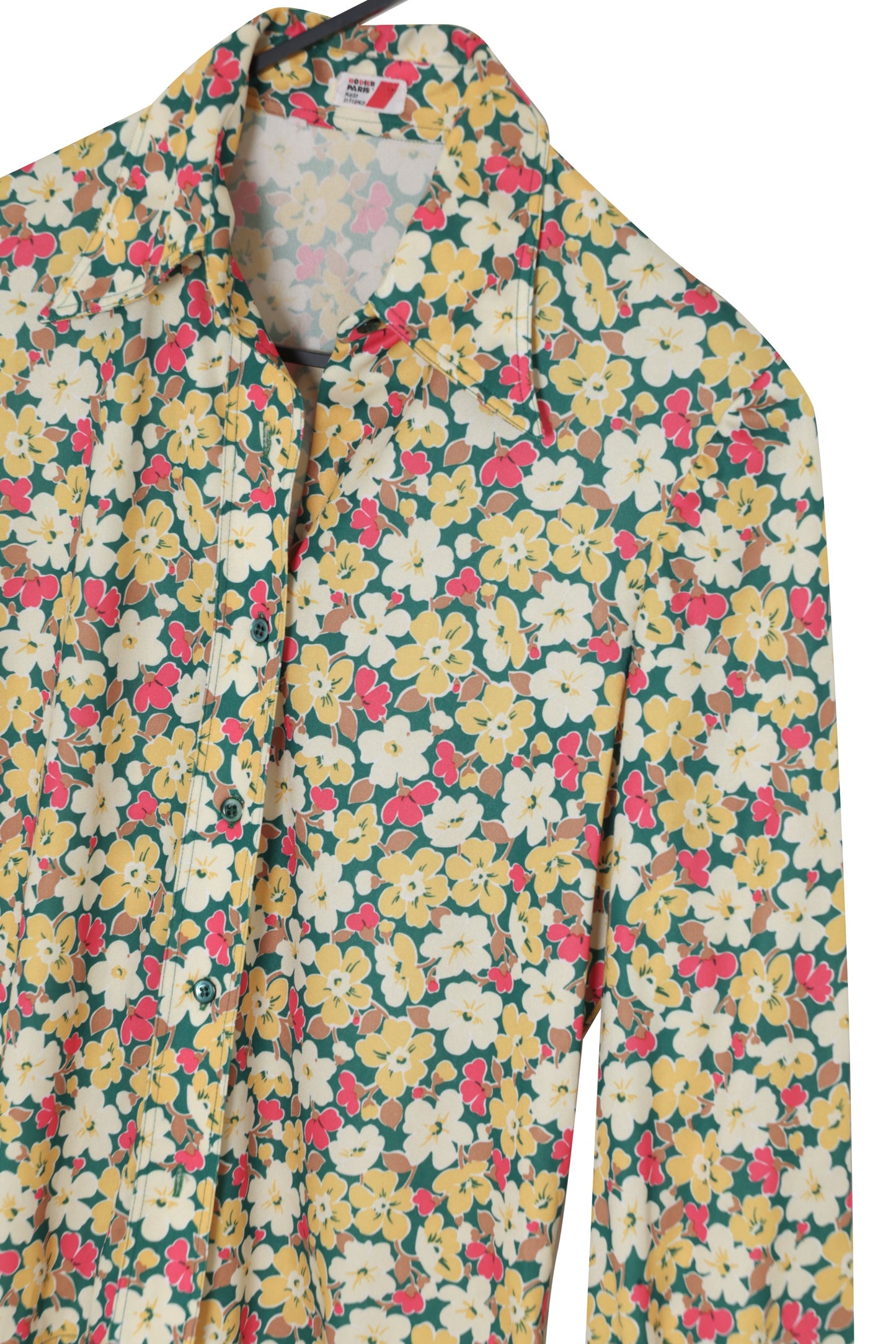
This garment is a long-sleeved printed jersey shirt-blouse by Rodier Paris, made in France, constructed with a broad convertible collar, button-front placket, long sleeves, and buttoned cuffs. The probable production range is circa 1972–1978, supported by the extended collar points, floral print scale, green ground, warm yellow and cream flowers, coral accents, and soft knit blouse construction. The textile is a printed knit jersey, with fiber content unverified; the surface, reverse, drape, and print penetration are consistent with a lightweight cellulosic or synthetic-cellulosic jersey used in 1970s blouse production. The construction combines shirt-derived components with knit handling: topstitched collar and placket edges, machine-set cuffs, and soft body panels without tailoring structure. Its significance rests in the way Rodier’s knitwear identity is carried into a printed chemisier format, joining French knit manufacture, commercial floral daywear, and 1970s collar architecture.
I. Designer Origin & Brand Profile
The sewn label establishes Rodier Paris and Made in France. Rodier is historically associated with French knitwear and textile innovation, especially the commercial translation of knitted cloth into fashionable separates. In this garment, that heritage is legible through the use of printed jersey in a shirt-blouse format: the object retains collar, cuff, and placket conventions while depending on knit elasticity, soft fall, and surface print for its primary effect. The garment is not structured through tailoring canvas or rigid shirting; its design system comes from textile behavior, collar scale, and French commercial blouse construction. The Rodier attribution gives the object stronger authorship than an anonymous blouse, because the material choice aligns directly with a house identity grounded in knit fabric development and wearable separates.
II. Brand Heritage & Industry Influence
Rodier’s importance lies in the movement of knitwear from underlayer, hosiery, and sweater categories into broader fashion garments. By the mid-twentieth century and into the 1970s, French knit manufacturers had developed strong market positions through jersey dresses, cardigans, tops, and blouse-like separates that offered movement and ease while retaining finished fashion presentation. This garment belongs to that trajectory. The floral shirt-blouse form shows how knit jersey could enter a category traditionally served by woven cotton, rayon, silk, or polyester shirting. The Made in France label is material to the record: it places the garment within French commercial production, not merely French-language retail presentation. The object reflects a period when European blouse production frequently absorbed knit structures, synthetic and regenerated fibers, and printed surface systems into everyday fashion garments.
III. Garment Classification & Design Intent
The garment is best classified as a printed jersey shirt-blouse or chemisier. It is not a tailored shirt in the strict sense, because the textile lacks crisp woven shirting behavior and the construction is adapted to knit movement. Its intended use is daywear: suitable for office-adjacent dressing, informal professional settings, travel, lunch, retail work, domestic entertaining, or layered seasonal wear. The broad collar gives the upper body a distinctly 1970s frame, while the dense floral print softens the shirt format and moves it into fashion-blouse territory. The button-front opening, long sleeves, and cuffs maintain shirt vocabulary, but the knit jersey gives the garment a more pliant body, less pressing demand, and greater tolerance for movement.
IV. Construction Methodology & Engineering
The garment is machine-sewn using methods suited to a lightweight printed jersey. The body is built from front and back panels with a button-front placket, shoulder seams, set-in sleeves, collar assembly, and cuffed sleeve endings. The seams must accommodate stretch without excessive tunneling or thread breakage, requiring controlled machine tension and a needle suitable for knit cloth. The collar is a self-fabric or fabric-faced shirt collar, edge-stitched to define the broad points and prevent distortion. The placket is machine topstitched and provides a stabilized center-front zone for buttons and buttonholes. The cuffs gather or contain the sleeve end and add structure at the wrist, counterbalancing the soft jersey body. Durability depends on the interaction between knit elasticity, seam stretch, placket stabilization, and buttonhole reinforcement.
V. Technical Design Elements & Detailing
The defining technical features are the broad pointed collar, the full printed surface, the front button placket, and the buttoned cuffs. The collar points are long and period-specific, drafted to extend across the upper chest and sit prominently when the neckline is open. Topstitching along the collar edge gives the soft knit enough perimeter control to hold a shirt-collar outline. The floral print is dense and allover, with cream, yellow, coral, tan, and green forms distributed across a dark green ground; the small repeat reduces the need for exact motif matching at seams, an important production advantage. The placket’s straight vertical stitching organizes the print at center front and provides the necessary support for closure hardware. The cuffs introduce a more formal termination to the sleeve than a simple hem would provide, preserving the shirt-blouse classification.
VI. Style Nomenclature & Historical Evolution
The appropriate style terms are printed jersey chemisier, jersey shirt-blouse, long-sleeved knit blouse, and floral button-front blouse. The type descends from the shirtwaist and blouse-shirt but belongs to the 1970s expansion of knitwear into mainstream fashion separates. Earlier shirtwaists depended heavily on woven cotton, rayon, or silk, with collar and cuff construction providing crispness. By the 1960s and 1970s, jersey technologies, regenerated cellulosics, polyester knits, and printed stretch fabrics allowed shirt forms to be softened without losing recognizability. The extended collar belongs to the 1970s shirt vocabulary, where collar points often widened and lengthened in both blouse and shirt categories. Rodier’s knitwear background makes this example especially coherent within that development, because the garment translates a conventional blouse structure into a knit textile language.
VII. Fabric Composition & Textile Engineering
Fiber content is unverified. Textile structure is the stronger evidence: the garment is a printed knit jersey, not a plain woven cloth. The face shows a fine, regular knitted surface with soft drape, moderate stretch, and a reverse that carries a paler version of the print through the cloth. The structure appears consistent with single jersey or a light interlock-type jersey; without fiber testing, the safer classification is printed jersey. The print sits on a green ground with cream, yellow, coral, and tan floral forms, with enough penetration to register on the reverse but with reduced saturation inside. Probable fiber categories include viscose jersey, polyester jersey, acetate-blend jersey, or a synthetic-cellulosic knit common to 1970s blouse production, but no specific fiber should be assigned as fact. Estimated weight likely falls around 110–180 GSM, heavier than sheer blouse crepe but still light enough for a draped shirt-blouse. The jersey structure gives elasticity, recovery, and body comfort, while also creating risks of edge curling, seam growth, print abrasion, and placket distortion if not stabilized. Breathability and thermal comfort depend on fiber content, but the knit structure offers flexibility and close body movement.
VIII. Construction & Pattern Analysis
The pattern follows a shirt-derived blouse block adapted for knit fabric. The body appears relatively straight, with no established evidence of darted waist shaping, princess lines, or tailored contouring. The collar is drafted broad and pointed, likely attached to a simple neckline with a soft stand or integrated collar-base treatment. The front placket stabilizes the knit at center front, allowing buttons and buttonholes to function without stretching the garment edge. The sleeves are long and set into the armholes, ending in buttoned cuffs that require either gathering, easing, or controlled sleeve-width reduction at the wrist. Grain behavior in jersey differs from woven grain; the course and wale direction must be managed so the body hangs evenly and the placket does not twist. Assembly requires a sequence that controls the most mobile areas first: shoulder seams, neckline, placket, collar, sleeves, side seams, cuffs, and hem.
IX. Structural Integrity & Panel Configuration
Structural integrity is concentrated in the placket, collar, cuffs, shoulder seams, and buttonholes. The body panels carry little internal support and depend on jersey recovery for fit and movement. The collar requires edge stitching and probable light stabilization to maintain point shape; without that, the knit would curl or collapse at the perimeter. The placket must resist stretching along the button line, especially where buttonholes interrupt the fabric. The shoulder seams require reinforcement or stable stitching because jersey can grow under hanger weight and wear tension. Cuffs distribute sleeve stress at the wrist and prevent the sleeve end from becoming an unstable knit edge. The garment’s structural balance is therefore not based on tailoring but on selective stabilization: firm enough at functional edges, soft through the body and sleeve.
X. Edge Finishing, Seam Termination & Closures
Edges are finished through machine stitching, topstitching, folded fabric, and enclosed construction at the collar, placket, and cuffs. The collar edge is turned and topstitched, producing a defined perimeter and controlling the broad point. The front opening uses a stitched placket with buttons and buttonholes, giving the garment a stable closure system despite the stretch textile. The neckline is finished through the collar assembly, with the collar base enclosing or covering the neck seam. Cuffs are turned, stitched, and buttoned, and their closure points are structurally important because they receive repeated strain during dressing. The hem is likely a turned machine hem, appropriate to jersey blouse production. Repairability is moderate: buttons and minor seam failures can be addressed easily, while stretched buttonholes, distorted placket edges, or damaged print at fold lines would be more difficult to restore cleanly.
XI. Edge Treatment, Wearability & Manufacturing Context
Manufacturing this garment required a balance between knit handling and shirtmaking operations. The main cost controls are the allover floral print, which reduces pattern-matching demands, the relatively simple body block, and the absence of lining or complex internal structure. The labor-sensitive operations are collar formation, placket stabilization, buttonhole sewing, sleeve setting, cuff attachment, and hem control on jersey. Knit fabric requires more careful feeding than stable woven shirting; differential stretching during sewing can distort collar edges, sleeve seams, and the button line. The production scale was likely commercial, with standardized sizing and repeatable operations. Wearability is strong because the jersey body allows movement, the collar supplies a dressed frame, and the print reduces the appearance of minor wrinkling or wear. Quality control would focus on collar symmetry, placket straightness, buttonhole stability, shoulder growth, cuff alignment, and print skew.
XII. Conceptual Influence & Psychological Design Intent
The garment’s concept is the translation of a conventional collared blouse into printed French knitwear. It reflects a 1970s preference for colorful day separates, floral pattern, extended collars, and soft textile performance. The floral surface connects the garment to casual and semi-dressed wardrobes without abandoning shirt structure. The green ground gives depth to the cream, yellow, coral, and tan flowers, producing a dense decorative field that works across the body without relying on isolated motifs. The design framework is period-specific: knit comfort, blouse presentation, and collar prominence combined into a single commercial garment. Rodier’s identity gives this concept additional coherence because the brand’s historical position was tied to the fashionable use of knit cloth.
XIII. Artistic & Aesthetic Direction
The aesthetic direction is floral, graphic, and strongly 1970s in collar proportion. The allover print covers the body, sleeves, collar, and cuffs, creating continuity across every major panel. The collar acts as the dominant architectural element, with long points extending into the floral field and framing the open neckline. The button placket creates a vertical axis through the print, while the dark buttons give small points of contrast against the green ground. The color system belongs to a warm mid-decade palette: cream and yellow flowers, coral secondary blossoms, tan leaves, and deep green background. The garment is decorative but not heavily ornamented; the print, collar scale, and knit surface carry the design.
XIV. Historical Placement & Contextual Analysis
The most defensible production range is circa 1972–1978. The extended collar points, dense floral print, green and yellow palette, long-sleeved shirt-blouse form, and printed jersey construction all support a mid-1970s placement. The Made in France label places manufacture in France, while the Rodier Paris label anchors the garment within French commercial fashion and knitwear production. The garment aligns with 1970s developments in which jersey moved beyond sweaters and dresses into collared blouse forms, supporting easier movement and lower maintenance than crisp woven shirting. The broad collar links the garment to period shirt styling, while the floral print connects it to daywear separates and soft blouse dressing. Its typology sits between knit top and shirt-blouse: a hybrid garment made possible by stable printed jersey and commercial machine finishing.
XV. Use Case
The garment is suited to daywear in temperate indoor or mild seasonal conditions. It could be worn with trousers, a skirt, a sleeveless knit vest, a cardigan, or a jacket with enough room for the collar and cuffed sleeves. The jersey body allows movement through the torso and arms, while the button placket gives adjustable ventilation at the neckline. The broad collar requires careful layering so that an outer garment does not crush the points or force the neckline out of position. The cuffs allow the sleeve to sit cleanly at the wrist and prevent the knit from stretching into an unshaped sleeve end. Care demands would include gentle laundering or dry cleaning according to fiber behavior, low heat, protection from hanger stretch, and cautious pressing of collar, cuffs, and placket. Its technical use-context is printed French jersey daywear: a Rodier knit blouse built for movement, color, and collared presentation within a 1970s wardrobe.
Share