(France)
1973–1978, Sleeveless Chemisier in Striped Plain-Weave Shirting
1973–1978, Sleeveless Chemisier in Striped Plain-Weave Shirting
Couldn't load pickup availability
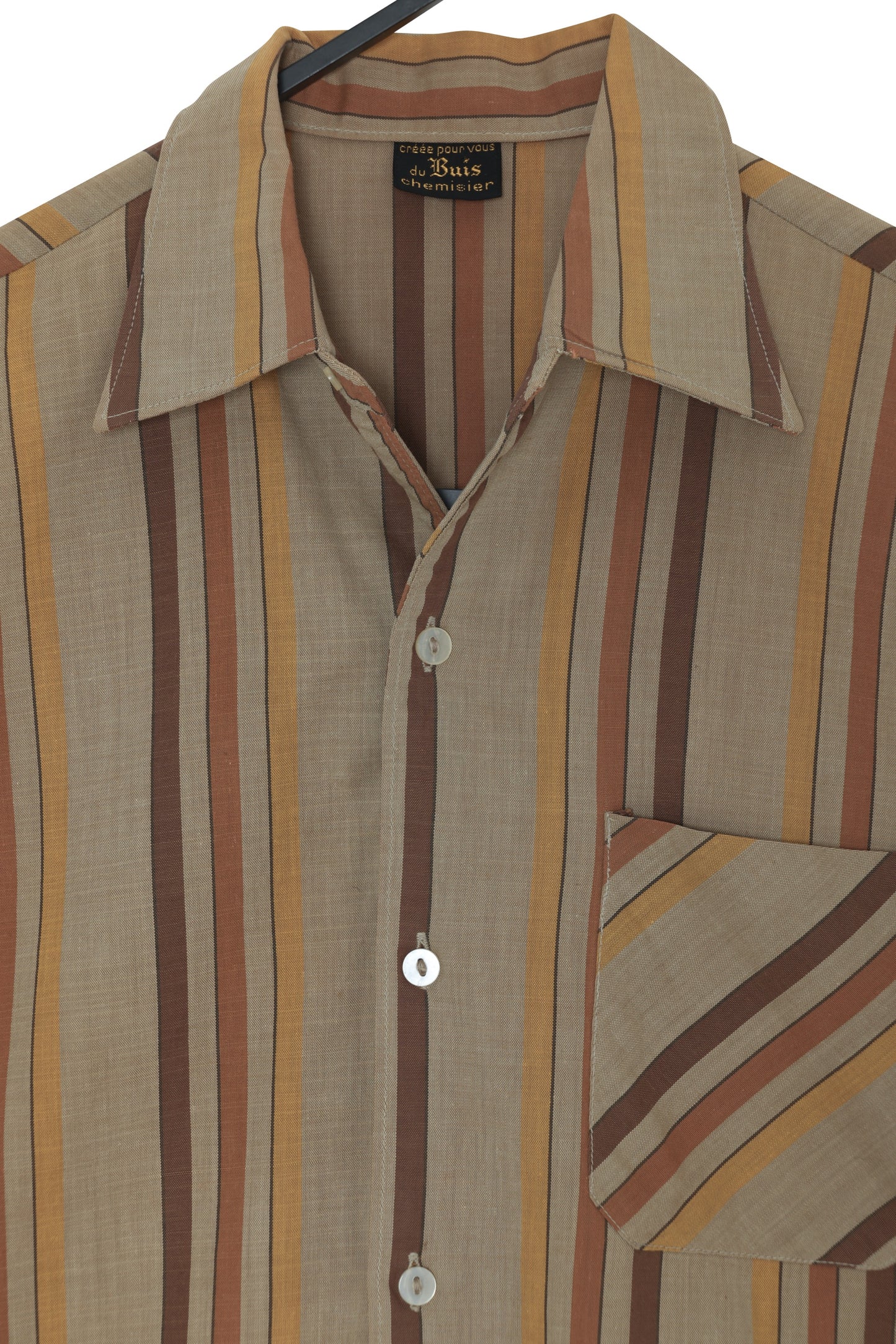
This garment is a sleeveless button-front blouse-shirt, or chemisier, with a convertible shirt collar, applied front placket, vertical stripe arrangement, and patch breast pocket cut on the bias. The label reading “créée pour vous du Buis chemisier” supports a French-language commercial retail or manufacturing attribution, with the precise country of manufacture unverified. The probable production period is circa 1973–1978, supported by the warm earth-toned stripe palette, broad collar points, sleeveless shirt-body format, applied chest pocket treatment, and light summer shirting construction. The textile is a lightweight woven plain-weave shirting with yarn-dyed or woven-in vertical stripes in tan, ochre, rust, brown, beige, and fine dark pinstripes; fiber content remains unverified, though the handle, drape, surface dryness, and slubbed cross-texture are consistent with a cellulosic shirting family. Construction is commercial machine work with folded and topstitched collar edges, a self-fabric placket, machine-finished armhole edges, and a bias pocket application that adds controlled diagonal movement to an otherwise vertically organized garment. Its significance rests in its precise registration of 1970s Francophone-market summer shirting: modest in material cost, deliberate in stripe management, and technically dependent on collar proportion, pocket orientation, and lightweight woven stability.
I. Designer Origin & Brand Profile
The maker attribution is limited to the sewn label: “créée pour vous du Buis chemisier.” The wording identifies a French-language commercial blouse or shirt specialist presentation, with “chemisier” functioning both as garment category and trade identity. No additional maker address, fiber label, production code, or size tab is present in the object record, so authorship should be treated as a label-supported commercial attribution, not as a documented couture, atelier, or named-designer record. The garment’s design principles are consistent with a small-to-mid market blouse line: a repeatable straight shirt-body pattern, controlled stripe usage, a convertible collar large enough to carry period identity, and a bias-cut patch pocket used as the main decorative and technical variation. The design is not dependent on complex tailoring; it depends on fabric placement, collar scale, and tidy machine assembly.
II. Brand Heritage & Industry Influence
The available label evidence does not establish a full brand history, retail chain, design office, or dated collection. The garment can be positioned within the French-language blouse trade of the 1970s, when the chemisier operated as a flexible summer separate across casual, office-adjacent, resort, and domestic wardrobes. Its industry relevance lies in the way blouse manufacturers converted shirtmaking conventions into lighter, more decorative forms: open collar, sleeveless body, vertical stripe, patch pocket, and an elongated placket. The label phrase “créée pour vous” belongs to a commercial register of personalized address common in mid-century and later Francophone fashion labeling, presenting a mass-manufactured article through a more intimate retail idiom. The garment’s construction aligns with small-batch or standard commercial assembly, where pattern repeat, limited pieces, and low-bulk finishes reduce labor while preserving a neat sales-floor appearance.
III. Garment Classification & Design Intent
The object is best classified as a sleeveless blouse-shirt or chemisier, not a tailored shirt, jacket, tunic, or waistcoat. Its intended purpose is warm-weather day wear, with sufficient collar structure for presentation under a light cardigan, jacket, or open overshirt, but without sleeves, cuffs, or tailored body shaping. The design centers on a straight torso, open neckline, convertible collar, and vertically arranged stripe system, with the breast pocket supplying directional contrast through bias placement. The garment’s market position is commercial separates dressing: washable or semi-washable, relatively low bulk, easy to press, and suitable for repeated wear in a summer wardrobe. The absence of darts, waist shaping, or fitted tailoring gives the garment a columnar hang that lets the vertical stripes define length and proportion.
IV. Construction Methodology & Engineering
The assembly follows a straightforward industrial blouse sequence. The front and back body panels are cut with the main stripe running vertically, the shoulder seams are joined before collar attachment, the front opening is stabilized by a self-fabric placket or folded front extension, and the collar is set into the neckline with a machine-closed seam and topstitched edge control. The collar appears to be a two-piece shirt collar with soft internal support, likely a light fusible or additional self-layer giving enough body to maintain the broad 1970s point without hard tailoring. Armholes are finished cleanly with turned or bound edges, a necessary choice on a sleeveless woven garment where the armscye must resist stretching, fraying, and distortion under wear. The placket and button area use machine buttonholes and small light-colored buttons, with stress concentrated along the center-front fold, neckline break, and armhole curve. Durability depends on the stability of the plain weave and the adequacy of narrow edge turning, not on heavy reinforcement.
V. Technical Design Elements & Detailing
The defining technical detail is the bias-set breast pocket. By rotating the stripe, the pocket interrupts the vertical body arrangement without adding embroidery, pleating, appliqué, or separate trim. This choice requires careful cutting because diagonal stripe placement exposes even small deviations in pocket squareness, top edge folding, and corner turning. The pocket is applied by machine with edge topstitching, and its lower corners appear shaped to reduce bulk and support clean lay against the lightweight shell. The collar points are broad and elongated, characteristic of 1970s shirt styling, with topstitching close enough to the edge to control roll and prevent the points from collapsing. The placket shows narrow edge control and button spacing appropriate to a light blouse body, although the upper opening is designed to sit open at the throat, making the collar stand and fall more important than a fully closed neck.
VI. Style Nomenclature & Historical Evolution
The correct style nomenclature is sleeveless chemisier, sleeveless blouse-shirt, or sleeveless button-front shirt blouse. The type descends from conventional shirt construction but is softened through lighter cloth, more decorative stripe selection, reduced sleeve architecture, and a collar intended for open-neck wear. During the 1960s and 1970s, the shirt blouse expanded beyond office shirting into patterned casual separates, often using synthetic, regenerated cellulosic, cotton, and blended shirtings that could support strong color layouts with manageable laundering and pressing. Broad collar points, earth-toned stripes, and sleeveless summer bodies became especially associated with mid-1970s casual dressing. This garment belongs to that lineage: it keeps the shirt’s placket, collar, and pocket vocabulary while reducing construction to a warm-weather blouse format.
VII. Fabric Composition & Textile Engineering
Fiber content and textile structure must be separated. The fiber content is unverified because no fiber label is present in the object record; the textile behavior is consistent with a lightweight cellulosic or cellulosic-blend shirting, possibly cotton, viscose, linen-blend, or mixed yarn construction, but that cannot be assigned as fact. The structure is a woven plain weave or plain-weave shirting with fine crosswise interlacing, dry surface drag, moderate translucency, and slub-like irregularity across the tan ground. The stripe system appears yarn-dyed or woven into the cloth, with vertical bands in ochre, rust, brown, beige, and narrow dark lines; the stripe edges register as integral to the fabric structure rather than a surface print. Estimated weight likely falls in a light blouse range, approximately 80–130 GSM, given the drape, opacity, seam bulk, and collar softness. Tensile stability is adequate along warp and weft, but the lightweight cloth requires seam control at the armscye, neckline, placket, and pocket corners. Abrasion resistance would be moderate; repeated wear may produce edge fray at the collar points, pocket corners, and armhole turnings. Breathability is structurally favorable due to the open plain weave and sleeveless format, while wrinkle retention and seam impression would depend on the exact cellulosic content.
VIII. Construction & Pattern Analysis
The pattern is based on a simplified shirt block with a straight body, extended shoulder coverage, sleeveless armscye shaping, applied front closure, and convertible collar. The front panels are cut to carry vertical stripe continuity down the body, while the pocket is cut diagonally to create a controlled contrast panel. The shoulder seam joins the front and back at a modest slope, with the armhole cut deep enough for mobility but not shaped with the fitted precision of a tailored sleeveless blouse. The collar is drafted with a broad fall and elongated points, likely attached to a simple neck opening without a separate tailored collar stand of major depth; its roll depends on soft support, seam turn, and topstitching. The assembly sequence would place body joining before collar setting, then armhole finishing, placket completion, pocket application, buttonhole formation, and hem closing. Stitch density appears consistent with commercial light-woven production, where fine machine stitching secures edges without adding excessive thread weight.
IX. Structural Integrity & Panel Configuration
The garment’s structural system is intentionally light. The body panels are broad and relatively straight, using stripe direction and vertical hang for proportional control in place of darts, princess seams, waist seams, or shaped side panels. Mobility is gained through sleeveless construction and a moderate armscye curve, while the lack of sleeve weight reduces strain at the shoulder line. The most important stress zones are the front placket, buttonholes, collar-neckline junction, armhole curve, side seams, and pocket upper corners. The collar requires enough internal stability to prevent point curling, but the support remains soft and compatible with summer shirting. The pocket’s diagonal grain introduces greater stretch potential than the vertical body grain; edge turning and topstitching counteract that bias movement. Hem and side-seam stress are minimal unless the garment is worn tucked, where repeated friction would concentrate at the lower placket and hem fold.
X. Edge Finishing, Seam Termination & Closures
The edges are resolved through folded machine finishes appropriate to lightweight woven shirting. The collar edges are turned, pressed, and topstitched, giving the points definition and helping the collar fall evenly from the neckline. The front opening is handled as a self-fabric placket or applied placket with machine buttonholes and light buttons, using the center-front stripe alignment as both structure and visual guide. The armholes are finished by narrow turning or binding, which reduces bulk and keeps the sleeveless edge stable against body movement. Seam terminations at the neckline and placket require neat clipping, grading, and enclosed seam management to prevent ridging at the collar break. The hem appears plain and narrow, suited to untucked wear and economical production. Repairability is favorable: buttons can be replaced, pocket corners can be reinforced, and armhole edges can be reworked if fraying develops.
XI. Edge Treatment, Wearability & Manufacturing Context
The garment is designed for efficient commercial manufacture with limited pattern pieces and minimal internal structuring. The primary labor points are collar preparation, collar setting, front placket finishing, buttonhole formation, armhole edge finishing, and bias pocket application. The bias pocket increases cutting attention and sewing time because stripe direction, pocket angle, top fold, and corner shaping must remain controlled; it also creates some material-yield loss compared with a pocket cut on the straight grain. The sleeveless body reduces sleeve-setting labor and removes cuff operations, making the garment suitable for volume production in a blouse workshop. Wearability is governed by the open neck, soft collar, low-bulk armholes, breathable woven cloth, and straight hem. Quality control would focus on collar point symmetry, neckline seam smoothness, placket straightness, buttonhole spacing, pocket placement, stripe orientation, and fray prevention at armhole and pocket edges.
XII. Conceptual Influence & Psychological Design Intent
The garment reflects 1970s casual shirting adapted to a Francophone blouse category. Its design language draws from shirtmaking, summer separates, and earth-toned textile palettes associated with the decade’s domestic, resort, and informal daywear markets. The warm tan ground with ochre, rust, brown, and narrow dark striping gives the garment a period-specific chromatic register without requiring ornate trim. The sleeveless body reduces formality, while the collar and placket retain enough shirt structure for semi-dressed presentation. The diagonal pocket is the main compositional device, converting the stripe from a lengthening body system into a localized geometric accent. The concept is therefore material and typological: a light woven shirt vocabulary reworked into a decorative summer blouse.
XIII. Artistic & Aesthetic Direction
The aesthetic direction sits within 1970s geometric casualwear and commercial blouse design. The garment is not avant-garde; its interest is in proportion, textile placement, and controlled repetition. The broad collar points frame the neck and upper chest, while the open neckline creates a relaxed break line that suits the sleeveless body. The vertical stripe layout elongates the torso, and the bias pocket provides an oblique counterpoint at the chest. Color is organized through warm earth tones associated with mid-decade domestic interiors, casual separates, and natural-fiber presentation, even where the exact fiber content remains unknown. The collar stance, placket line, and pocket angle form the garment’s main visual hierarchy: face frame, center-front axis, then diagonal chest accent.
XIV. Historical Placement & Contextual Analysis
The most defensible date range is circa 1973–1978. The broad collar point, warm ochre-rust-brown palette, sleeveless shirt-blouse format, and striped plain-weave shirting place the garment more precisely than a broad twentieth-century designation. The French-language label supports a Francophone retail or manufacturing sphere, though manufacture country, store network, and distribution route remain unverified. The garment aligns with 1970s blouse production in which shirt details were softened for casual daywear and warm-weather dressing. The collar belongs to the era’s expanded shirt-collar vocabulary, wider and more pronounced than early 1960s blouse collars, but less exaggerated than some late disco-era collars. The absence of shoulder pads, sleeve cuffs, shaped tailoring, or synthetic shine points toward a daytime blouse category, likely intended for summer separates rather than evening or uniform use.
XV. Use Case
The garment is suited to a warm-weather day setting: worn untucked over a skirt or trousers, tucked into a waistband, or layered under a light jacket or cardigan where the collar remains exposed. The sleeveless cut permits arm mobility but requires adjacent garments to accommodate the armhole depth and shoulder extension without compressing the collar. The neckline is open enough for ventilation, and the convertible collar can lie flat or sit slightly raised depending on pressing and body posture. The lightweight plain weave requires care in laundering, pressing, and storage, especially at the collar points, armhole edges, placket, and bias pocket corners. The button closure provides basic adjustability, but the straight body means fit depends on bust, chest, and hip allowance more than on shaped waist control. Its technical use-context is summer daywear in a Francophone commercial blouse tradition, with functional value concentrated in breathability, low sleeve bulk, washable construction, and patterned textile organization.
Share