1
/
of
4
(Unattributed)
1972–1978, Yarn-Dyed Plaid Slub-Crepe Cloth Blouse
1972–1978, Yarn-Dyed Plaid Slub-Crepe Cloth Blouse
Regular price
$33.00
Regular price
Sale price
$33.00
Unit price
/
per
Shipping calculated at checkout.
Couldn't load pickup availability
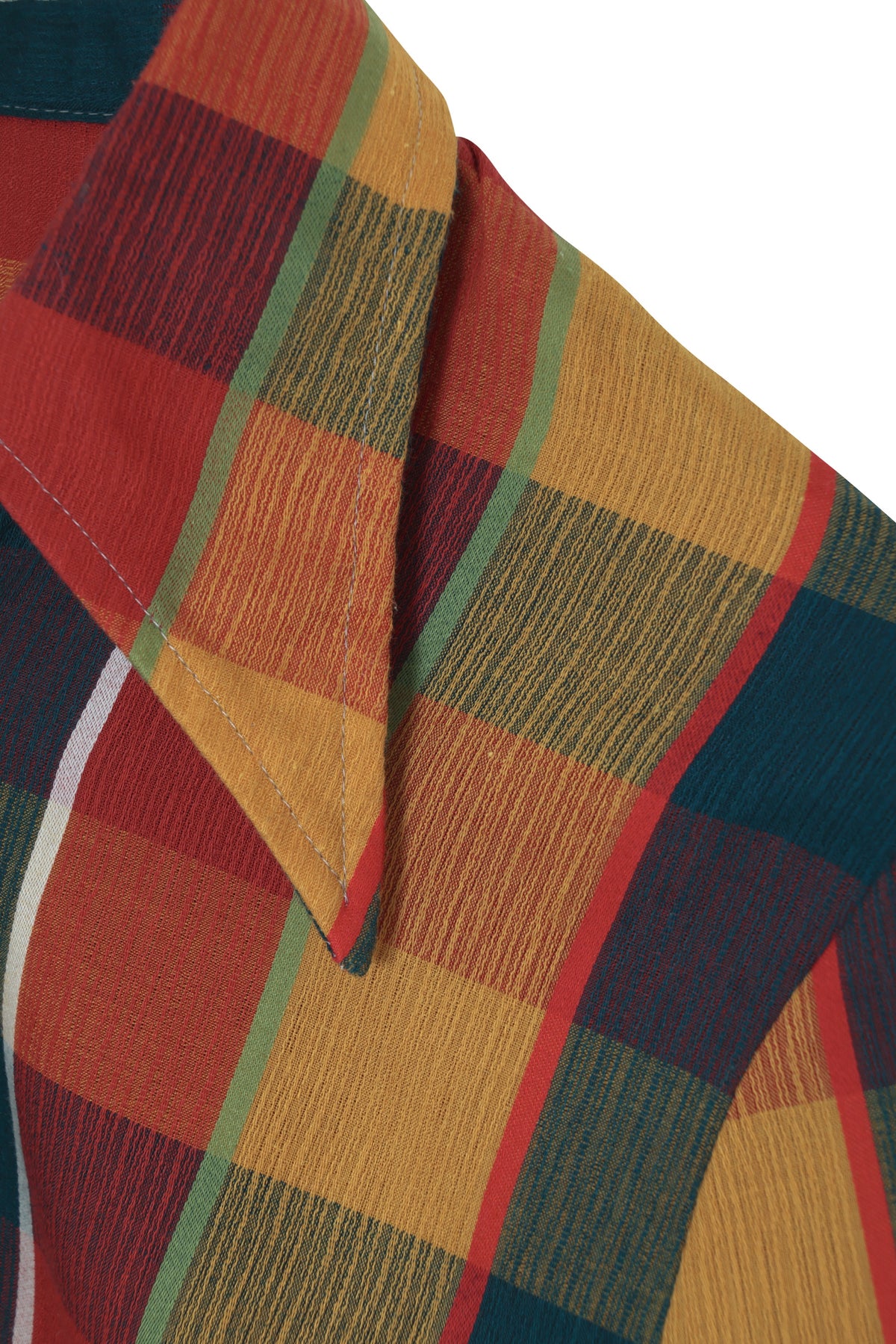
This is a long-sleeved button-front blouse with a lightweight slub-crepe plaid, supple unlined body, modest buttoning system, and limited structural reinforcement establishing its position as an under-jacket or independently worn daywear separate. The extended point collar, straight torso, narrow front bands, set-in sleeves, and buttoned cuffs place production most plausibly between 1972 and 1978, when elongated collar geometry and large-scale checks were widely incorporated into blouse and shirt-derived daywear. The yarn-dyed textile combines broad blocks of red, ochre, teal, olive, orange, burgundy, and cream with fine secondary overstripes and a vertically striated crepe surface. Construction is consistent with standardized small- or medium-series manufacture, using economical panel geometry, machine-stitched collar and placket assembly, and minimal internal support. The garment is significant as an example of 1970s blouse engineering in which a forceful woven check and enlarged collar supply visual structure without recourse to lining, tailoring canvas, padding, or outerwear-grade cloth.
I. Designer Origin & Brand Profile
Authorship is best assigned to an unidentified manufacturer working within a standardized blouse-production system. The only documentary marking is a small size tab reading 48; it functions as a sizing record and does not identify a designer, retailer, textile mill, converter, or manufacturing house. No maker label, fiber-brand designation, country-of-origin mark, care label, cooperative insignia, or institutional supplier notation establishes a more exact attribution. The size tab, industrial buttonholes, regular machine stitching, applied front bands, and repeated component geometry support series production through a blouse, separates, or light-clothing workroom.
The design is governed by textile selection and proportion more than by complex shaping. A large yarn-dyed plaid requires disciplined placement at the front opening, collar, sleeves, and cuffs because discrepancies become immediately legible across adjoining components. The front bands maintain the vertical direction of the cloth, while the collar and cuffs use the check as broad fields instead of attempting exact pattern continuity across every seam. This indicates a production system that accepted controlled motif displacement in exchange for economical cutting and dependable throughput.
The garment was designed around a simple torso block with limited suppression. Its visual identity resides in the extended collar points, compact front opening, long narrow sleeves, broad cuffs, and saturated colour grid. Such decisions are compatible with manufacturers supplying department stores, catalogue trade, independent clothing shops, or regional retail networks during the 1970s. The absence of a named house does not reduce the technical importance of the garment; it places emphasis on textile procurement, standardized drafting, cutting-room economy, and the period blouse market.
II. Brand Heritage & Industry Influence
The most authoritative placement is within the 1970s expansion of coordinated separates made from easy-care woven textiles. Across Central and Western Europe, blouse manufacturers increasingly used textured filament cloths, regenerated-cellulosic crepes, and synthetic or blended yarn systems that could retain saturated colour, resist crushing, dry rapidly, and sustain repeated laundering. The exact fiber content remains unverified, but the low mass, dry granular surface, strong colour retention, and persistent vertical crinkle are consistent with a textile economy shaped by easy-care fiber development.
Large multicolour checks moved between shirting, leisure dress, blouse production, children’s clothing, and informal daywear during the decade. In this garment, the check has been translated into blouse cloth through low mass, soft bending behavior, limited opacity, and a body cut without heavy pocketing or protective infrastructure. The cloth therefore carries a visual association with robust plaid shirting while functioning mechanically as a lighter dress and blouse textile.
The size designation 48 suggests circulation within a numbered continental sizing system, although the number cannot be assigned to a current national chart without measurements. Central European blouse production during this period ranged from state-sector clothing combines and cooperative workshops to private manufacturers, mail-order contractors, and department-store suppliers. The regularity of the sewing operations and absence of individualized fitting point toward a standardized distribution environment in which fit was mediated by numbered size grading and a comparatively forgiving straight-cut body.
Industry influence is present through the integration of bold surface design with low-operation garment engineering. The check provides the dominant graphic content, allowing the pattern block to remain uncomplicated. This relationship between cloth and cut was economically useful: design differentiation could be achieved through textile selection, collar proportion, and colour assortment while retaining familiar production machinery and assembly sequences.
III. Garment Classification & Design Intent
The primary classification is blouse. The cloth has blouse-weight mass, moderate transparency, low thermal capacity, soft drape, and insufficient body for use as protective outer clothing. The garment is unlined and lacks shoulder padding, chest support, substantial interfacing, heavy closures, capacious pockets, storm protection, weather resistance, or allowance engineered for thick underlayers. Its front opening and pointed collar derive from shirt construction, but those features do not establish an overshirt or jacket.
The torso is cut with modest ease and little internal shaping, producing a straight, lightly bloused silhouette when tucked or worn over a waistband. The hem is short and minimally weighted, indicating coordination with skirts, trousers, pinafores, sleeveless dresses, or tailored separates. The absence of patch pockets also keeps the frontal surface subordinate to the check and reduces localized loading on the light cloth.
Design intent centers on a high-impact textile held within a familiar blouse framework. The extended collar creates width across the upper chest and responds to the large scale of the plaid. Narrow front bands preserve a strong vertical axis, while the long sleeves and deep cuffs extend the colour grid along the arm. The result belongs to 1970s daywear, office separates, informal visiting dress, and leisure-oriented coordinated wardrobes.
The blouse could be worn closed to produce a continuous checked field or opened at the upper buttons to form a shallow V below the collar. It was not engineered for exterior protection. Its practical role is that of a washable, visually assertive upper-body separate capable of moving between domestic, retail, administrative, and informal social settings.
IV. Construction Methodology & Engineering
The blouse uses an industrial cut-and-sew system based on a front pair, back body, set-in sleeves, two-piece or folded collar components, applied front bands, and separate cuffs. The front opening is stabilized by narrow folded extensions or applied bands stitched in parallel vertical rows. This construction contains the raw front edges, supplies sufficient thickness for buttonhole formation, and limits distortion under repeated opening and closing.
The shoulder seams join the front and back at a moderately extended line consistent with 1970s blouse proportions. The sleeves are inserted into shaped armholes, with a relatively low to moderate sleeve-cap height that permits everyday arm movement without creating a sharply tailored crown. Sleeve fullness is controlled into the cuff through small pleats, gathers, or localized ease near the wrist. The cuff is formed as a separate rectangular component and secured by a single button.
The collar is a broad turn-down convertible form with elongated points. Its components are joined around the outer perimeter, clipped or graded at the point and corners, turned, pressed, topstitched, and set into the neckline. Support appears light, potentially through a thin sew-in or fusible interlining, though the collar’s body may also derive from doubled cloth and the textile’s inherent crinkle memory. The collar retains a broad spread but remains sufficiently soft to follow the upper chest.
The front bands are the main load-bearing structures. Buttonholes have been machine worked at regular intervals, and small dark buttons are attached along the opposite band. Their scale is compatible with blouse cloth: large enough for routine handling but not heavy enough to impose excessive drag. Stitching is functional and generally consistent, with some local irregularity characteristic of ordinary serial production and subsequent wear.
The unlined construction reduces bulk and labor. Interior seam allowances were likely overcast, overlocked, turned, or otherwise machine secured, depending on the equipment available to the original workroom. The open, textured cloth would require seam containment because exposed yarns could fray and because the check’s relatively fine yarn system may be susceptible to edge breakdown under laundering.
V. Technical Design Elements & Detailing
The dominant technical feature is the relationship between the woven check and component scale. The plaid is composed of broad rectangular fields crossed by narrow red, cream, and pale green lines. Within the larger blocks, mixed-colour yarns create fine vertical striation, preventing the surface from reading as a flat printed grid. The design therefore combines macro-scale geometry with micro-scale yarn variation.
The collar points are unusually extended and narrow. Their length is proportionate to the broad check repeat and the wide shoulder line, while their acute tips sharpen the neckline. Edge topstitching follows the collar perimeter at a consistent distance, compressing the two cloth layers and helping the points remain planar. The topstitching is not ornamental in isolation; it contributes to edge control in a fabric with surface spring and slight dimensional instability.
The narrow front bands provide a strong interruption within the plaid. Their vertical placement creates a denser dark central line because the folded cloth doubles the colour and opacity. Parallel rows of stitching further reinforce this axis. Button placement follows the band at intervals suited to a short blouse body, with the upper button positioned below the collar opening so that the neckline can shift between closed and partially open configurations.
The cuffs are comparatively broad and rectangular. Their scale anchors the lightweight sleeves and repeats the collar’s horizontal mass. Because the fabric is light, the cuff also acts as a structural termination, preventing the sleeve edge from collapsing and controlling any excess circumference. Single-button closure limits labor and hardware cost while providing adequate wrist adjustment for the intended fit range.
No darts, yokes, pocket components, decorative tucks, embroidery, appliqué, or applied trim compete with the cloth. Manufacturing complexity is concentrated in collar turning, front-band preparation, sleeve insertion, and cuff attachment. The rest of the garment relies on direct seams and broad uninterrupted panels.
VI. Style Nomenclature & Historical Evolution
The garment is best described as a plaid daywear blouse with shirt-derived construction. “Blouse-shirt” may describe its genealogy, but blouse remains the more accurate registry class because the textile, short body, softened support, and probable use within coordinated separates place it outside conventional shirting. It does not meet the structural thresholds for an overshirt, shirt-jacket, or jacket.
Its historical lineage passes through the shirtwaist blouse, a garment type established in the late nineteenth century and repeatedly revised through twentieth-century office, leisure, and daywear systems. By the 1930s and 1940s, button-front blouses had become standard components of coordinated wardrobes. Postwar industrial production expanded their range through wash-and-wear fabrics, standardized sizing, and fashion-led collar variation.
During the late 1960s and 1970s, collar points lengthened, spreads widened, and printed or woven geometric textiles increased in scale. The pointed collar used here belongs to that period shift. It is neither a tailored jacket collar nor a conventional small shirt collar. Its broad fall and extended points create a strong visual frame over the upper chest and work effectively with open-neck layering.
The straight body also reflects 1970s movement away from tightly darted 1950s blouse blocks. Suppressed waist shaping was often replaced by softer fit, tucking, belting, or coordination with high-waisted trousers and skirts. This garment retains a short length, indicating that the waist and hip line were expected to be completed by an adjacent garment.
Plaid has a long history in woven shirting, work dress, regional textiles, and leisure clothing. Here it has been recontextualized through a thin crepe-textured cloth and extended collar. The design references familiar check shirting while occupying a lighter, more fluid daywear category.
VII. Fabric Composition & Textile Engineering
Fiber content remains unverified. The textile is woven and yarn-dyed, with colour changes generated through differently coloured warp and weft systems instead of surface printing. Broad blocks of red, ochre, teal, orange, olive, burgundy, and mustard are crossed by narrow cream, green, and red overstripes. The colour intersections produce secondary tones, demonstrating integral plaid construction.
The base structure is consistent with a lightweight plain weave modified by slubbed, crimped, or high-twist yarns. Fine vertical channels and irregular streaking create a crinkle-crepe surface. The texture may derive from overtwisted filament or spun yarns, differential shrinkage, texturing, or a creping finish. Without fiber analysis, it is not possible to distinguish securely among synthetic filament crepe, regenerated-cellulosic crepe, or a blended system.
The cloth has low to moderate opacity and an estimated blouse-weight range of approximately 80–130 GSM. This estimate rests on its translucency, limited bending rigidity, unlined use, and capacity to form a broad collar without behaving as shirting canvas or jacketing. It falls away from the body with limited bulk and supports a straight torso without requiring darts for compression.
Surface drag appears moderate because the crinkle structure increases friction between layers. This assists the collar and cuff by reducing slippage, though it may also complicate cutting and seam feeding. The cloth likely required careful ply alignment in the cutting room to prevent the check and crinkle channels from shifting. Differential feed or controlled presser-foot pressure would be important during assembly.
The woven structure has minimal mechanical stretch across the straight grain, with some diagonal mobility on the bias. Recovery is likely adequate for ordinary wear but less elastic than jersey or interlock. Sleeve and armhole mobility therefore depend on pattern ease and sleeve-cap geometry. The straight body accommodates sitting and reaching through circumference instead of stretch.
The textile’s abrasion resistance is appropriate for blouse use but not for repeated exterior friction or load-bearing pockets. The lack of pockets aligns with this limitation. A patch pocket filled with objects would distort the plaid, pull the light cloth, and concentrate stress at the upper corners. The material therefore confirms the blouse classification and contradicts an outerwear reading.
The colour system suggests strong dye affinity or stable synthetic-compatible colouration. Yarn-dyed construction gives the plaid greater depth and continuity than a print, while the textured surface diffuses reflection. Care would likely have depended on gentle machine or hand washing, moderate heat, and limited pressing pressure to avoid flattening the crepe relief.
VIII. Construction & Pattern Analysis
The pattern architecture is economical and textile-led. The body appears to use two front panels and a single back or two-part back, joined at shoulder and side seams. There is no separate shoulder yoke, waist seam, princess panel, or shaped peplum. This reduces cutting complexity and allows large uninterrupted areas of plaid to remain legible.
The front panels are aligned so that the dominant vertical bands run parallel to the opening. Exact check matching across the closure is secondary to preserving grain and maintaining sufficient turnback for the front bands. This is a defensible cutting decision because precise horizontal matching at every button position would increase fabric consumption and marker inefficiency. The broad repeat would create substantial wastage if full matching were imposed across all components.
The back is likely cut with limited suppression and enough width for shoulder-blade movement. Side seams provide the principal control of torso circumference. The lack of bust darts may indicate that shaping was transferred into the side seam, absorbed through ease, or omitted within a fuller graded block. The size 48 tab supports a block intended to accommodate body volume through circumference and ease instead of intricate darting.
The sleeve is a conventional one-piece set-in sleeve. Its check direction runs longitudinally down the arm, preserving visual continuity and reducing torsion. The cap is shaped to the armhole with moderate ease. A very high cap would restrict movement in this nonstretch cloth; a very low cap would create excess underarm bulk. The surviving form indicates an intermediate solution suited to daywear.
At the wrist, excess sleeve width is reduced into the cuff. The sleeve opening is finished through a short slit, simple turned vent, or narrow placket. This operation is one of the more labor-sensitive points because the light fabric can fray and because the check makes misalignment evident. The cuff is cut on straight grain, doubled, and topstitched.
The collar is drafted with a shallow stand integrated into the fall, producing a convertible collar that can sit close to the neck when buttoned or spread outward when the top button is open. The neckline seam must accommodate the collar’s inner curve without puckering. Its extended points increase torque at the front edge, so the collar requires accurate grain placement and sufficient internal support to avoid twisting.
Assembly would proceed through front-band preparation, shoulder joining, collar construction, neckline setting, side-seam closure, sleeve-seam closure, cuff preparation, sleeve insertion, hem finishing, buttonhole formation, button attachment, and final pressing. This sequence permits flat preparation of the front and collar before cylindrical operations begin.
IX. Structural Integrity & Panel Configuration
Structural support is concentrated at the neckline, collar, front bands, cuffs, buttonholes, and sleeve openings. The body itself remains soft and unstructured. This distribution is appropriate for blouse cloth because reinforcement is applied only where repeated handling or edge definition demands it.
The collar-neckline junction carries stress from turning, opening, and the weight of the extended points. A poorly stabilized neckline would stretch along the bias sections near the front neck and cause the collar to sit unevenly. The topstitched collar perimeter and doubled neckline seam help contain this movement. The front bands also stabilize the lower ends of the neckline opening.
Shoulder seams carry sleeve weight and upper-body tension. The cloth’s low mass limits the load, but the open crinkle surface may permit localized seam slippage if stitch density is too low. A balanced stitch length is therefore essential: excessively long stitches would permit yarn displacement, while excessively dense stitching could perforate or pucker the cloth.
The sleeve cap distributes movement around the armhole. Because there is no knit elasticity, adequate biceps width and underarm ease are necessary. The set-in sleeve gives a cleaner shoulder profile than a dropped sleeve and supports the period blouse silhouette. The armhole seam also acts as a circular reinforcement band around a mobile junction.
The cuffs provide both form and stress control. Button and buttonhole anchoring must resist repeated wrist movement, and any sleeve pleat or gathered section must be secured evenly to prevent localized tearing. The cuff’s doubled construction supplies sufficient thickness for the buttonhole and limits edge collapse.
The hem has minimal structural work. It appears narrow and machine stitched, compatible with the textile’s low mass and the garment’s short length. A deep hem would produce a dark horizontal band, interfere with the plaid, and add excessive stiffness. The selected hem therefore maintains drape and minimizes material consumption.
X. Edge Finishing, Seam Termination & Closures
The collar edges are turned and topstitched. This method encloses raw edges, controls the sharp points, and supports repeatable production. The extended tips require clipped seam allowances and careful turning so that bulk does not accumulate at the points. The perimeter stitching also limits rolling between upper and undercollar layers.
The neckline is enclosed through the collar-setting seam and internal facing or band finish. The absence of a separate tailored collar stand reduces operations and bulk. A convertible collar of this type can be attached through a combined neckline seam, after which the interior edge is secured by topstitching, stitch-in-the-ditch work, or a turned inner allowance.
The front edges are enclosed within folded bands. Parallel stitching fixes the folds and provides a stable channel for buttonholes. The buttonholes are machine worked in the vertical direction, aligning with the front opening and distributing load along the band. Small dark plastic buttons maintain colour neutrality against the complex plaid.
The cuffs are turned, enclosed, and topstitched. Their buttonholes are oriented to accommodate circumferential wrist tension. Button attachment requires sufficient thread shank or local allowance to admit the doubled cuff thickness. The modest hardware scale is appropriate to the textile and does not pull the sleeve downward.
The sleeve openings are likely finished with narrow turnings or a small bound slit. These terminations require secure bar tacking or concentrated stitching at the upper end because this is the principal stress point when the hand passes through the cuff. The fabric’s fraying tendency makes full containment important.
The lower hem is narrow and machine stitched. Side-seam allowances terminate into this hem and should be locked to prevent migration. Any internal overlocking or overcasting would reduce yarn loss during washing and repeated wear. The blouse remains repairable through conventional machine stitching, replacement buttons, localized seam reinforcement, and careful mending along the check.
XI. Edge Treatment, Wearability & Manufacturing Context
Edge treatment is calibrated to a light woven blouse. Narrow turnings preserve fluidity, while doubled collar, band, and cuff components provide localized body. No bound hem, hand-rolled finish, piping, braid, or lining integration is required. This limits labor and prevents unnecessary thickness at intersections.
The neckline is moderately open when the upper button is released. The extended collar then spreads across the upper chest and may sit over a pullover, waistcoat, sleeveless dress, or jacket lapel. When closed higher, it creates a compact neck frame suitable for office, retail, or daywear presentation.
The cuffs regulate sleeve length and keep the light textile clear of the hands. Their breadth also permits a small amount of sleeve blousing above the wrist. The buttoned closure allows the sleeve to remain narrow enough for layering under a jacket while retaining sufficient opening for dressing.
The short hem supports either tucked or untucked use. When tucked, the low-bulk cloth would sit beneath a waistband without creating excessive accumulation. When worn outside, the narrow hem and straight body create a compact line over high-waisted trousers or skirts. The garment does not contain the weight or hem support required for outer-layer use.
Production feasibility is high. The body block uses few panels, the collar omits a separate stand, the cuffs are rectangular, the button system is conventional, and no print registration is required because the design is yarn-dyed. The principal cost pressures arise from plaid placement, potential marker wastage, collar-point accuracy, front-band alignment, and control of the unstable crinkle surface during sewing.
Quality control would focus on paired collar-point symmetry, balanced collar roll, even button spacing, vertical front-band alignment, sleeve-pair length, cuff circumference, seam puckering, and check skew. The large plaid makes grain distortion immediately apparent, so cutting accuracy is more consequential than the apparent simplicity of the garment suggests.
XII. Conceptual Influence & Cultural Design Intent
The blouse participates in a 1970s design culture that combined familiar garment archetypes with enlarged colour and pattern. Its check recalls work shirts, regional woven cloths, domestic textiles, travel clothing, and casual leisure dress, but the low-mass crepe structure shifts those references into a softer daywear system.
The palette is characteristic of the decade’s preference for mineral, earth, and saturated synthetic-compatible colour families. Ochre, rust, red, teal, olive, burgundy, and cream create a dense chromatic field associated with interior textiles, printed furnishings, knitwear, and coordinated separates of the period. The narrow overstripes prevent the broad blocks from becoming visually static.
The extended collar reflects the decade’s enlarged framing of the face and upper torso. It could interact with long hair, scarves, pendants, waistcoats, and broad jacket lapels without disappearing beneath adjacent clothing. Its geometry also links the blouse to unisex shirt styling, though the garment itself should not be assigned a gender category without firmer evidence.
The short, straight body belongs to a wardrobe organized around high waistlines and modular separates. Such garments could be coordinated across trousers, skirts, pinafore dresses, cardigan layers, and tailored jackets. The blouse’s cultural position is therefore connected to flexible daily dressing in which a single upper-body garment moved between workplace, domestic, retail, travel, and social use.
The absence of applied ornament is integral to the textile concept. Decorative work would disrupt the woven colour grid and add labor without improving the garment’s function. The check, collar, and cuffs provide the full design program.
XIII. Artistic & Aesthetic Direction
The composition is based on repeated orthogonal divisions. Broad coloured rectangles establish the principal rhythm, while fine pale and saturated stripes subdivide the grid. The garment block translates this flat textile system onto a three-dimensional body, producing curved distortions at the sleeve cap, neckline, and collar roll.
The front opening acts as the central compositional axis. Dark buttons punctuate the vertical band at regular intervals, giving measured scale to the larger plaid repeat. The collar interrupts the grid diagonally, creating acute points that direct attention toward the opening and upper chest.
Colour distribution is dense and evenly dispersed. No single hue forms a stable ground; red, ochre, teal, olive, orange, and burgundy alternate across the surface. This gives the blouse strong compatibility with solid-coloured adjacent garments drawn from any of those tones. It also reflects a period preference for chromatic coordination across complete outfits.
The silhouette remains simple because the textile already carries substantial visual information. Straight body panels prevent excessive fragmentation of the check. Limited shaping reduces interruption and preserves broad colour fields. The sleeves continue the same fabric vertically, extending the textile rhythm from shoulder to cuff.
The collar’s scale balances the assertive plaid. A smaller collar would be visually absorbed by the broad blocks; the extended points create sufficient area to register as a separate structural feature. The cuffs perform a corresponding task at the wrists, ending the sleeves with doubled, more opaque bands.
The textile surface adds another level of composition through fine crinkled channels. These channels soften reflected light and create a dry, fibrous appearance even where the yarns may be filament based. The surface therefore complicates the strict geometry of the check with subtle vertical irregularity.
XIV. Historical Placement & Contextual Analysis
The most probable production range is 1972–1978. Dating rests on the extended pointed collar, broad collar spread, straight body, short hem, long narrow sleeves, broad single-button cuffs, saturated earth-and-jewel colour system, large-scale plaid, and lightweight textured woven cloth. These features cluster most strongly in the first and middle portions of the 1970s.
The collar is especially useful for dating. Late 1960s collars had already begun to lengthen, but the broad, sharply pointed configuration became pervasive during the early 1970s. By the later 1970s, collar dimensions often contracted or shifted toward softer disco, tie-neck, cowl, and simplified shirt forms, though regional production retained extended points beyond their earliest fashion peak.
The cloth belongs to a period of extensive experimentation with textured yarns and easy-care finishing. Synthetic filament crepes, polyester blends, viscose mixtures, and differential-shrinkage fabrics were widely used for blouses and dresses because they combined colour stability with low ironing demands. The fiber cannot be named securely, but the surface and garment application align with that material environment.
The large yarn-dyed check also reflects the decade’s movement between folk-associated colour schemes, leisure shirting, rustic decorative vocabulary, and industrial textile production. Its palette has affinities with Central European and broader continental clothing, furnishing, and knitwear colour systems of the period. The size tab 48 strengthens the probability of continental circulation but does not determine a specific country.
Manufacturing evidence points to standardized series production. The garment does not display individualized fitting, hand-worked buttonholes, bespoke canvas structures, or complex atelier shaping. Its technical interest lies in disciplined execution of a simple blouse block in a demanding plaid textile.
The garment aligns with the postwar evolution of the shirtwaist into a modular daywear separate. It diverges from earlier fitted shirtwaists through reduced waist suppression and from later oversized shirts through its short body and controlled sleeve proportions. It also differs from workwear and outerwear through its light cloth, absence of pockets, small closures, limited reinforcement, and low thermal function.
Its probable retail sphere includes department-store separates, mail-order clothing, independent dress shops, and regional apparel distribution. The lack of maker identification is compatible with private-label or secondary-label circulation, though no surviving mark confirms a specific channel. The garment remains best catalogued through its textile, construction, typology, and date range.
XV. Use Case
The blouse is suited to an ordinary indoor day involving seated work, standing retail activity, domestic movement, travel, informal meetings, or social visiting. Its set-in sleeves and straight torso provide sufficient mobility for writing, reaching, walking, and light manual activity, provided the wearer is fitted within the original graded ease.
It could be worn beneath a cardigan, waistcoat, tailored jacket, sleeveless dress, or light coat. Adjacent outer layers would need enough neckline and lapel width to accommodate the extended collar points without folding them inward. Sleeve openings would also need sufficient circumference for the broad cuffs to pass comfortably.
When worn closed, the front bands stabilize the torso and maintain the plaid’s vertical center. Releasing one or two upper buttons increases neck mobility and allows the collar to spread across the upper chest. The small buttons are appropriate for indoor dress but require deliberate fastening and offer no protection against wind or cold.
The short hem is compatible with high-waisted skirts and trousers. Tucking would control the straight body and introduce waist definition through the lower garment. Untucked wear would produce a compact, lightly squared silhouette, with the narrow hem moving freely over the waistband.
The cloth’s crinkle surface reduces the need for a perfectly pressed planar finish, though laundering should avoid excessive heat and forceful pressing that could alter the textured relief. Friction from bags, rough jackets, or repeated desk contact could produce yarn disturbance at the cuffs, lower front, and side seams. The garment’s functional range is therefore strongest as an indoor blouse or lightly layered daywear separate, not as a protective overshirt or exterior jacket.
Share