(Netherlands)
1970–1978, Dutch Sportswear-Derived Hooded Jacket in Utility Cloth
1970–1978, Dutch Sportswear-Derived Hooded Jacket in Utility Cloth
Couldn't load pickup availability
~ EU 38–40, US 6–8
Measurements (cm):
shoulder to shoulder: 42
sleeve (shoulder to cuff): 58
chest (pit to pit): 48
length (collar to hem): 68
SKU: 900785
This is a hooded zip-front leisure jacket situated within the broad sportswear and casual outerwear category that expanded substantially during the late 1960s and throughout the 1970s. The object combines a medium-weight textured shell cloth in a rust-brown tone with a contrasting dark brown interior fabric carrying a large-scale white polka-dot print. Construction evidence indicates a moderately skilled small-scale industrial or workshop production environment rather than couture, bespoke tailoring, or heavily automated mass production. The design merges practical utility-jacket conventions with decorative interior treatment, suggesting a garment intended for everyday urban wear, travel, and transitional weather conditions. Its significance lies less in technical innovation than in the manner in which domestic sportswear aesthetics, graphic print culture, and simplified outerwear engineering converge into a coherent middle-market product characteristic of the decade.
I. Designer Origin & Brand Profile
No identifying label, maker’s mark, or manufacturing designation is visible in the submitted imagery. Consequently, attribution must remain suspended. The garment nevertheless exhibits characteristics associated with independent regional manufacturers and medium-scale sportswear producers active during the 1970s. The design language privileges ease of wear, approachable styling, and moderate visual distinction through contrast interior treatment instead of elaborate tailoring or experimental pattern engineering.
From a design standpoint, the most deliberate decision is the exposure of the hood interior. Unlike conventional linings intended to disappear into the garment’s interior architecture, this polka-dot textile is strategically positioned where it remains visible when the hood rests against the upper back and neckline. The designer appears aware that the hood functions simultaneously as weather protection and as a graphic framing device around the face and shoulders.
The overall philosophy is grounded in accessible leisurewear. The garment attempts neither technical mountaineering performance nor luxury tailoring. It occupies the familiar territory where practicality and mild visual amusement enter into a negotiated settlement.
II. Brand Heritage & Industry Influence
Without attribution, broader industrial placement becomes more useful than speculative authorship. The jacket belongs to a generation of sportswear that emerged as distinctions between work garments, leisure garments, and travel garments became increasingly permeable. During the 1970s, hooded jackets moved from specialized sporting contexts into ordinary civilian wardrobes.
The combination of an earthy shell tone and graphic dot interior corresponds closely with color and print preferences visible throughout the decade. Manufacturers increasingly recognized that consumers expected visual interest beyond pure utility. Interiors became opportunities for differentiation without requiring substantial increases in manufacturing complexity.
Industry influence here derives not from innovation but from absorption of existing trends. The garment reflects widespread adoption of metal zip-front closures, simplified set-in sleeves, patch-pocket economies, and relaxed body proportions. It serves as a representative example of middle-market sportswear production during a period when practicality was expected to coexist with decorative surface treatment.
III. Garment Classification & Design Intent
This garment is best classified as a women’s hooded leisure jacket or lightweight casual outerwear jacket.
The intended function appears transitional weather protection during commuting, shopping, travel, and informal daytime activity. The relatively loose silhouette permits layering over blouses, knitwear, or lightweight dresses. Elasticized sleeve hems reduce air ingress while maintaining ease of movement.
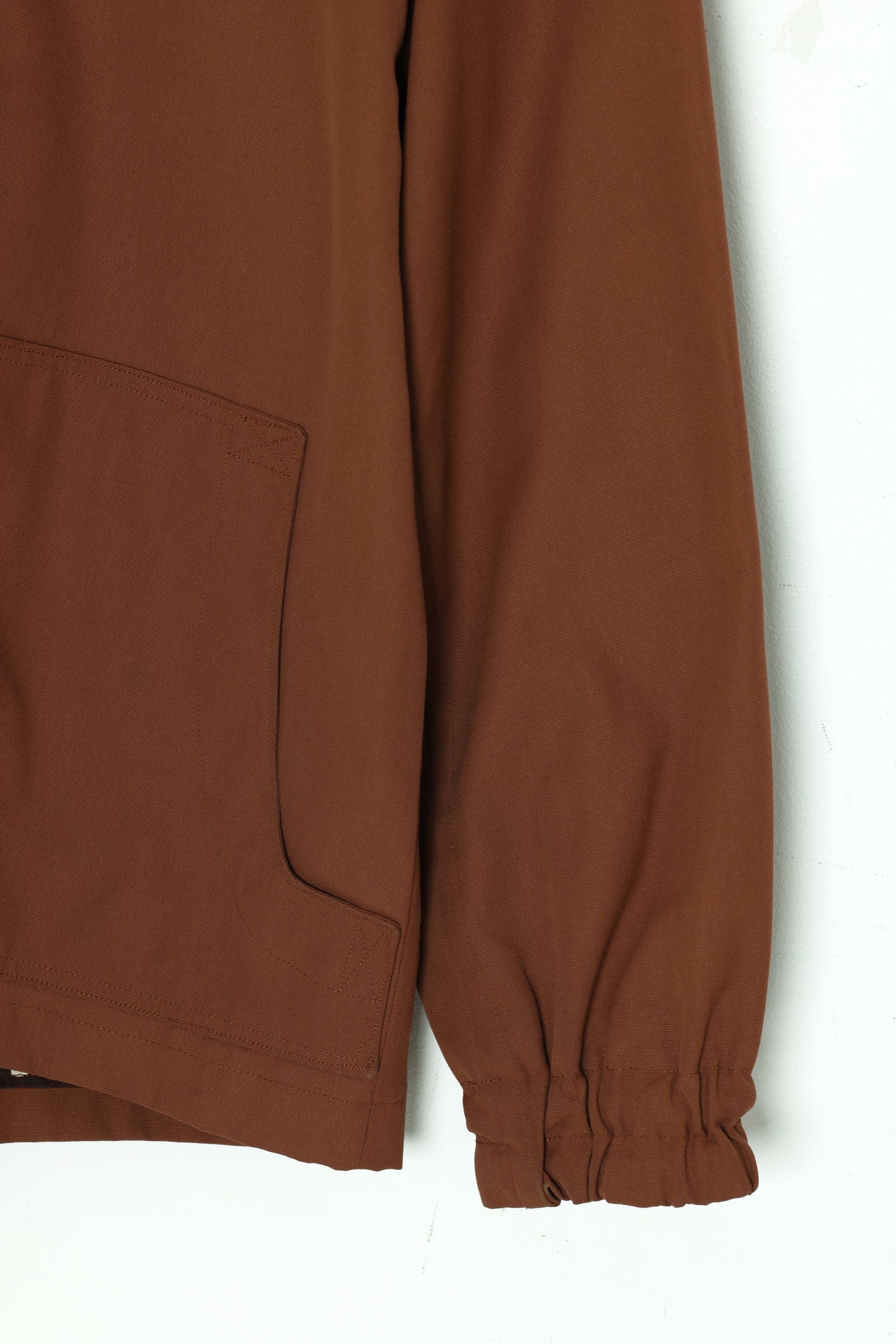
The hood serves as both a functional weather element and a stylistic component. The full-length zipper permits rapid adjustment of ventilation and coverage. Large patch pockets provide carrying capacity and visual balance across the lower front.
The design intent is fundamentally rooted in convenience. The wearer is expected to move through ordinary daily environments without requiring the garment to perform heroic feats. It is outerwear for a day involving errands, train platforms, and perhaps an optimistic weather forecast.
IV. Construction Methodology & Engineering
Construction appears predominantly machine assembled using lockstitch operations throughout major structural seams. Visible topstitching suggests standardized industrial equipment rather than hand-executed finishing.
The front opening incorporates a metal zipper inserted between folded front facings. The zipper tape appears concealed behind the front edge folds, creating a cleaner exterior presentation. Assembly likely followed a conventional sequence of shoulder joining, sleeve insertion, side seam closure, pocket application, zipper insertion, hood assembly, hood attachment, and final hemming operations.
The pocket corners display reinforcement stitching in triangular or crossed configurations. These localized stress-management measures indicate awareness of pocket strain during use.
The hood appears fully lined or self-faced with the contrasting printed textile. This approach stabilizes the hood perimeter while improving visual finish and wearer comfort.
V. Technical Design Elements & Precision Detailing
The dominant technical detail is the contrast relationship between exterior and interior textiles. Many garments of this category rely solely upon color; this example introduces graphic pattern as a secondary visual system.
Patch pockets are rectangular with slightly softened lower corners. Their attachment is straightforward but thoughtfully reinforced. The reinforcement stitching at upper and lower stress points suggests practical experience on the production floor, where pocket failures generate warranty complaints and irritation disproportionate to the cost of preventing them.
The elasticized cuffs are achieved through gathered casing construction. This provides sleeve retention without requiring cuff bands, button tabs, or knit rib components.
The metal zipper introduces a visual vertical axis that organizes the otherwise uncomplicated front composition.
VI. Style Nomenclature & Historical Evolution
The garment falls within the lineage of the hooded leisure jacket, casual utility jacket, and sportswear wind jacket.
Its ancestry can be traced through postwar sportswear development, military-derived field garments, and recreational outerwear of the 1950s and 1960s. By the 1970s, hooded jackets had become normalized within civilian wardrobes, losing much of their association with specialized activity.
The large-scale polka-dot interior references an even older decorative vocabulary. Polka-dot prints enjoyed recurring popularity throughout the twentieth century, appearing in daywear, resort clothing, blouses, and novelty sportswear. Here the motif functions not as dominant decoration but as controlled visual contrast.
The garment therefore occupies a point where practical outerwear construction intersects with decorative textile traditions inherited from earlier decades.
VII. Fabric Composition & Textile Engineering
The shell fabric presents visually as a medium-weight woven cloth exhibiting a compact, slightly granular surface texture. The weave appears denser than ordinary shirting and may approach a basket-like or textured plain-weave construction. The surface lacks pronounced luster and demonstrates sufficient body to maintain shape through the pocket and hood areas.
Estimated weight likely falls within approximately 220–320 GSM based on observed drape and edge behavior.
The shell demonstrates moderate structural memory. It neither collapses completely nor behaves like heavily tailored cloth. Sleeve folds indicate controlled flexibility combined with moderate recovery.
The interior printed textile appears lighter in weight and more openly woven. The fabric demonstrates increased drape, reduced bulk, and improved comfort against the body. The printed dots are mechanically regular, suggesting industrial printing methods.
The pairing is sensible. The heavier shell supplies protection and shape; the lighter interior reduces bulk and facilitates assembly.
VIII. Construction & Pattern Analysis
Pattern architecture is notably economical.
The body appears composed of straightforward front and back panels with minimal seam interruption. No visible princess seams, waist shaping seams, or complex contour systems are present. Shaping is achieved primarily through proportional ease rather than dart manipulation.
The sleeves appear to be standard set-in sleeves with relatively generous bicep circumference. This facilitates layering and reduces fitting complexity across size ranges.
The hood is cut as a multi-piece structure incorporating a central seam or joining configuration visible internally. The hood shape prioritizes production simplicity and coverage rather than sculptural facial framing.
The pocket pattern is highly efficient. Rectangular applied units minimize cutting waste and reduce sewing time. Pocket placement also assists visual balance across the front.
Stitch density appears consistent and commercially competent. No evidence suggests couture hand-finishing or bespoke workroom methods.
IX. Structural Integrity & Panel Configuration
The garment derives structural stability from fabric properties and seam placement rather than hidden internal support.
Shoulder seams function as primary load-bearing junctions. The hood attachment line introduces additional stress concentration around the neckline and upper shoulder region. The attachment appears adequately supported by the doubled hood construction.
Pocket reinforcement improves resistance to distortion during use. Elasticized cuff construction concentrates strain around the wrist but distributes it through gathering rather than isolated anchor points.
The front zipper acts as a structural spine. Its insertion stabilizes the front opening and assists vertical alignment.
No evidence of shoulder padding, canvas structuring, chest support systems, or significant internal reinforcement is visible.
X. Edge Finishing, Seam Termination & Closures
The neckline architecture is entirely hood-driven. No independent collar is present.
Consequently, collar classification is technically absent. The hood assumes the visual and structural role normally occupied by a collar system. The neckline transitions directly into the hood attachment seam without an intermediate stand collar.
The front opening is finished through zipper integration into folded front edges. The metal zipper appears robust relative to the garment weight, suggesting durability priorities exceeded strict cost minimization.
Hood perimeter finishing appears turned and topstitched, creating a clean edge with moderate stability. The hood edge maintains a soft roll without significant stiffening.
Pocket edges are folded and topstitched. Hem finishing appears double-turned and machine secured.
Closure engineering is straightforward, durable, and serviceable.
XI. Manufacturing Context, Production Scale & Industrial Feasibility
The garment appears entirely feasible within a medium-scale industrial production environment.
Pattern complexity remains low. Cutting efficiency is favorable. Assembly operations are familiar and repeatable. Training requirements for operators would be modest.
The greatest labor investment likely resides in hood construction, zipper insertion, and pocket application. Even these operations remain routine by industry standards.
The contrast interior increases cutting coordination and inventory management requirements but contributes substantially to visual appeal. This is precisely the sort of feature a production manager approves because customers notice it while accounting departments remain relatively calm.
No component suggests unusually high labor burden.
XII. Conceptual Influence & Psychological Design Intent
The conceptual framework combines domestic familiarity with functional outerwear.
The earth-toned shell projects stability and utility. The concealed interior print introduces visual contrast revealed selectively during wear. This creates a garment that alternates between discretion and expression depending upon posture and movement.
The hood serves as a framing device around the face while simultaneously exposing the patterned textile. The design therefore creates intermittent visual engagement without overwhelming the overall composition.
The psychological appeal derives from accessibility. The wearer receives both utility and ornament without committing fully to either.
XIII. Artistic & Aesthetic Direction
The aesthetic direction aligns with 1970s casual modernism filtered through sportswear conventions.
The silhouette is uncomplicated, slightly relaxed, and function-oriented. Visual hierarchy is organized around three elements: the zipper axis, the hood volume, and the contrast print.
The absence of lapels redirects attention toward the hood opening. Because there is no collar stand or lapel break line, the face-framing effect emerges entirely from hood geometry and neckline spread.
The large-scale dot motif introduces a graphic counterpoint to the otherwise monochromatic exterior. This relationship supplies the garment’s principal aesthetic tension.
XIV. Historical Placement & Contextual Analysis
The strongest dating indicators point toward approximately 1970–1978.
Supporting evidence includes the earth-toned coloration, relaxed sportswear silhouette, large-scale polka-dot print, exposed metal zipper, patch-pocket treatment, and simplified leisurewear engineering.
The garment does not display the exaggerated proportions associated with later 1980s casualwear. Nor does it exhibit the more tailored, fitted shaping commonly encountered in many early 1960s jackets.
Construction methods and stylistic decisions align comfortably with mid-1970s commercial production.
XV. Use Case
The garment belongs to a day structured around movement rather than ceremony.
It begins in transitional weather. The wearer leaves a residence in the morning, uncertain whether conditions justify a coat. The jacket accommodates that uncertainty. A blouse, lightweight sweater, or simple knit top occupies the layer beneath. The hood remains down until weather, impatience, or both intervene.
The patch pockets collect small objects acquired throughout the day. Receipts, keys, tickets, folded notes, and the occasional item whose original purpose has long since vanished accumulate there with democratic indifference.
The garment performs effectively in urban transit, informal shopping environments, casual social visits, and routine travel. It begins to reach its limits under sustained rain, substantial cold, or circumstances demanding formal presentation.
As an artifact, it documents an era when casual outerwear absorbed decorative impulses from everyday dress while retaining the construction economy demanded by commercial manufacturing.
Share