COURTELLE (UK)
1968–75, Pastel Pointelle Cardigan in Courtelle Yarn, British Domestic Knitwear
1968–75, Pastel Pointelle Cardigan in Courtelle Yarn, British Domestic Knitwear
Couldn't load pickup availability
... approximate size: EU 38-40, US M
SKU: 901169
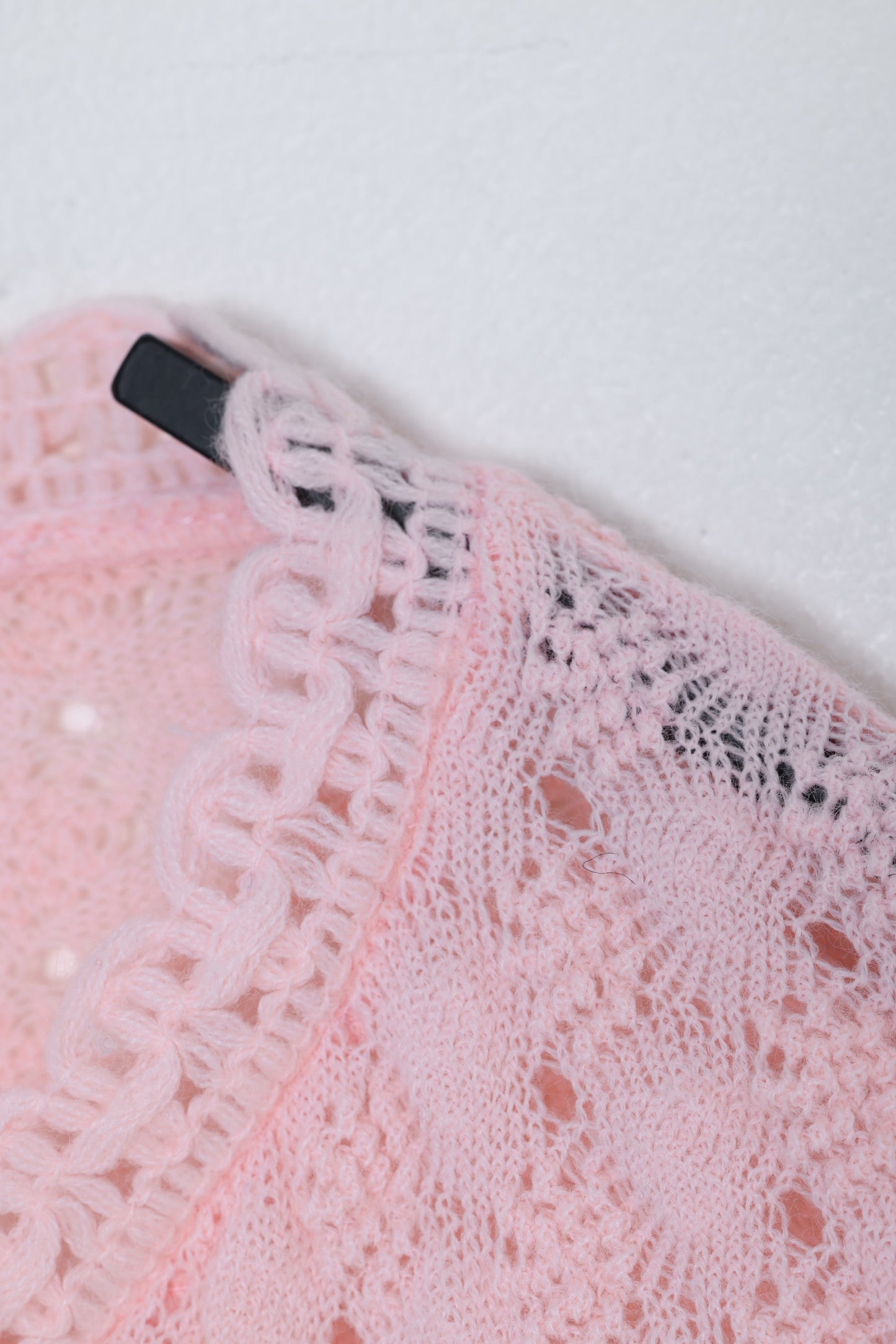
This is a women’s cardigan executed in an openwork machine-knit structure with decorative applied edging and pearlized button closure. The label attribution to “Courtelle” situates the piece within the large-scale adoption of soft-hand synthetic staple yarns popular in British and European knitwear manufacturing during the late 1960s through early 1970s. The textile presents a low-density brushed surface with engineered pointelle repeats arranged in vertical undulating columns, producing controlled transparency and modest extensibility without requiring additional shaping complexity. Construction indicates fully fashioned industrial knitwear assembly with linked seam joining and post-knit decorative application, suggesting medium-scale factory production aimed at department-store or catalog distribution rather than boutique artisanal manufacture. The garment occupies a transitional category between domestic leisure cardigan, lightweight occasion knitwear, and the aggressively cheerful pastel economy of postwar synthetic textile marketing, a sector that promised softness, washability, femininity in tones, and strawberry milk.
Designer Origin & Brand Profile
The “Courtelle” designation visible at the neckline refers not to a couture house or independent designer but to a branded yarn technology associated with postwar synthetic staple-fiber development, particularly linked to British textile manufacturing and licensing systems. Courtelle yarns became heavily marketed during the 1960s and 1970s for domestic knitwear because they imitated the halo and tactile softness associated with brushed wool or mohair while remaining inexpensive, colorfast, lightweight, and machine washable. Garments bearing this branding frequently emerged from decentralized manufacturing structures: regional knitwear factories, contract manufacturers, catalog suppliers, and private-label operations producing for chain retailers. The absence of individualized branding language, stylistic authorship, or prestige-oriented labeling suggests the garment was positioned through material familiarity and consumer reassurance rather than designer identity.
The aesthetic philosophy embedded in this category of knitwear centered on accessible femininity through texture. The garment depends less on silhouette innovation than on surface manipulation. Openwork knitting, pastel coloration, scalloped edging, and soft-focus yarn bloom collectively construct a visual vocabulary associated with domestic respectability and controlled ornamentation. This is not experimental knitwear in the Sonia Rykiel sense, nor technically athletic knitwear, nor folkloric handknit revivalism. It belongs instead to the broad commercial territory where machine capability was used to simulate delicacy while maintaining industrial repeatability.
Brand Heritage & Industry Influence
Courtelle-branded knitwear occupied an important position in postwar textile industrialization because it normalized synthetic softness as a consumer expectation. Earlier synthetic knitwear often carried associations of stiffness, shine, or thermal discomfort. By contrast, brushed staple constructions such as this one attempted to replicate the visual diffusion and tactile loft of animal-hair yarns while eliminating cost volatility and laundering complications. The resulting garments became staples of middle-market womenswear across Britain and parts of Europe.
The cardigan demonstrates how industrial knitwear manufacturing absorbed visual codes historically associated with handcraft. The applied loop trim imitates crochet edging without requiring fully hand-worked finishing. The pointelle repeats reference lace insertion traditions while being generated mechanically on industrial knitting equipment. This translation of labor-intensive domestic textile aesthetics into scalable manufacturing systems defined much of mid-century knitwear production. One suspects the machine operators deserved more credit than the advertising copywriters who insisted everything was “luxuriously feminine.”
Garment Classification & Design Intent
The garment is properly classified as a lightweight fully fashioned women’s cardigan intended for indoor or transitional seasonal wear. Its abbreviated body length, moderate ease, and low-bulk construction indicate use as a layering garment over sleeveless dresses, blouses, or lightweight knit shells. The visual emphasis falls on the neckline and front opening through the application of decorative looped trim, creating a vertical framing device that compensates for the otherwise straightforward rectangular body geometry.
The neckline is a shallow V formation terminating relatively high on the sternum. This positioning maintains compatibility with modest daywear and reinforces the garment’s intended role within conservative social environments: office-adjacent use, church attendance, daytime visits, department-store luncheon culture, and the sort of domestic hospitality where one is expected to own a serving tray. The silhouette avoids aggressive waist suppression or dramatic shoulder emphasis. Instead, proportional balance is generated through textural continuity and soft verticality.
Construction Methodology & Engineering
The cardigan appears manufactured using a fine-to-medium gauge flatbed knitting system with fully fashioned shaping at shoulders and neckline. The body panels and sleeves were likely knitted separately and linked together using a linking machine rather than overlocked cut-and-sew assembly. Evidence for this appears in the narrow seam transitions and controlled stitch alignment visible at the shoulder and armhole junctions.
The pointelle structure combines eyelet transfer techniques with alternating knit and purl texturing to produce repeating scalloped vertical motifs. Yarn tension appears moderately loose, allowing controlled drape and a soft collapsed hand. The applied trim along neckline, center front, hem, and cuff edges was likely produced separately using a crochet-chain imitation mechanism or narrow trim machine before attachment through machine stitching. This decorative border functions structurally as well as visually, stabilizing vulnerable edges prone to distortion.
Button closure placement is conservative and evenly spaced. The button band itself appears integrated into the front edge structure rather than separately sewn as a woven placket. This reduces labor input while preserving flexibility. Internal reinforcement around buttonholes is minimal, which aligns with lightweight domestic-use expectations rather than long-term high-stress wear.
Technical Design Elements & Precision Detailing
The most technically significant design feature is the controlled integration of decorative openwork into a production-efficient knit repeat. The lace motif is engineered directly into the textile rather than appliquéd afterward. This minimizes assembly labor while maximizing perceived intricacy. The eyelet columns create rhythmic vertical movement across the garment surface without interrupting structural continuity.
The looped trim is particularly revealing from a manufacturing perspective. It visually references hand crochet picot edging but is executed with mechanical regularity. The loops maintain relatively consistent scale and spacing despite minor variation from yarn bloom and wear history. This indicates machine-assisted production with possible manual finishing at corners and neckline transitions.
The neckline architecture is notably simple but competently balanced. The shallow V-neck is shaped through gradual stitch reduction rather than abrupt angular narrowing. No separate collar exists. Instead, the neckline edge itself functions as both framing device and structural termination. The absence of collar stand, lapel extension, or facing insertion reduces bulk and preserves flexibility within the lightweight knit system. Neckline stability is achieved through trim attachment and tension control rather than interfacing or structural reinforcement.
Style Nomenclature & Historical Evolution
This garment belongs within the lineage of the pointelle cardigan, itself derived from earlier openwork undergarment knitting and lace-inspired domestic knit traditions. Pointelle structures became especially prominent in women’s knitwear during the 1940s and 1950s before expanding dramatically in synthetic yarn markets during the 1960s and 1970s. By this period, the style had migrated from intimate apparel associations into mainstream leisure and daywear.
The cardigan also reflects the persistence of the “sweetheart domestic knit” category common in postwar catalog retailing. Characteristics include pastel coloration, decorative edging, lightweight texture, pearlized buttons, and abbreviated torso proportion. Unlike earlier 1950s fitted cardigans with waist emphasis and tighter gauge construction, this example adopts a softer, more relaxed body line consistent with late-1960s shifts toward ease and less rigid torso definition.
Fabric Composition & Textile Engineering
The textile exhibits characteristics associated with brushed synthetic staple yarns marketed as wool alternatives during the postwar period. Surface behavior includes diffuse reflectivity, low directional sheen, soft halo formation, and moderate loft without true elasticity recovery associated with animal fibers. The yarn possesses a slightly dry bloom visible at edge abrasion points, particularly near neckline and shoulder stress areas.
The knit structure appears executed at approximately fine-to-medium gauge, likely between 10 and 14 gg equivalent depending on machine system. GSM estimation falls within lightweight cardigan territory, perhaps approximately 180–240 GSM in functional density despite the openwork structure. The fabric demonstrates low compressive resilience but acceptable drape due to yarn softness and stitch openness.
Breathability is enhanced through repeated eyelet formations, though thermal retention remains modest. Tensile stability is dependent primarily upon stitch integrity rather than fiber strength. Areas subjected to repeated friction, particularly underarm zones and front edge tension points, would predictably pill or elongate over time. The textile was selected not for endurance but for tactile appeal and low-cost visual softness.
Construction & Pattern Analysis
Pattern architecture is straightforward and economically rational. The body appears constructed from symmetrical front panels and a single back panel with minimal contour shaping. There is little evidence of waist suppression or bust-specific dart substitution through knit shaping. Fit is generated primarily through material compliance rather than sculptural pattern engineering.
Sleeves are moderately narrow with slight fullness toward the upper arm, tapering gently toward the cuff. Sleeve cap shaping appears fully fashioned with transferred decreases integrated into the knit structure. Shoulder seams are short and lightly dropped, reducing fitting complexity while maintaining a softly natural shoulder line.
The neckline shaping is handled through gradual reduction sequences along the front opening edges. Because the garment lacks a separate collar, neckline balance becomes especially dependent upon stitch tension and trim application. The applied edging acts almost as a substitute collar frame, visually defining the opening while mechanically resisting distortion.
Construction Systems, Stitch Engineering & Assembly
Assembly sequencing likely followed conventional industrial knitwear order: panel knitting, linking at shoulders, trim application preparation, sleeve insertion, side and sleeve seam linking, button attachment, final pressing, and inspection. Seam joining appears executed through linked loops rather than cut-edge overlocking, preserving elasticity and minimizing seam bulk.
Stitch density remains consistent across body and sleeve panels, indicating competent machine calibration. Minor irregularity visible near some eyelet transfers reflects either age-related relaxation or ordinary production tolerance. Importantly, these inconsistencies do not compromise structural continuity.
The applied trim required secondary handling operations beyond core assembly, increasing labor slightly. However, because the trim itself is mechanically generated, the additional cost remained manageable within mass-market production frameworks. This balance between decorative complexity and labor containment defines much of the garment’s industrial intelligence.
Structural Integrity & Panel Configuration
The cardigan relies upon distributed flexibility instead of rigid support systems. There is no evidence of interfacing, reinforcement tape, shoulder padding, or stabilizing canvas. Structural stability emerges through knit tension equilibrium and edge control. Stress distribution occurs primarily along front closure points, shoulder seams, and sleeve insertion zones.
The front opening experiences the greatest long-term strain due to button tension and hanging weight. The trim attachment partially mitigates edge stretching by increasing edge density. Nevertheless, the lightweight knit remains susceptible to elongation over prolonged wear or improper storage.
The absence of heavy structural support allows the garment to collapse naturally around the torso. This produces softness of silhouette but limits durability under repeated tensile stress. The cardigan was designed for moderate domestic wear cycles, not archival immortality. One could say the same of much 1970s interior carpeting.
Edge Finishing, Seam Termination & Closures
Edge finishing is unusually prominent relative to the garment’s overall simplicity. The looped trim resolves neckline, center front, cuffs, and hem simultaneously, creating visual continuity while concealing potential instability at exposed knit edges. The trim itself behaves almost like a decorative binding system.
The neckline edge is folded minimally, with the trim attached directly over stabilized knit termination rows. This prevents excessive bulk accumulation around the V-neck intersection. The front opening maintains acceptable alignment despite the lightweight textile, indicating successful balancing between trim weight and body fabric density.
Button anchoring appears adequate though not heavily reinforced. Buttons are lightweight pearlized plastic with low mass, minimizing drag on the front opening. Closure spacing avoids excessive gaping, though the textile’s open structure means underlayers remain visually active beneath the garment surface.
Manufacturing Context, Production Scale & Industrial Feasibility
This garment was almost certainly produced within a medium-to-large-scale industrial knitwear system operating with specialized flatbed machinery and semi-skilled labor. The construction complexity exceeds the simplest jersey cardigan production but remains entirely feasible within standardized factory workflow.
The fully fashioned knitting reduced fabric waste compared to cut-and-sew knit assembly. Decorative value was generated through machine programming and stitch manipulation rather than intensive hand labor. The trim application introduced modest labor increase but significantly elevated perceived delicacy and retail desirability.
Production efficiency is evident throughout. No unnecessary panel complexity appears. Collar construction is eliminated entirely in favor of stabilized neckline edging. Seam finishing is integrated into knit assembly methodology. The garment demonstrates a production philosophy centered on visual softness, affordability, and scalable femininity.
Conceptual Influence & Psychological Design Intent
The cardigan operates psychologically through managed gentility. Every design decision reinforces accessibility, softness, and non-threatening femininity. The pastel coloration, lace-like pointelle, rounded trim loops, and lightweight transparency collectively reject severity. The garment presents softness not as sensual aggression but as social reassurance.
This visual language emerged strongly in postwar consumer culture, particularly within domestic retail sectors marketing stability, cleanliness, and pleasantness as aspirational middle-class virtues. The cardigan’s delicacy is therefore ideological as much as aesthetic. It reassures observers that the wearer has no intention of alarming the upholstery.
Artistic & Aesthetic Direction
The aesthetic system draws heavily from domesticated romanticism filtered through industrial knitting capability. There are faint traces of Edwardian lace revival filtered through postwar machine logic, though simplified for mass production. The repeated pointelle motifs create surface rhythm analogous to lightweight curtain lace or machine-made trousseau textiles.
The neckline treatment is central to this visual organization. Without a collar or lapel system, the applied loop edging becomes the primary framing device around the face and chest. Its rounded geometry softens the neckline perimeter and visually diffuses the transition between body and opening. The garment frames the upper torso through texture instead of structure.
Historical Placement & Contextual Analysis
The garment aligns strongly with late-1960s to early-1970s British knitwear production. Several indicators support this dating: Courtelle labeling style, pastel synthetic-brush coloration, fully fashioned lightweight cardigan construction, pearlized buttons, and decorative applied loop trim. Earlier examples from the 1950s would likely show denser gauge construction and more fitted torso shaping, while later 1980s interpretations would typically exaggerate silhouette or introduce bulkier synthetic textures.
Its industrial context belongs to the mature phase of postwar synthetic knitwear expansion, when machine capabilities had become sufficiently refined to imitate handcraft aesthetics at low cost. The garment therefore occupies an important position within the democratization of decorative knitwear. Not luxurious. Not primitive. Not handmade. Not entirely honest about any of those conditions either.
Use Case
The cardigan functions most effectively in transitional indoor environments where warmth is secondary to surface presentation. It performs well over sleeveless woven dresses, lightweight blouses, or synthetic shell tops common in middle-market womenswear wardrobes of the period. The shallow V-neck accommodates collars poorly but accepts rounded jewel necklines and narrow shoulder silhouettes with little resistance.
Movement is unrestricted due to the low structural density, though the knit’s vulnerability to snagging limits compatibility with abrasive outerwear, jewelry, or occupational environments requiring repetitive friction. The wearer is not performing manual labor, nor attending an avant-garde opening, nor preparing for weather of any ideological seriousness. The garment belongs to the category of social dressing where one expects upholstered seating, overheated interiors, and conversation involving desserts suspended in gelatin.
Share