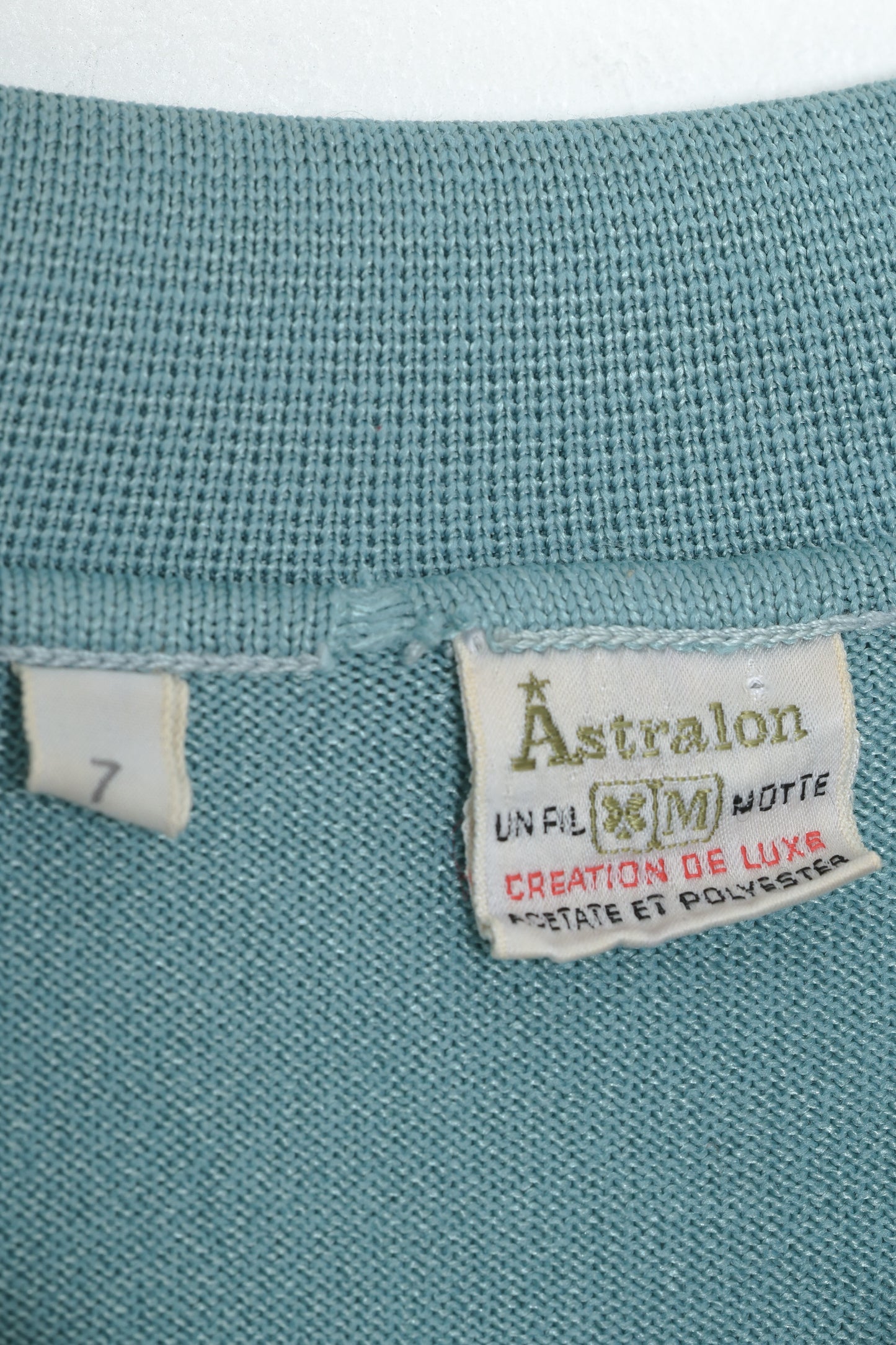
Astralon (France)
1968–1974, Astralon “Création de Luxe” Fine-Gauge Polo Knit
1968–1974, Astralon “Création de Luxe” Fine-Gauge Polo Knit
Couldn't load pickup availability
~ EU 36–38, US S–M
Measurements (cm):
shoulder to shoulder: 39
sleeve (shoulder to cuff): 59
chest (pit to pit): 52
length (collar to hem): 60
SKU: 901209
This garment is a women’s fine-gauge knitted polo pullover produced under the Astralon label, identified through its woven brand label as part of the “Création de Luxe” line associated with Un Fil Motte. Construction characteristics, label typography, fiber declaration, silhouette, collar shape, and placket treatment collectively suggest production during the late 1960s through early 1970s. The garment is manufactured from a fine filament yarn blend identified on the label as acetate and polyester, knitted to a dense and stable gauge producing a smooth, slightly reflective surface with moderate drape and excellent dimensional regularity. Its fully fashioned construction, integral collar assembly, linked seams, and carefully engineered placket indicate manufacture within a specialized knitwear production environment rather than cut-and-sew jersey fabrication. As an artifact, it represents a period in which continental European knitwear manufacturers adapted traditional fully fashioned sweater production toward the expanding leisurewear and sportswear market, producing garments intended to bridge the social territory between blouse, sweater, and informal tailored attire.
I. Designer Origin & Brand Profile
Astralon appears to occupy the middle-to-upper segment of the French knitwear market during the postwar period, operating under the umbrella of Un Fil Motte, a textile and yarn-producing concern with roots in the northern French textile industry. The label designation “Création de Luxe” is especially revealing. It signals not haute couture in any institutional sense, but an attempt to distinguish premium knitwear from mass-market offerings through material selection, finishing quality, and styling sophistication. The garment reflects a manufacturer interested in presenting knitwear as an alternative to woven separates. From a design perspective, the objective was not innovation through silhouette distortion but through material refinement and versatility. The piece sits at the intersection of sweater, blouse, and polo shirt, offering a level of social adaptability highly valued by middle-class European consumers during the period.
II. Brand Heritage & Industry Influence
French knitwear production during the 1960s and 1970s occupied an interesting industrial position. Manufacturers such as Astralon benefited from advances in fine-gauge flatbed knitting technology and the increasing availability of stable filament yarns. Unlike couture houses, these firms rarely shaped fashion discourse directly. Their contribution was infrastructural. They normalized a wardrobe category in which knitted garments could replace woven tailoring in many social settings. This garment demonstrates precisely that transition. It borrows the collar language of shirts, the comfort of knitwear, and the presentation standards of more formal dress. Such products contributed significantly to the democratization of polished casual dress long before the vocabulary of contemporary lifestyle marketing emerged to claim credit.
III. Garment Classification & Design Intent
The garment is best classified as a fully fashioned fine-gauge knit polo pullover. More specifically, it belongs to the European leisure-knit category that emerged prominently between the mid-1960s and early 1970s. Its intended function was versatile daytime wear suitable for travel, informal business environments, resort settings, social gatherings, and urban leisure activities. The design intent centers on visual neatness without the rigidity of woven shirting. The collar projects authority; the soft knit body removes obligation. The deep placket creates a vertical opening that elongates the torso while allowing adjustable neckline presentation.
IV. Construction Methodology & Engineering
Construction appears to rely primarily on fully fashioned flatbed knitting. The shoulder lines, armhole transitions, and side shaping suggest narrowing and widening operations integrated into knitting rather than subsequently cut. Seam formation appears linked rather than conventionally sewn, producing narrow and efficient joins with minimal bulk. The placket is separately engineered and attached during assembly, reinforced sufficiently to support repeated buttoning stress. The collar is knitted as an independent component before being linked to the neckline opening. Ribbed waistband and cuffs are integrated through gauge and stitch variation rather than attached woven components. Durability derives less from seam redundancy and more from the inherent stability of the dense fine-gauge structure.
V. Technical Design Elements & Precision Detailing
The most sophisticated detail is the relationship between collar, placket, and chest pocket. The pocket is not merely applied decoration. Its vertically ribbed structure introduces textural contrast against the smooth body knit and visually balances the elongated placket. The placket terminates in a pointed base, an engineering decision frequently encountered in knit polos of the era because it distributes strain at the base of the opening more effectively than a blunt termination. The buttons appear shell-like or imitation shell, selected for visual luminosity against the pale ground color. The collar points are moderately elongated, reflecting period preferences moving away from compact 1950s collar geometry.
VI. Style Nomenclature & Historical Evolution
This garment descends from the knitted tennis and polo shirts of the interwar period. By the 1960s, advances in yarn technology enabled manufacturers to reinterpret those garments as long-sleeve knit pullovers. The resulting category became known variously as knit polos, leisure sweaters, sports pullovers, or sweater blouses. The style flourished between approximately 1967 and 1975, coinciding with broader acceptance of soft tailoring and informal elegance. Collar dimensions increased, plackets deepened, and synthetic filament blends gained favor due to dimensional stability and laundering convenience. This example fits squarely within that lineage.
VII. Fabric Composition & Textile Engineering
The label identifies acetate and polyester composition. Visually, the textile exhibits a smooth surface with slight luster, moderate density, and relatively crisp drape compared with wool-based knitwear. The yarn possesses a dry, cool visual character and reflects light evenly across the fabric surface. Gauge appears fine, likely within a range typical of dress-oriented knitwear rather than outerwear. Abrasion resistance would have been enhanced by the blend structure, while recovery characteristics exceed those associated with many natural regenerated cellulose yarns used independently. The fabric’s dimensional stability aligns well with the intended use as a frequently worn garment expected to retain shape after repeated laundering and storage.
VIII. Construction & Pattern Analysis
The knit structure appears to be a fine-gauge jersey-based construction with controlled stitch density throughout the body. Collar and waistband employ rib variation for elasticity and edge recovery. Pattern architecture is economical and disciplined. The front and back panels are largely symmetrical, shaped subtly through fully fashioned decreases and increases rather than aggressive contouring. The collar is a classic fall collar drafted with moderate spread and a shallow stand. It is linked into the neckline without visible distortion. The placket is engineered as an inserted opening integrated into the front panel rather than merely slit after production. This distinction matters. It indicates planning at the knitting stage rather than correction at the assembly stage.
IX. Structural Integrity & Panel Configuration
The garment derives structure primarily from stitch architecture rather than internal support materials. There is no evidence suggesting interfacing, canvas, shoulder reinforcement, or supplemental stabilizing systems. Stress concentrations occur at the placket base, collar attachment seam, shoulder transitions, cuff junctions, and pocket attachment points. The collar’s success depends upon yarn firmness and stitch density. Notably, the collar retains definition despite lacking the architectural assistance available to woven shirting. The chest pocket introduces localized weight but remains proportionally modest enough to avoid distortion. Ribbed hem and cuffs function as the principal silhouette-controlling mechanisms.
X. Edge Finishing, Seam Termination & Closures
The collar edges are cleanly finished through fully knitted turnings. Collar points appear sharply resolved without excessive curling, suggesting successful balancing between stitch tension and edge structure. The placket edges are reinforced through doubled knit layers capable of supporting repeated button use. Buttonholes appear machine-worked and integrated with the knitted substrate. Hem and cuff terminations utilize rib structures that prevent excessive rolling. The lapel question is mercifully absent; knitwear manufacturers of this period frequently attempted lapel simulations with results best described as optimistic. Astralon wisely confined itself to a conventional polo collar.
XI. Manufacturing Context, Production Scale & Industrial Feasibility
Production characteristics indicate medium-scale industrial manufacture using specialized knitwear equipment. Nothing suggests couture production, yet nothing suggests cost-minimized commodity manufacturing either. The fully fashioned method reduces material waste compared with cut-and-sew knit production. Labor input remains moderate because linking operations, placket assembly, collar attachment, and pocket application require skilled handling. The garment represents an industrial sweet spot: sophisticated enough to justify premium branding, efficient enough to remain commercially viable. French knitwear firms of the period excelled in precisely this territory.
XII. Conceptual Influence & Psychological Design Intent
The garment responds to a postwar desire for elegance untethered from traditional tailoring. It offers visual order through geometry and proportion while removing much of the physical rigidity associated with woven jackets and structured blouses. The pale aqua coloration reinforces notions of cleanliness, leisure, and seasonal lightness. The design encourages a wearer to appear composed without appearing dressed for inspection. This distinction proved commercially valuable throughout the late twentieth century and remains so today.
XIII. Artistic & Aesthetic Direction
Aesthetically, the garment belongs to the modernist leisure tradition that emerged across Europe during the 1960s. The silhouette is controlled but not fitted. Decoration is nearly absent. Visual interest derives from proportion, texture, and construction. The collar establishes the dominant horizontal frame. The placket introduces vertical movement. The pocket provides asymmetrical counterweight. The design demonstrates confidence in proportion as ornament. Many contemporary garments attempt to compensate for weak structure with excessive detailing; this example declines the invitation.
XIV. Historical Placement & Contextual Analysis
Several factors support a dating range of approximately 1968–1974. These include the elongated collar points, deep placket geometry, fine-gauge filament blend construction, label typography, luxury knitwear marketing language, and silhouette proportions. Earlier examples generally exhibit shorter collar points and more conservative openings. Later examples increasingly adopt broader body dimensions and different finishing methods associated with changing knitwear technology. This garment belongs to a period when European manufacturers successfully translated shirt-derived styling into technically sophisticated knitwear. It stands as a representative example of that transition.
XV. Use Case
Placed on a moving body, the garment functions most effectively in environments requiring social polish without formal dress. It belongs in travel wardrobes, resort dining rooms, offices operating below the threshold of jacket-and-tie expectations, gallery visits, daytime social engagements, and urban leisure contexts. The wearer is not a character but a sequence of choices: selecting comfort without surrendering presentation, preferring a collar to a crew neck, and accepting that knitwear can perform duties once assigned to woven garments. Trousers would ideally remain smooth and minimally textured to avoid competing with the knit surface.
Share